
Vol.38 The Economic Effects of Attracting Foreign Airlines to Regional Airports: Yangyang Case Study
- Reg Date
- 2026.03.11


The Economic Effects of Attracting Foreign Airlines to Regional Airports:
A Case Study of Yangyang International Airport
Kyuwan Choi / Professor, Kyung Hee University & Director, H&T Analytics Center / [email protected]
SooCheong Jang / Professor, Purdue University & Director, Yanolja Research / [email protected]
Deachul (David) Seo / Senior Researcher, Yanolja Research / [email protected]
Kwanyoung Lee / Associate Research Fellow, Yanolja Research / [email protected]
South Korea stands at a pivotal point toward becoming a major tourism power. Moving beyond fragmented tourism promotion policies of the past, the tourism industry is now establishing itself as a core industry that influences the macroscopic flow of the national economy. According to Yanolja Research’s AI-based tourism demand forecasting model, 2026 is expected to be the inaugural year of the “20 million inbound” era. This signifies more than just a numerical increase in tourists; it means the influence of this industry on the national and regional economies is expanding significantly. Beyond economic ripple effects, it is also expected to contribute greatly to solving societal issues facing Korea, such as suppressing regional extinction, saving small businesses, and creating jobs for the youth.
However, despite expectations for quantitative growth, the influx of foreign tourists remains concentrated in the capital area. Of the 18.93 million foreign tourists who visited Korea in 2025, approximately 72% entered through capital area airports such as Incheon and Gimpo. Conversely, the proportion of entries through non-capital area airports remained at 16.7%. This concentration in the capital area is the most critical weakness hindering the qualitative growth of Korea's tourism industry. While Seoul and the capital area suffer from side effects of overtourism—such as capacity saturation, traffic congestion, and rising prices—regional areas are trapped in a vicious cycle of undertourism, where a lack of visitors leads to the decline of tourism infrastructure.
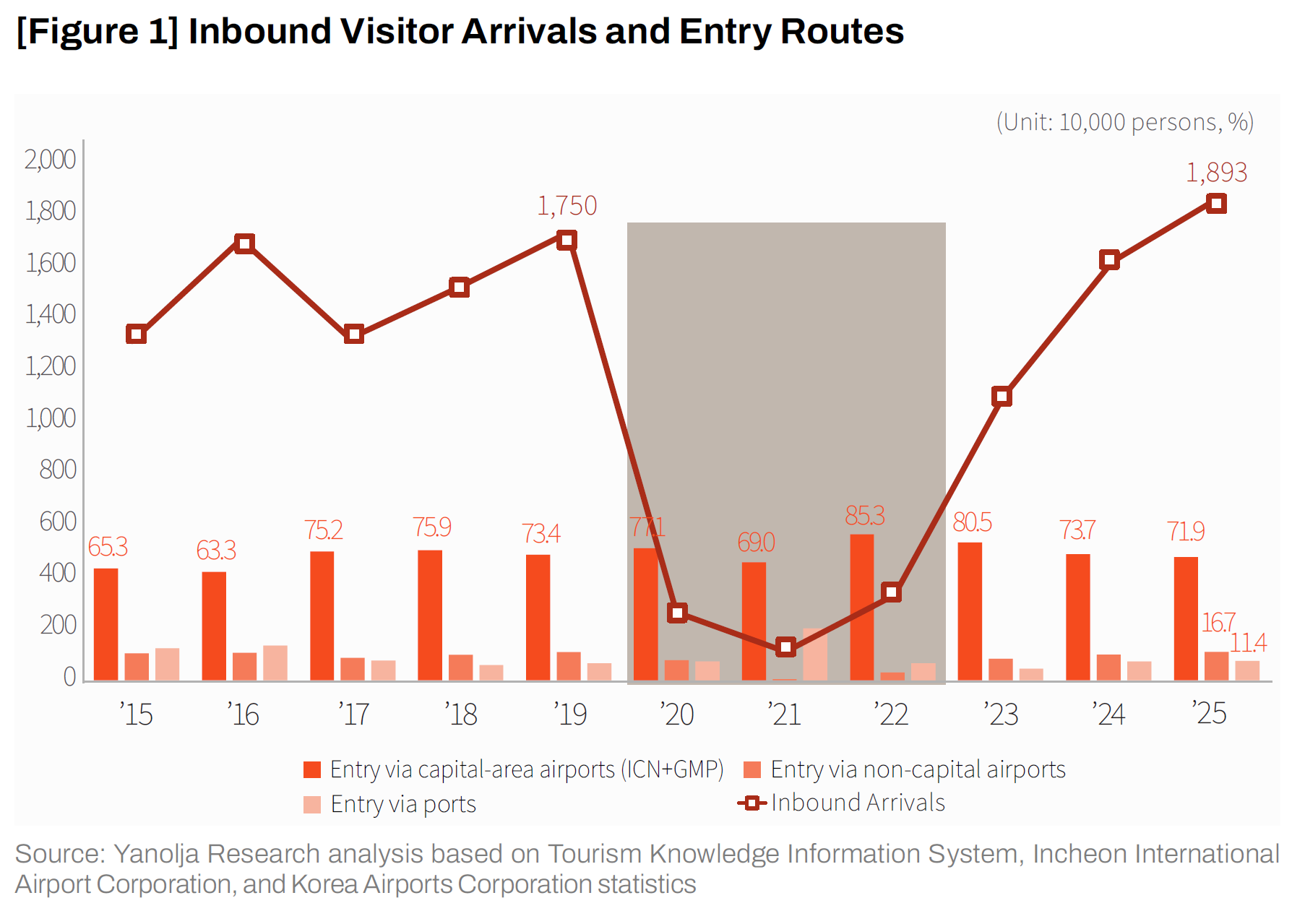
Furthermore, the "regional extinction" crisis faced by local governments due to population decline and aging has become a national disaster beyond mere demographic collapse. In a situation where the population of the capital area has overtaken that of non-capital areas, the zero-sum game of taking resident populations from neighboring municipalities has reached its limit. It is time to completely shift the paradigm of regional economic policy toward the "consumption population"—those who create consumption regardless of residency. Distributing tourists to regional areas as a new engine to support regional economies autonomously is an urgent task of our time.
Nevertheless, domestic-oriented policies alone cannot guarantee the sustainability of Korean tourism. Given the clear seasonal limitations where demand spikes during weekends or specific peak seasons, and the excessive capital outflow through outbound tourism, moving domestic travel capital between regions has its limits. Expanding regional tourism and strengthening local economic resilience requires attracting inbound visitors, who bring new spending from outside the country.
This report examines the concentration of inbound tourism in the capital region and explores how local airports can enable mega-regional tourism development under a hub-and-spoke framework (introduced in Yanolja Research Insight Vol. 37). Balanced regional development is difficult to achieve without a hub-and-spoke network that channels inbound tourists through international airports and distributes demand to surrounding destinations via well-connected transportation systems.
Among non-metropolitan airports, with the exception of Jeju that have secured some level of international demand, many remain extremely limited in their ability to attract foreign visitors due to a weak regular international flight base. Notably, as of 2025, Yangyang and Muan airports do not operate a single regular flight. Consequently, the apparent growth of Korea’s inbound tourism market has failed to translate sufficiently into regional tourism, while tourism spending, employment, and service demand remain concentrated in the capital area.
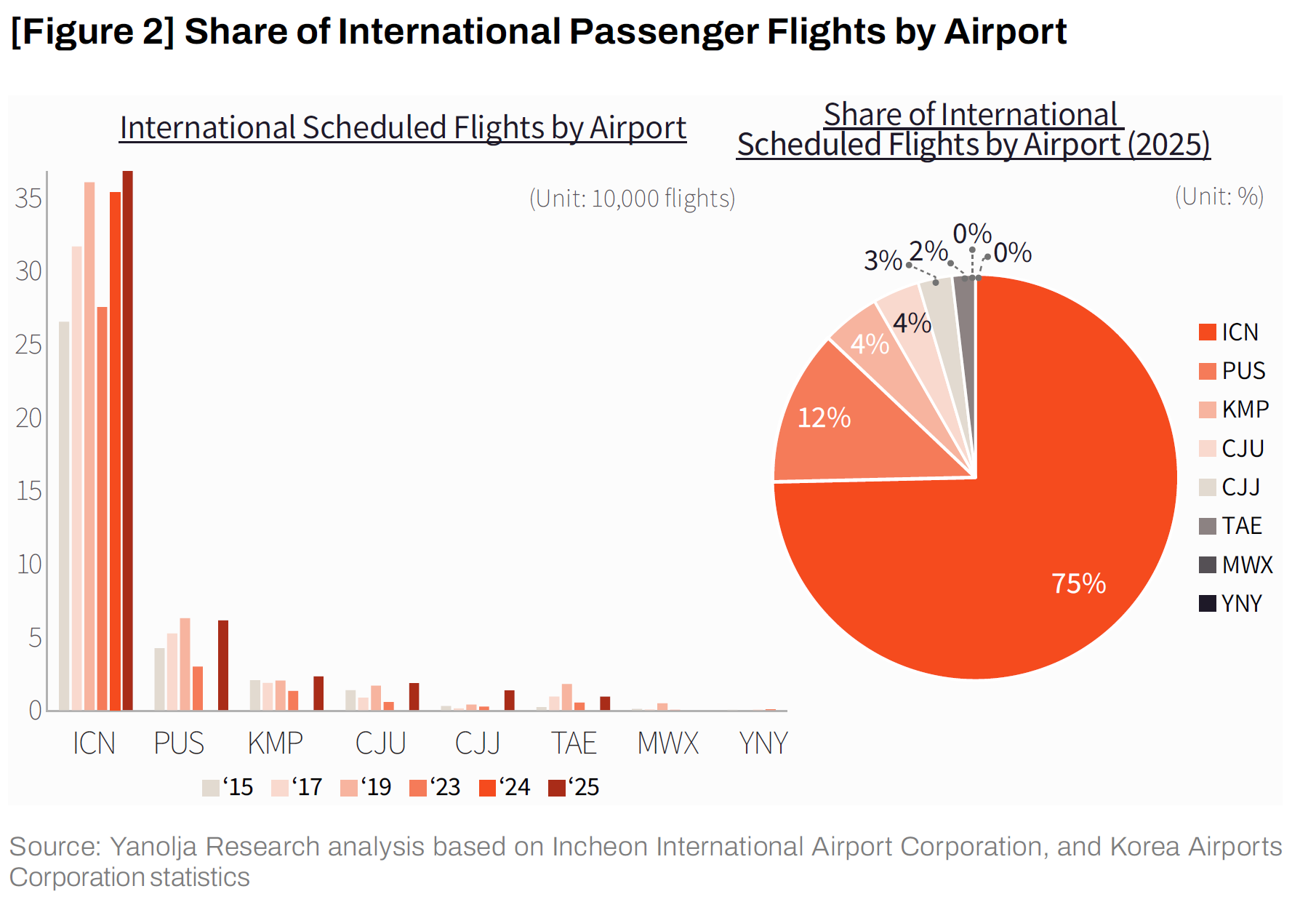
In response to these issues, the Korean Government announced a blueprint to actively foster regional airports as hubs for foreign tourist entry at the 11th Expanded National Tourism Strategy Meeting chaired by the President on February 25, 2026. In line with this policy direction, this study focuses on Yangyang International Airport, arguably the most ideal testing ground for the hub-and-spoke strategy and, at present, an airport with extremely low utilization of international services —so much so that it has gained the stigmatizing label of a “ghost airport.” Through an empirical analysis of visitor spending creation effects and input-output analysis, this report seeks to demonstrate how revitalizing Yangyang Airport could generate substantial economic spillover effects across the wider Gangwon region. In doing so, it aims to present both the rationale and policy measures explaining why the government and local authorities must now commit themselves to attracting foreign airlines to underutilized regional airports.
Why Yangyang: A Strategic Zero-to-One
Within this context of structural concern and evolving policy direction, the airport currently most worthy of attention is Yangyang International Airport. While Yangyang has long been recognized for its potential as the only international airport in the Gangwon region, it has failed to produce expected results due to unstable route operations and a limited domestic demand base. Especially after Fly Gangwon —which served as the regional base carrier—entered corporate rehabilitation in May 2023 and suspended all operations, Yangyang Airport effectively lost its entire regular international flight base. The airport now faces a survival crisis where its very existence is being called into question.
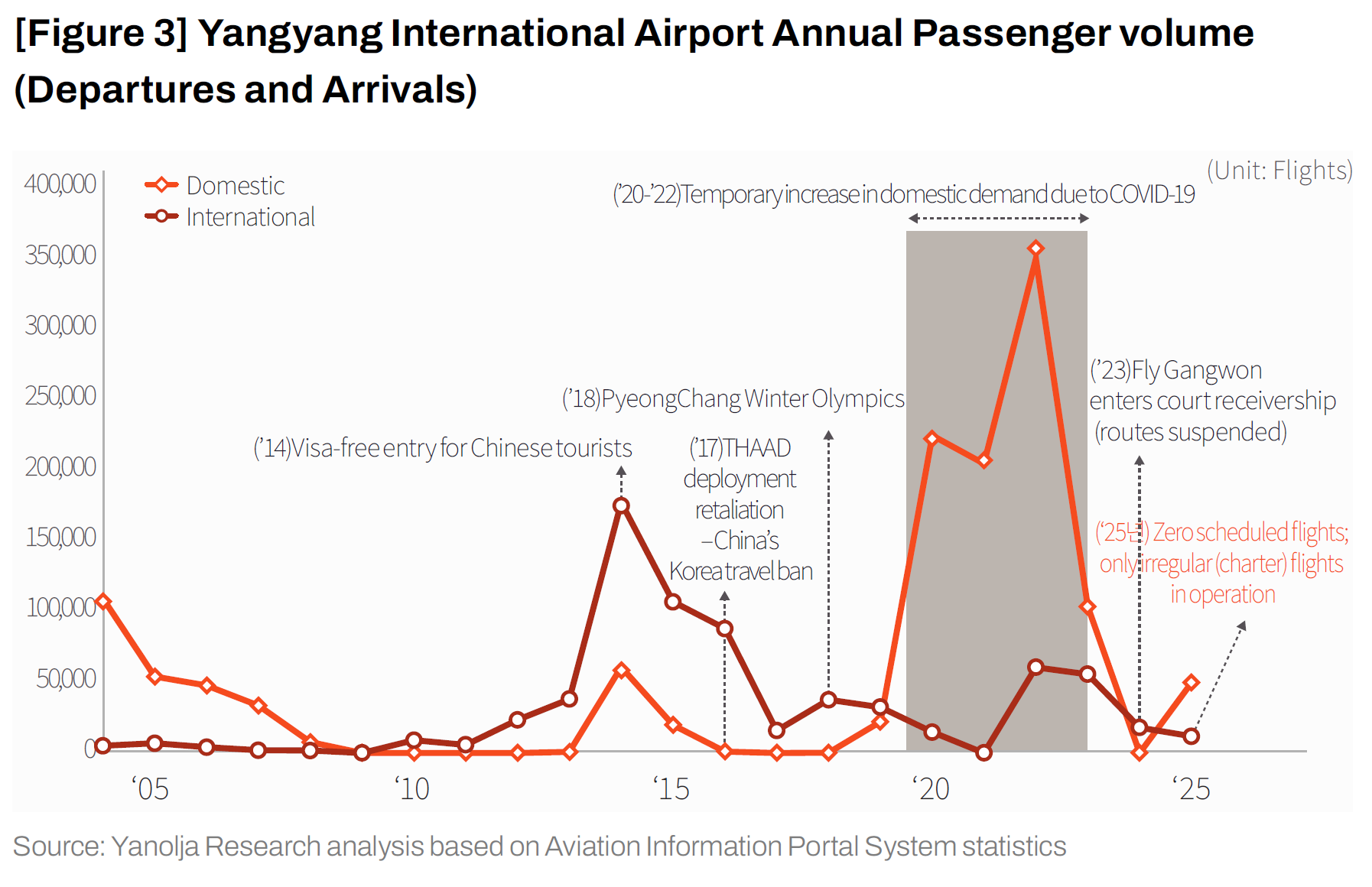
Yet paradoxically, this very crisis also means that Yangyang is now in the best possible position to embrace entirely new opportunities from a clean slate. In fact, the airport’s hardware potential remains considerable. Although its 2,500-meter runway imposes physical limitations that make it unsuitable as a large-scale international hub in the conventional sense, its annual handling capacity of approximately 37,000 flights is more than sufficient to attract multiple scheduled services operated by foreign low-cost carriers (LCCs) focused on short- to medium-haul markets such as Southeast Asia, Japan, and Greater China. Beyond the airport itself, the surrounding tourism assets are extensive: the scenic East Coast’s marine tourism resources, wellness and mountain tourism centered around Seoraksan, Yangyang as a surfing destination, world-class winter sports infrastructure inherited from the 2018 PyeongChang Winter Olympics, Goseong’s proximity to North Korean tourism resources, and the coastal attractions of Samcheok and Donghae. Compared to Japan's recently popular small-town tourism resources, the Gangwon region is in no way inferior as an inbound tourism zone.
Despite these strengths, revitalizing the currently idle airport becomes commercially viable only when it decisively shifts to a global inbound-oriented strategy centered on directly attracting foreign visitors, rather than relying on limited domestic intrabound and outbound demand. Historically, Yangyang Airport relied heavily on domestic passenger demand and on hub dependence linked to a particular carrier. But with the opening of the Seoul–Yangyang Expressway and the expansion of ground transportation networks such as the KTX Gangneung Line, the traditional approach of relying on domestic mobility demand has lost its persuasiveness. There is little incentive for capital area residents to travel enduring the inconvenience of reaching the airport, while the surrounding population is too small to support a sustainable airport strategy.
Precisely because Yangyang Airport currently operates zero scheduled flights, the economic and symbolic significance of attracting even one new foreign airline is far greater than at other airports. At larger airports such as Gimhae (Busan) and Cheongju, which already operate numerous international routes, face many operational cannibalization constraints, such as fierce slot competition between airlines, dilemmas in golden time allocation, and market overlap with existing domestic carrier routes. Even when a new foreign carrier enters such markets, the result is often little more than a redistribution of existing demand.
In contrast, at Yangyang—which is effectively a blank slate—attracting the first scheduled route can be seen as a "zero-to-one" case, creating a completely new inbound influx path from nothing. It would mean that Yangyang and its surrounding areas begin functioning as a direct gateway into Korea for international tourists. That, in turn, could immediately trigger a domino effect: the development of travel products for the broader hinterland, the execution of overseas marketing and promotion budgets by local governments, multi-day stays and local consumption by foreign visitors, and even the consideration of additional routes by other foreign carriers.
Yangyang Airport also holds an institutional advantage unmatched by other airports: the visa-free group entry program for Yangyang International Airport, implemented through cooperation between the Ministry of Justice and Gangwon Province. This measure allows citizens of four countries—Vietnam, the Philippines, Indonesia, and Mongolia—who enter via direct flights to Yangyang Airport as part of groups of five or more through designated travel agencies are allowed to stay in Gangwon and the Seoul metropolitan area for up to 15 days without a visa. Although it was at risk of expiring as a temporary arrangement, continued efforts by the local government have led to its extension and operation through 2026 (Gangwon State Notice No. 2025-929), even though the airport has not yet been able to fully capitalize on its practical benefits.
The visa-free program could serve as a key policy lever to channel growing middle-class travel demand from emerging markets into Gangwon Province. For travelers deterred by Korea’s stringent visa requirements, direct flights to Yangyang provide the fastest and most accessible entry point. At the same time, the policy helps secure initial load factors, reducing entry risk for foreign airlines and increasing the likelihood of route viability.
Furthermore, the Gangwon-East Coast region offers a clear setting to observe inbound tourism spillovers. While the effects of new routes are diluted in major hubs, smaller cities such as Sokcho, Gangneung, and Yangyang can experience tangible changes from even modest increases in foreign visitors—across accommodations, dining, transport, and local experiences. Attracting foreign airlines to Yangyang therefore represents not just airport revitalization, but a policy test case for regional economic activation through air connectivity.
How a Single New Foreign Airline Route Can Transform the Regional Economy
At today’s Yangyang Airport, where there are zero scheduled flights, even a single route operating three times per week could generate a meaningful flow of foreign visitors that reshape the local economy. Based on conservative and realistic assumptions, Yanolja Research developed the following scenario to estimate the economic ripple effects.
- Aircraft: One B737-800 class medium-sized aircraft (max 189 seats), commonly operated by Asian LCCs, operating 3 round trips per week.
- Passenger Demand: A conservative average load factor of 70%, the typical minimum break-even point (BEP) for airline operations.
- Foreign Tourist Proportion: The proportion of foreign tourists (inbound) among all passengers is set at 80-90% (reflecting the reality of low domestic passenger demand at Yangyang Airport).
Even under these conservative conditions, it is estimated that approximately 16,000 to 18,000 foreigners would set foot in Yangyang, Gangwon-do, annually if one foreign airline launches a route. Given the resident population of Yangyang-gun (approx. 27,000) and the basic capacity of local small-business districts, this is by no means a trivial figure.
What matters most, however, is not the sheer headcount of tourists but the scale of spending retained within the local economy. This analysis therefore focuses only on direct expenditure categories that are likely to occur within Gangwon after arrival through Yangyang Airport—such as shopping, accommodation, food and beverage, and short-distance transportation.
Assuming an average length of stay of 6.7 days, each inbound visitor to Yangyang would generate approximately KRW 1.6 million in regional spending. Multiplied by the estimated annual number of inbound visitors (approximately 18,574), just one foreign airline route operating three times a week could generate approximately KRW 29.81 billion in direct annual spending for the Gangwon regional economy.
Estimated Annual Regional Consumption for a New Foreign Airline Operating Three Times per Week
| Category | Key Assumptions | Calculation Results | Remarks |
| Operation Scale | B737-800 (189 seats, 3x weekly) | 156 flights per year (3x/wk x 52wks) | Standard medium LCC model |
| Passenger Demand | Avg. Load Factor 70% | 20,639 total annual passengers | Conservative load factor applied |
| Inbound Demand | 90% Foreigners | 18,574 annual foreign influx | Core target for local consumption |
| Foreign Consumption | Avg. 1,604,954 KRW/person | ~29.81 billion KRW annually | Excludes non-regional items like airfare |
Source: Yanolja Research analysis
An annual figure of KRW 29.81 billion does not simply mean an increase on a macroeconomic chart. It represents a dramatic expansion of the very revenue base that sustains local lodging providers, restaurants, retailers, and other small business owners who are currently struggling to survive. Tourist spending directly lowers vacancy rates at regional accommodations and boosts sales at local dining establishments and shops. It also ripples outward to mobility services such as rental cars and taxis, destination-based experiences such as surfing and nature exploration, and a broad range of related local service industries.
Compared with tourists who arrive through Incheon Airport and then disperse to Gangwon only after a long and complicated overland journey, visitors entering directly through Yangyang Airport begin generating strong regional consumption from the very start of their trip—rental cars, first meals, first-night lodging, and beyond. This makes their impact on the local economy far more immediate and powerful.
At the same time, the launch of a new foreign route can also catalyze structural changes in the regional economy that are difficult to quantify in monetary terms. First, as the Hub and Spoke strategy begins functioning in earnest, Yangyang and nearby areas can become not just a transit corridor but the true point of departure for stay-based Gangwon tourism. For example, travelers could rent a car at Yangyang Airport, enjoy seafood in Sokcho, visit the Goseong Unification Observatory, stop by Gangneung’s coffee street, pass through Daegwallyeong in PyeongChang, and return to Yangyang—forming circular itineraries that fundamentally change how travel products are designed. Second, once scheduled routes become stable, local SMEs and tourism businesses, including global online travel agencies (OTAs), can begin planning mid- to long-term travel products and overseas marketing investments based not on vague expectations but on reliable and recurring foreign demand. Third, if active efforts by Gangwon State and its cities to attract foreign carriers are effectively combined with strong branding around the visa-free benefit, the name “Gangwon” itself could be repeatedly exposed in overseas tourism markets such as Taiwan and Vietnam and gradually solidify as a recognizable global tourism destination.
Therefore, the launch of just one foreign airline route at Yangyang Airport should be understood as a golden opportunity to redefine the paradigm of the Korean tourism ecosystem, beyond a mere increase in flight supply figures.
Analysis of Economic Effects of Attracting Foreign Airlines to Yangyang Airport
The preceding section examined the microeconomic effects of a single route. This section expands the scope to estimate broader economic ripple effects across the Gangwon regional economy once airport revitalization policies gain traction.
Precise Estimation of Regional Consumption by Visitor Nationality
To realistically estimate the economic impact of gradually attracting multiple new foreign carriers to Yangyang Airport, this analysis first calculates the average spending per foreign visitor by nationality, then combines these values with a multi-year route expansion scenario.
We aimed to capture only the "consumption that actually remains within the Gangwon region" realistically and conservatively. Spending items likely to be paid directly in Yangyang and adjacent spoke areas were selected: accommodation, general restaurants, grocery purchases, road passenger transport (bus/taxi), rental of transport equipment (car rental), fuel, cultural services (museums/performances), sports/recreation services (surfing/skiing), and shopping.
Applying this conservative framework to raw data from the 2024 Survey of Foreign Tourists (Ministry of Culture, Sports and Tourism), the analysis finds substantial differences in per-capita regional spending by nationality. Chinese visitors (average stay: 6.8 days) showed the highest purchasing power at approximately KRW 1.87 million per person, followed by Hong Kong (KRW 1.81 million, 5.9 days), Taiwan (KRW 1.45 million, 5.6 days), Vietnam (KRW 1.41 million, 8.2 days), Thailand (KRW 1.23 million, 6.3 days), Mongolia (approximately KRW 0.91 million), and Japan (KRW 0.83 million, 3.7 days). Although spending may rise modestly in the future due to inflation, this study holds 2024 average spending levels constant in keeping with its conservative estimation approach.
One notable finding is that Japanese visitors spend significantly more than other nationalities on recreation and sports-related services, at approximately KRW 42,000 per person. This suggests that Gangwon could effectively target Japanese leisure travelers through golf, skiing, and other sports tourism offerings. By contrast, visitors from Southeast Asian countries such as Vietnam and Thailand spend a particularly large share on restaurants and food purchases, nearly rivaling accommodation expenditure, indicating strong spillover potential for the regional food and beverage sector.
Estimated Average Spending by Foreign Tourist Nationality (Assuming Direct Entry and Stay)
| Nationality | Length of Stay (days) | Accommodation | Restaurants | Food & Beverages | Road Passenger Transport | Vehicle Rental | Fuel | Cultural Services | Recreation & Sports Services | Shopping | Total |
| Total | 6.7 | 530,167 | 319,672 | 43,222 | 47,712 | 6,455 | 1,403 | 22,733 | 17,261 | 616,329 | 1,604,954 |
| China | 6.8 | 389,696 | 339,458 | 38,591 | 56,693 | 3,929 | 1,544 | 36,205 | 6,596 | 994,519 | 1,867,231 |
| Japan | 3.7 | 266,627 | 180,885 | 17,682 | 28,487 | 561 | 140 | 17,682 | 42,239 | 279,257 | 833,560 |
| Taiwan | 5.6 | 452,003 | 191,691 | 41,678 | 22,453 | 5,333 | 702 | 11,367 | 12,910 | 710,350 | 1,448,486 |
| Vietnam | 8.2 | 413,553 | 247,402 | 119,561 | 24,277 | 1,403 | 1,403 | 6,455 | 4,491 | 593,035 | 1,411,579 |
| Philippines | 7.2 | 435,444 | 275,748 | 30,031 | 37,328 | 2,526 | 140 | 13,191 | 10,525 | 442,320 | 1,247,253 |
| Thailand | 6.3 | 237,579 | 394,327 | 13,752 | 16,840 | 1,684 | 982 | 9,963 | 16,980 | 534,938 | 1,227,046 |
| Hong Kong | 5.9 | 525,957 | 379,031 | 28,347 | 45,888 | 9,823 | 3,929 | 19,506 | 9,683 | 786,269 | 1,808,433 |
| Mongolia | 10.9 | 420,288 | 364,297 | 49,677 | 47,572 | 6,315 | 702 | 14,033 | 12,489 | 1,049,809 | 915,373 |
Source: Yanolja Research analysis based on raw data from the 2024 Survey of Foreign Tourists
5-Year Route Expansion Scenario
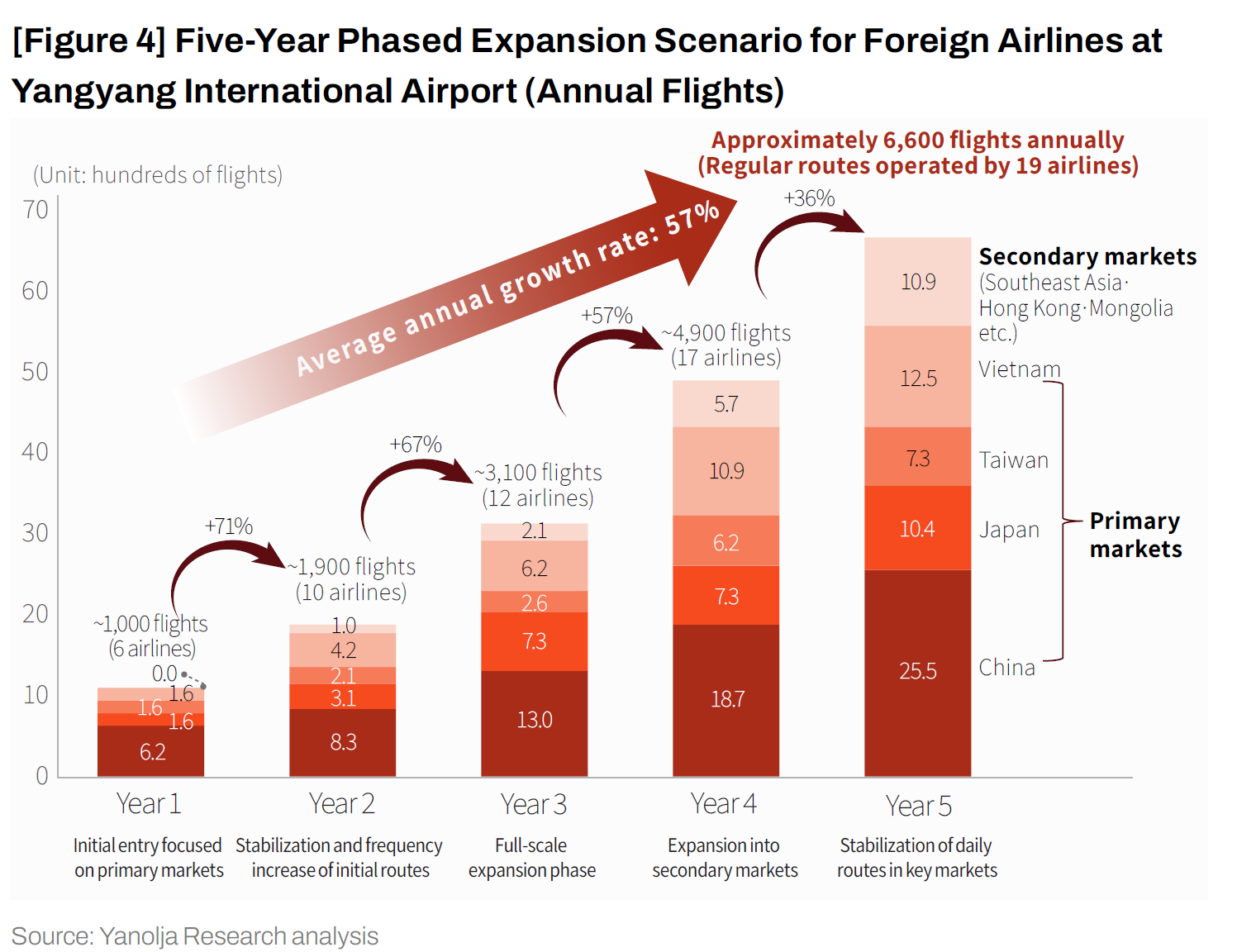
Based on the estimated per-capita spending by nationality, a five-year route expansion scenario was constructed under the assumption that Gangwon State’s policy efforts to attract foreign carriers to Yangyang Airport are successful and that the airport’s operating network gradually expands. The basic strategy follows a snowball model: during the initial introduction period (Years 1–2), routes are established in the most feasible and accessible first-priority markets; once operations stabilize and market performance becomes visible, expansion gradually extends into second-priority countries and regions.
The first-priority markets in this scenario are China, Japan, Taiwan, and Vietnam. China remains a market with substantial group-tour demand that once played a major role in Yangyang’s growth and is expected to have strong recovery potential, especially in the event of an easing of political and regulatory barriers. Moreover, as China–Japan tensions persist, Korea may benefit from substitution effects in Chinese outbound travel demand. Japan, with its short-haul distance and high-frequency FIT-oriented travel market, offers clear strategic advantages. Taiwan is a familiar and proven market, as TransAsia Airways once operated regular charter services between Taipei and Yangyang. Vietnam is especially important because of its direct linkage to Gangwon’s visa-free entry program for four Asian countries; indeed, VietJet Air’s Da Nang–Yangyang service in 2025 reportedly recorded a very high load factor of 94.3%, nearly full capacity. By contrast, the Philippines, Thailand, and Hong Kong are treated as second-priority expansion markets, helping diversify the market mix and address seasonal demand fluctuations.
Under this framework, the scenario assumes that in Year 1, airlines from the four first-priority countries—China, Japan, Taiwan, and Vietnam—launch limited scheduled services to Yangyang, each operating at roughly three weekly flights. In subsequent years, route expansion proceeds as second-priority Southeast Asian and Hong Kong markets enter the network. From Year 3 onward, operations on the initial Japanese and Chinese routes are expanded, and by Year 5, the seven major markets are assumed to be fully established with daily or near-daily operations, positioning Yangyang Airport as a bona fide international tourism hub for the Gangwon region.
Under these staged assumptions, annual flights are estimated to grow from ~1,000 in Year 1 to ~6,600 in Year 5, representing a compound annual growth rate (CAGR) of approximately 57%.
Estimated Flight Scale and Foreign Entries Under Scenario
Category | Y1 | Y2 | Y3 | Y4 | Y5 |
| Number of operating airlines (annual) | 6 | 10 | 12 | 17 | 19 |
| Annual flights (hundreds) | 10.9 | 18.7 | 31.2 | 48.9 | 66.6 |
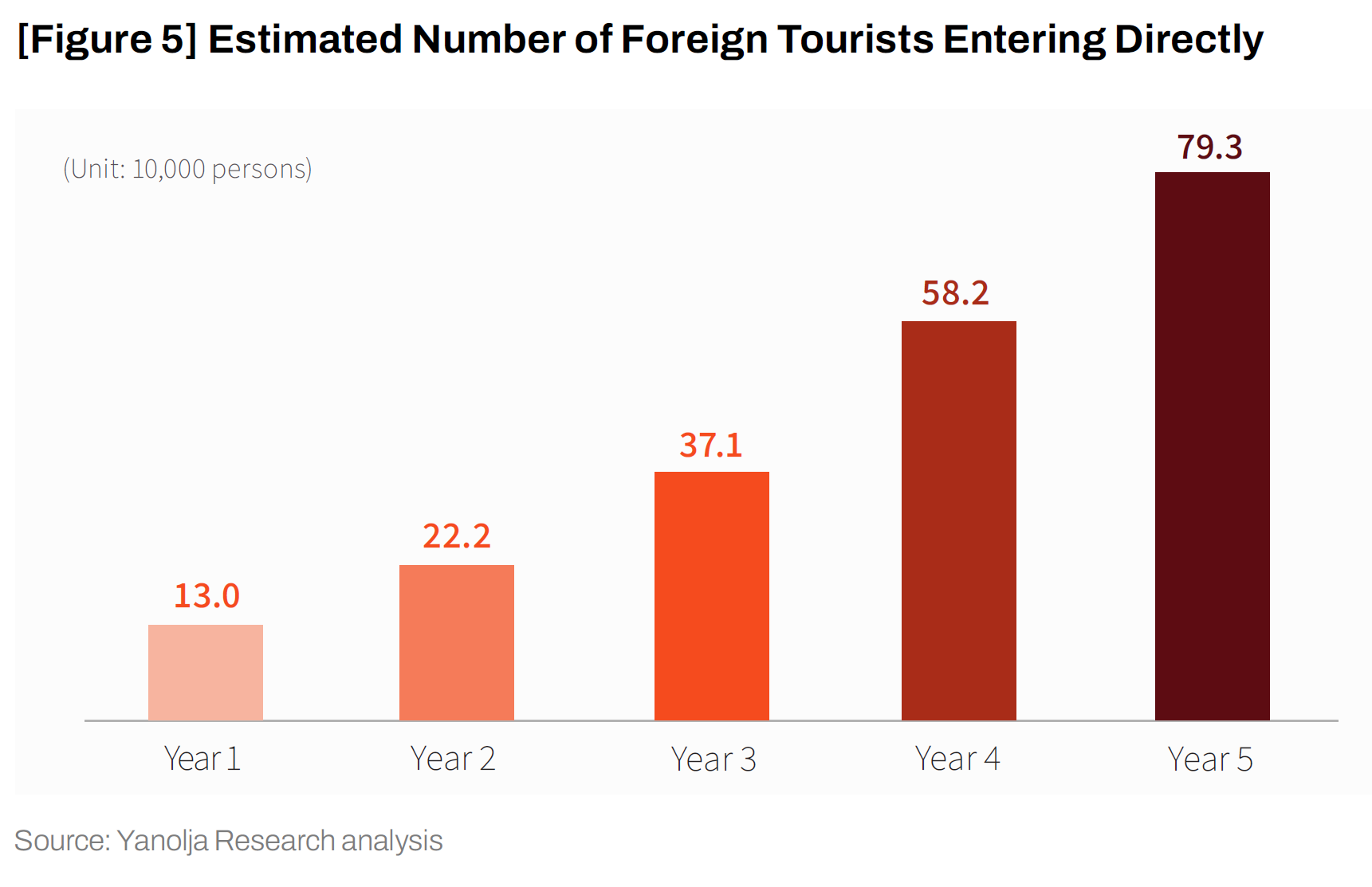
| Annual foreign arrivals (10,000 persons) | 13.0 | 22.2 | 37.1 | 58.2 | 79.3 |
| YoY (%) | – | 71.4 | 66.7 | 56.7 | 36.2 |
Source: Yanolja Research analysis
Annual Foreign Visitor Estimates
Under this scenario, the number of foreign visitors entering Gangwon directly through Yangyang Airport is projected to expand at a remarkable pace. Annual direct foreign arrivals are estimated to rise from approximately 130,000 in Year 1 to 222,000 in Year 2, 371,000 in Year 3, 582,000 in Year 4, and 793,000 in Year 5.
The most important inflection point occurs after Year 3. If Years 1 and 2 represent a testing phase to assess the viability of newly launched routes, surpassing 300,000 annual visitors in Year 3 signals that Yangyang Airport has entered the stage of a self-sustaining inbound hub. By Year 5, the projected scale of nearly 790,000 inbound tourists would be large enough to reshape consumption patterns across Gangwon’s East Coast region.
For comparison, Japan’s Setouchi coastal tourism zone records approximately 600,000 foreign tourist overnight stays annually on average, according to Japan National Tourism Organization statistics. Against this backdrop, the scenario’s projection of about 790,000 inbound visitors is by no means small, even in comparison with leading regional tourism zones in Northeast Asia. It suggests that a tourism market anchored by a single regional airport could be large enough to support a substantial stay-based tourism economy on Gangwon’s East Coast.
It should also be emphasized that this estimate is based on a conservative assumption of a 70% load factor—roughly the break-even level. If visa-free entry, overseas marketing, and a more developed hub-and-spoke system strengthen demand and extend stays in Gangwon, load factors could exceed 90%. In that case, actual outcomes could reasonably surpass twice the estimates presented here.
Regional Consumption and Economic Ripple Effects (Input-Output Analysis)
By multiplying the average per-capita regional spending by nationality (Table 2) by the number of foreign visitors by year (Table 3), we estimated how much new spending could be generated in the Gangwon region each year.
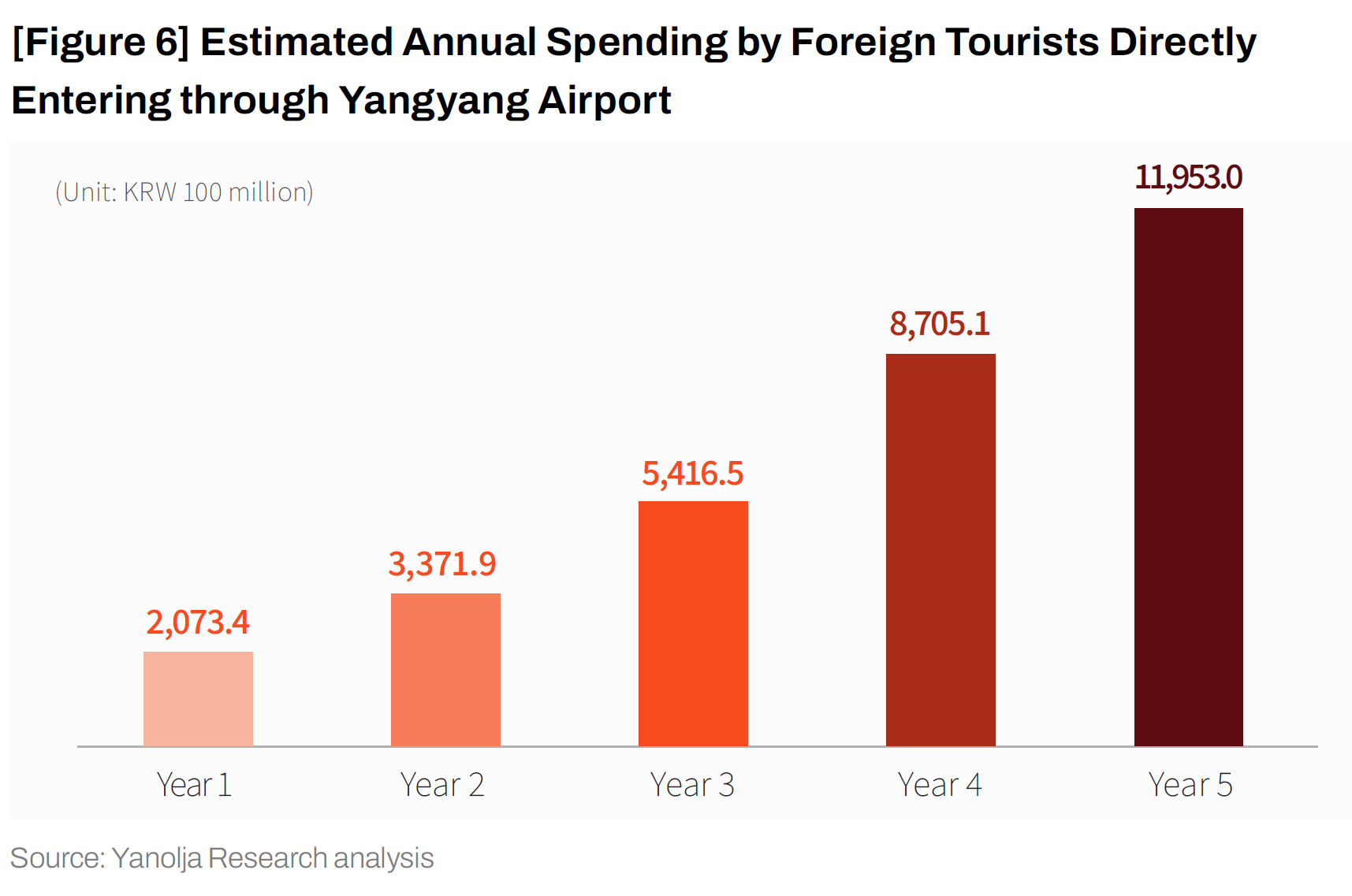
Analysis shows that total annual direct regional spending in Yangyang and Gangwon rises from approximately KRW 207.34 billion in Year 1 to KRW 337.19 billion in Year 2, KRW 541.65 billion in Year 3, KRW 870.51 billion in Year 4, and KRW 1.1953 trillion in Year 5. Over five years, cumulative direct cash inflows into the regional economy are estimated at approximately KRW 3.15 trillion.
To precisely determine the ripple effect across the Gangwon economy, this study employs Input-Output Analysis, a standard macroeconomic tool for estimating economic spillovers. Input-output analysis uses the official Input-Output Tables and Employment Tables published by the Bank of Korea on a producer-price basis to examine how an increase in final demand in one sector—in this case, tourism—spreads backward into related sectors such as agriculture, fisheries, construction, transportation, and services, thereby generating additional value added across the economy.
Importantly, this analysis uses the Bank of Korea’s Regional Input-Output Table rather than a national-level table to better reflect the specific industrial structure of Gangwon Province. Because this regional table captures both internal and interregional industrial linkages, it allows for a more realistic estimate of how tourist spending spreads through the local economy. This enables a more accurate analysis of how much production, income, and employment could be created within Gangwon through the revitalization of Yangyang Airport.
In this case, the estimated KRW 3.15 trillion in tourist spending is treated as an increase in final demand. The relevant inducement coefficients for Gangwon’s tourism-related sectors—namely the production inducement coefficient, value-added inducement coefficient, and employment inducement coefficient—are then applied to estimate the full range of indirect and induced synergies.
- Production Inducement Effect: This refers to the increase in total output across Gangwon industries generated as foreign tourist spending on food, beverages, and accommodations raises demand for upstream suppliers such as food distributors, laundries, and other businesses. The analysis estimates that this effect would amount to approximately KRW 3.88 trillion cumulatively over five years.
- Value-added Inducement Effect: This refers to the creation of real regional income—such as corporate operating profits and employee wages—generated as increased final demand stimulates domestic production. This effect is estimated at approximately KRW 1.84 trillion cumulatively over five years.
- Employment Inducement Effect: This measures the number of jobs created as rising consumption generates labor demand. The analysis estimates that employment inducement would increase from 3,625 jobs in Year 1 to 9,420 jobs in Year 3, reaching 20,512 jobs in Year 5.
Economic Ripple Effects of New Foreign Airline Routes at Yangyang Airport
| Item | Year 1 | Year 2 | Year 3 | Year 4 | Year 5 | Cumulative |
| Total flights | 1,092 | 1,872 | 3,120 | 4,888 | 6,656 | 17,628 |
| Total foreign visitors | 130,024 | 222,899 | 371,498 | 582,014 | 792,530 | 2,098,966 |
| Total regional spending (KRW 100 million) | 2,073.4 | 3,371.9 | 5,416.5 | 8,705.1 | 11,953.0 | 31,519.8 |
| Production inducement effect (KRW 100 million) | 2,568.6 | 4,182.2 | 6,721.0 | 10,660.0 | 14,623.2 | 38,755.0 |
| Value-added inducement effect (KRW 100 million) | 1,226.6 | 1,983.8 | 3,181.6 | 5,047.7 | 6,914.4 | 18,354.0 |
| Employment inducement effect (persons) | 3,625.4 | 5,877.3 | 9,420.2 | 14,965.2 | 20,512.1 | – |
Source: Yanolja Research analysis
This employment figure represents the total ripple effect of airport revitalization throughout the local ecosystem—hoteliers, rental car staff, restaurant workers, and leisure instructors—not just airline ground staff. In the face of regional extinction due to a lack of quality jobs, attracting inbound tourism through foreign airlines is the only policy alternative capable of creating over 20,000 jobs within 5 years.
In sum, this strategy uses "direct consumption" as a primer to build a powerful economic engine of self-sustaining production and employment. Given the exponential acceleration of effects after Year 3, policies must be approached with a medium-to-long-term (3-5 years) perspective rather than judged on single-year results.
Policy Recommendations for the Revival of Yangyang Airport and the Defense Against Regional Decline
This analysis demonstrates the substantial economic benefits that Gangwon Province could gain if foreign airlines begin operating at Yangyang International Airport. Yet, attracting airline routes is the starting point, not the finish line. Success depends on whether Korea can build a sophisticated and organically connected tourism reception ecosystem—one that enables foreign visitors to disperse throughout Gangwon, generate spending across the province.
To address the Seoul-centered tourism structure and to develop Gangwon as a hub-and-spoke tourism region centered on Yangyang Airport, we propose the following core policy tasks for the key players including the central government, Gangwon State, local governments, the Korea Tourism Organization, and Korea Airports Corporation.
First, Korea needs an aggressive incentive framework to attract foreign airlines, alongside a publicly supported ground handling system. For airlines facing low initial destination awareness and uncertain load factors, regional routes offer limited immediate upside—making voluntary entry unlikely.
Japan provides a clear benchmark. Under inbound aviation policies led by the Ministry of Land, Infrastructure, Transport and Tourism, selected airports offered up to 100% exemptions on landing and facility fees for up to three years, combined with matching funds to offset demand shortfalls.
A more binding constraint, however, is operational. Many regional airports lack sufficient ground handling capacity, creating a structural bottleneck: even willing airlines cannot launch routes without personnel to service aircraft and manage baggage. Addressing this requires direct intervention. Either the state—through Korea Airports Corporation—or local governments must establish a publicly supported pool of handling agents or subsidize handling costs for foreign carriers.
More importantly, there is the issue of manpower. Many regional airports currently face a structural vicious cycle in which even airlines interested in entry cannot operate because there is no ground handling workforce available to process baggage and service aircraft. As in Japan, either the state—through Korea Airports Corporation—or local governments must step in to build a publicly funded pool of handling agents or directly subsidize handling costs for foreign airlines. Only then can Yangyang Airport’s closed door truly be opened. In this process, close cooperation between Korea Airports Corporation and local governments is essential. With its broad network among foreign airlines, Korea Airports Corporation must serve as a key player in making route attraction efforts more effective.
Opening routes at airports like Yangyang is not just a matter of incentives, but of ensuring operational feasibility. This, in turn, hinges on coordinated action. Korea Airports Corporation, with its established global airline network, should play a central role in structuring and executing route development efforts in close partnership with local governments.
Second, Korea must strengthen the “K-Travel Shuttle” system and the integrated mobility network connecting Yangyang Airport to key destinations across Gangwon. Increasing arrivals alone is insufficient—without reliable onward transport, demand cannot diffuse beyond the airport. At present, reliance on rental cars and taxis—combined with language barriers and limited public transit—creates a clear bottleneck. Mobility, not demand, becomes the binding constraint.
The immediate priority is to establish dense, direct shuttle routes from Yangyang Airport to major destinations such as Sokcho, PyeongChang (Alpensia), Gangneung (Coffee Street), DMZ attractions, and the Unification Observatory. These routes should be timed with flight schedules to ensure seamless transfers.
In parallel, Gangwon should develop an integrated mobility platform that allows foreign visitors to search, book, and pay for airport shuttles and existing rail services (e.g., KTX Gangneung Line) through a single mobile interface. Reducing friction at the point of movement is critical to unlocking multi-destination travel.
Network expansion should follow observed demand. As visitor flows stabilize, connections to additional cities—such as Samcheok, Donghae, and Chuncheon—can be phased in. The core objective is not just connectivity, but controlled diffusion: ensuring that inbound demand spreads efficiently from the hub to surrounding destinations rather than concentrating in a few nodes.
Third, the visa-free entry program—one of the most powerful tools for attracting inbound demand—must be institutionalized and expanded. Gangwon’s current visa-free scheme for Vietnam, the Philippines, Indonesia, and Mongolia could be a strong incentive for airlines considering Yangyang. For Southeast Asian travelers, visa-free access via a direct flight significantly lowers the barrier to entry. The core issue is not effectiveness, but credibility. The program’s year-by-year extensions create policy uncertainty, making it difficult for airlines and tour operators to commit to multi-year route planning.
To resolve this, the Ministry of Justice and Gangwon State should formalize the program as a stable, long-term framework. This requires clearly demonstrating performance, strengthening overstay monitoring systems, and signaling policy continuity. At the same time, eligibility should be gradually expanded beyond the current four countries. A more proactive, diplomacy-linked approach—targeting both Southeast Asia and nearby markets—would further enhance Yangyang’s competitiveness as an entry gateway.
Fourth, Gangwon must establish a mega-regional DMO and shift from fragmented promotion to unified global branding. The objective of attracting foreign airlines is not airport profitability alone, but the creation of a regional consumption ecosystem that disperses benefits across the full network of destinations. Yet current overseas marketing remains fragmented across municipalities such as Sokcho, Gangneung, and Yangyang, leading to diluted impact and inefficient spending.
Japan’s Setouchi DMO—where multiple prefectures operate under a single strategy—offers a relevant benchmark. Gangwon should adopt a similar approach by launching an integrated “Gangwon-East Coast DMO,” led at the provincial level and encompassing key cities across Yeongdong, Yeongseo, and the East Coast. This structure would enable the consolidation of tourism assets into a unified product: K-drama filming locations, coastal and surfing experiences, local gastronomy, winter sports, and wellness tourism packaged under a single brand and distributed through global channels.
Conclusion: Korea’s Tourism Future Depends on the Survival of Its Regional Airports
The empirical economic analysis presented in this study demonstrates that attracting foreign airline to Yangyang International Airport is an effective policy option for reviving regional economies. Even under conservative assumptions, the projected KRW 3.9 trillion in production inducement effects and more than 20,000 new jobs over the next five years suggest a policy intervention that could function as one of the fastest and most powerful forms of economic resuscitation for Gangwon Province and its local communities, which now face youth outmigration, population decline, and a deepening regional survival crisis.
Revitalizing regional airports should not be framed as a question of sustaining loss-making infrastructure. It is a frontline policy lever in a national inbound strategy—one that redirects growing international demand away from an already saturated Seoul metropolitan area toward underutilized regional economies. Within this context, Yangyang International Airport is uniquely positioned as a testbed. Its blank-slate condition allows Korea to design and implement a fully integrated model from the gound up—combining foreign airline attraction with a hub-and-spoke tourism system. At the same time, airports such as Gimhae, Daegu, Muan, and Jeju must also accelerate efforts to attract foreign carriers to strengthen inbound tourism in regional Korea.
As Korea moves beyond 20 million inbound visitors toward the long-anticipated 30 million era, the system is already approaching its limits. With nearly 80% of arrivals concentrated in Seoul and the capital region, further growth risks running into a structural ceiling. The constraint is not demand, but distribution. Without viable pathways for visitors to enter through regional gateways, spend locally, and generate employment outside the capital region, additional volume will simply intensify existing concentration.
Ultimately, the takeoff of Yangyang International Airport—currently stigmatized as a ghost airport—would amount to far more than a single boost to the Gangwon regional economy. It would represent a strategic milestone to overcome capital centralism and emerge as a true global tourism power, one in which the entire territory is energized by international visitors.
Governments must treat airports as economic gateways rather than mere transit points. By ensuring tourism growth reaches local merchants in Gangwon—not just Seoul’s commercial hubs—Korea can finally address regional imbalance and the threat of local extinction.
--
*To reference this article, please use the following citation: "Kyuwan Choi, SooCheong Jang, Deachul Seo, Kwanyoung Lee. (2026), The Economic Effects of Attracting Foreign Airlines to Regional Airports: A Case Study of Yangyang International Airport, Yanolja Research Insights, Vol.38."
 Prev
Prev  Back
Back 