
Vol.41 A Structural Analysis of Tourist Inconveniences in Korea
- Reg Date
- 2026.04.26


A Structural Analysis of Tourist Inconveniences in Korea: A Reddit-Based Korea-Japan Comparison
Hyo Won Yoon, Senior Researcher at Yanolja Research / [email protected]
Soocheong Jang, Professor at Purdue University & Director at Yanolja Research / [email protected]
Kyuwan Choi, Professor at Kyung Hee University & Director at H&T Analytics Center / [email protected]
The global tourism market is rapidly shifting beyond simply attracting more visitors, toward competing on the quality of the overall experience tourists have during their stay. South Korea's tourism industry, in particular, is facing an unprecedented opportunity, fueled by the worldwide spread of K-content such as K-Pop and K-Drama. This cultural wave has significantly raised international interest in and expectations of Korea, becoming a key driver that turns cultural enthusiasm into actual visits. The Korean Wave acts as a powerful force that shapes a positive and attractive image of South Korea as a travel destination in the minds of potential tourists. However, this surge in expectations is a double-edged sword. When a gap emerges between the idealized image tourists have built through media and the actual services and environment they encounter on the ground, it goes beyond simple service dissatisfaction — it registers as a fundamental disconnect between expectation and reality, triggering serious cognitive dissonance.
The travel experiences of foreign tourists directly shape their likelihood of returning and their overall perception of the country. In particular, negative experiences are a primary driver of poor satisfaction and unfavorable word-of-mouth. As a result, the biggest challenge facing inbound tourism to Korea has moved beyond "what to show tourists" — it now needs to focus on "how to make them experience it," reducing friction across the entire customer journey to meet rising expectations. This makes it increasingly important to pinpoint exactly where tourists feel inconvenienced, and to understand the context and emotions behind those experiences.
That said, existing data sources have clear limitations when it comes to capturing not just where tourists feel discomfort, but how they actually process and respond to it. Survey-based data — such as the Survey on Foreign Tourists conducted by the Ministry of Culture, Sports and Tourism — relies on pre-set response options, which limits the depth and context of what can be captured. Complaint-based data, such as the Korea Tourism Organization's Comprehensive Analysis of Tourism Grievances, is confined to cases where tourists have consciously recognized a problem and gone out of their way to file a report — meaning it likely skews toward specific incidents and stronger expressions of dissatisfaction.
[Table 1] Overview of National Statistical Data on Tourist Inconvenience Experiences
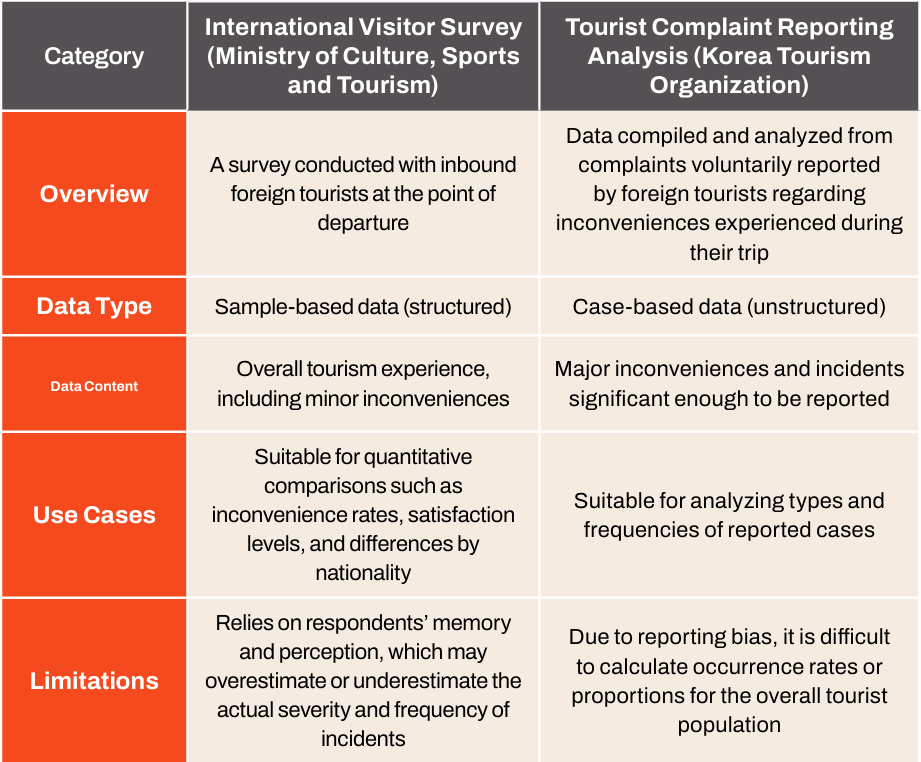
To capture the range of inconveniences tourists encounter — and the contexts in which they arise — a complementary approach drawing on unstructured data from spaces where people share experiences voluntarily is needed. Reddit, built around topic-specific Subreddits, is a platform where users actively exchange experiences and information. In travel-related Subreddits, tourists' experiences accumulate as narrative posts describing specific situations in detail. Participation skews heavily toward English-speaking global tourists, and posts tend to combine concrete context with personal emotion — allowing us to reconstruct at what point tourists felt friction (when), under what circumstances (where and how), and how strong the emotional impact was. Where survey data relies on pre-set categories and complaint data reflects only escalated cases, Reddit more naturally surfaces friction points across the full arc of tourists' expectations, experiences, and evaluations.
This report reconstructs the customer journey of foreign tourists visiting Korea through the lens of Service Quality Gap theory, diagnosing structural issues and psychological impact using Reddit data. It also compares Korea with Japan — a direct East Asian competitor with mature tourism infrastructure that many travelers consider interchangeable with Korea — to identify relative strengths and vulnerabilities. Through this comparison, the report moves beyond cataloguing inconveniences, offering a structured analysis of experiential differences between the two countries and drawing actionable implications for policymakers and industry stakeholders.
How Tourist Expectations Turn into Disappointments: Understanding the Psychology of Negative Experiences
A clear analytical framework is essential for understanding the inconveniences foreign tourists experience in Korea. This analysis draws on three theoretical foundations: Oliver's (1980) expectation-disconfirmation theory, which explains why tourists can feel strongly dissatisfied even over seemingly minor issues; Parasuraman, Zeithaml, and Berry's (1985) service quality gap model, which helps pinpoint where breakdowns occur across the tourism infrastructure; and SERVQUAL, which breaks down the specific dimensions of service quality as perceived by customers. Developed by Parasuraman, Zeithaml, and Berry (1988), SERVQUAL categorizes perceived service quality into five dimensions: tangibles, reliability, responsiveness, assurance, and empathy. Grounding these academic concepts in everyday experience makes it far easier to understand the challenges foreign tourists actually face.
Expectation-disconfirmation theory can be understood through a familiar scenario: a highly recommended restaurant that turns out to be underwhelming, or a film so hyped by friends that it inevitably disappoints. A tourist's final satisfaction is determined by how closely their pre-visit expectations align with what they actually experience. In Korea's case, the global K-culture boom sets expectations unusually high before tourists even arrive. Seeing Korean dramas and variety shows where characters seamlessly handle delivery, transportation, and payments with a single smartphone — amid sleek, high-functioning infrastructure — leads many visitors to arrive expecting a cutting-edge, effortlessly navigable country.
When reality falls short of that polished image, the gap feels like more than a minor inconvenience — it registers as a significant letdown. A tourist might open a ride-hailing app only to find it requires a Korean phone number or a domestically issued credit card. They might download a food delivery app at the Han River, eager for the iconic chicken-and-beer experience, only to find no English interface — and then discover that even with a local's help, their foreign credit card won't go through. The question that surfaces is fundamental: "If Korea is such a tech powerhouse, why can't I, as a foreign visitor, even order food?" When expectations are set this high, small cracks appear large — and this expectation-disconfirmation can rapidly erode a destination's image and widen the psychological distance between tourist and place.
SERVQUAL offers a useful lens for unpacking these issues further. Parasuraman et al. (1988) argued that service quality is not determined by visible facilities alone, but shaped by how reliable a service is, how quickly problems are addressed (responsiveness), how much confidence and reassurance providers offer (assurance), and how well they understand and accommodate the customer's perspective (empathy). Even if Korea's tourism environment scores well on tangibles — digital infrastructure, stylish spaces, fast internet — satisfaction remains elusive if promised services fail to work consistently for foreign users (reliability), if problems go unresolved (responsiveness), if visitors feel unable to navigate the environment with confidence (assurance), or if there is little effort to understand their situation (empathy). In short, impressive hardware alone is not enough — when the intangible dimensions of service quality fail to match, the experience turns into disappointment.
The service quality gap model helps trace exactly where these failures occur. It holds that multiple gaps exist between the intentions of service designers and what customers actually experience. Consider a local government that heavily promotes trendy restaurants and pop-up stores to attract foreign tourists. A shop owner, responding to that push, installs a digital waitlist system and payment kiosks — an apparent upgrade in tangibles. But if the system requires authentication via a Korean carrier phone number or KakaoTalk account, foreign tourists cannot even get a queue ticket. What looks like a modern digital solution becomes a wall. This is not merely a technical glitch — it is a reliability failure that undermines trust, a responsiveness failure that offers no alternative, and an empathy failure that leaves tourists feeling unseen.
Ultimately, the frustration born from the gap between services designed for domestic users and the realities foreign visitors face is vividly documented in the accounts tourists have left across online spaces like Reddit.
Research Methodology: Turning the Inner Voices of Global Tourists into Objective Data
What aspects of traveling in Korea and Japan do foreign tourists find most frustrating? To answer this question and objectively assess Korea's standing as a tourist destination, this study collected English-language posts from Korea- and Japan-related Subreddits (r/korea, r/koreatravel, r/SouthKoreaTravel, r/japan, r/japantravel, r/JapanTravelTips) over a three-year period from January 2023 to December 2025. Both countries share key characteristics as leading East Asian destinations — city-centered tourism structures and a focus on food, shopping, and cultural experiences — and are frequently perceived by long-haul travelers as interchangeable options.
The raw data underwent an initial filtering stage using keywords associated with negative sentiment (e.g., "issue," "frustrated," "problem"), after which posts were broken down into shorter paragraph-level segments for context-based analysis, yielding a total of 7,260 segments (3,480 for Korea, 3,780 for Japan). Each segment was then subject to a rigorous refinement process to determine whether it represented an actual inconvenience experience, excluding general information-sharing or opinion posts and retaining only specific accounts of difficulties encountered during the travel experience.
The refined dataset was analyzed through two core approaches designed to capture both structural differences between the two countries and the emotional depth of tourist responses. First, a common classification framework was applied to both the Korea and Japan datasets to calculate the share of complaints within each category. To identify areas of relative weakness, a gap analysis method was employed — subtracting Korea's share from Japan's share within each category — making it possible to clearly identify where Korea's tourism infrastructure falls short in relative terms. Second, VADER (Valence Aware Dictionary and Sentiment Reasoner) sentiment analysis was used alongside frequency analysis to quantify not just how often each type of inconvenience appeared, but how intensely negative the emotional response it triggered was, scored on a scale from -1 to 1. This allowed the study to pinpoint high-impact friction points that, while less frequent, carry disproportionate emotional weight.
Tourism Friction and Its Structural Differences: Korea's 'Digital Fortress' vs. Japan's 'Usage Fatigue'
Looking at how frequently complaints appear across the full dataset, posts containing at least one dissatisfaction segment accounted for approximately 7% of Japan-related content, compared to around 11% for Korea — a notably higher figure. This suggests that inconveniences arise more frequently in the Korea travel experience, or that tourists perceive and actively express them more acutely. That said, interpreting this gap as simply "more complaints vs. fewer" has its limits. As the analysis below reveals, the nature of the experience differs considerably depending on where friction occurs and how it operates.
Complaint Frequency by Major Category: Barriers to Entry (Korea) vs. Physical Capacity Limits (Japan)
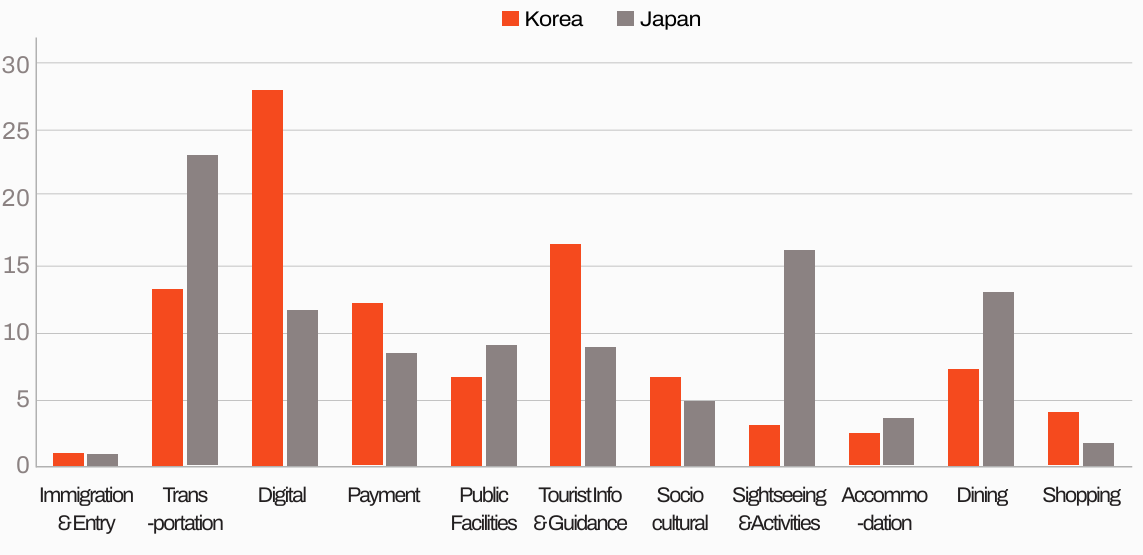
Breaking complaints down by major category reveals a clear divergence in the structural fault lines of each country's tourism ecosystem. In Korea, complaints are overwhelmingly concentrated in the digital domain (27.8%), followed by tourist information and guidance (16.4%), transportation (13.1%), and payment (12.0%) — with these four categories alone accounting for 69.3% of all complaints. This points to a pattern where Korea's tourism bottlenecks are less about on-the-ground service failures and more about the information-gathering and system access stages tourists must navigate before they can even use a service.
Japan, by contrast, sees transportation top the list at 23.0%, followed by sightseeing and activities (15.9%), dining (12.8%), digital (11.5%), and public facilities (8.9%). This distribution suggests that while system entry — booking, payment, and the like — tends to be relatively smooth, frustrations accumulate across the physical experience of getting around and spending time in offline settings.
[Fig. 1] Comparison of Inconvenience Complaint Share (%) by Major Category among Tourists Visiting Korea and Japan
Subcategory Comparison: Hard Barriers to Entry vs. Relentless Accumulated Fatigue
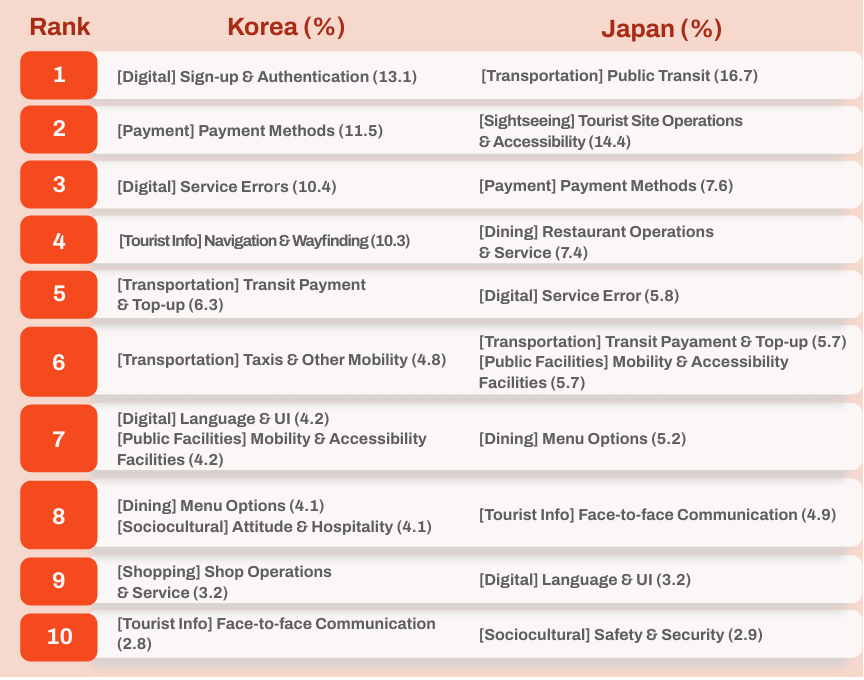
This structural divergence becomes even clearer at the subcategory level. For Korea, the leading complaint areas are digital service sign-up and authentication (13.1%), payment methods (11.5%), digital service errors (10.4%), navigation and wayfinding (10.3%), and transportation payment and top-up (6.3%). Most of these top items cluster around the early stages of the tourist journey — the hurdles travelers must clear before they can even begin exploring. Tourists are repeatedly hitting walls during the preparation phase: gathering information, making reservations, and setting up payments. In other words, Korea's friction is less about whether the infrastructure exists and more about the barriers built into the pre-use stages — login, authentication, and payment. Korea can aptly be described as a "Digital Fortress": dazzling and efficient on the inside, but sealed off from the outside by layers of domestic-only authentication and payment requirements — a Galápagos-style ecosystem locked behind two or three deadbolts that foreign visitors simply cannot open.
Japan, by contrast, sees public transportation use (16.7%), tourist site operations and accessibility (14.4%), payment methods (7.6%), restaurant operations and service (7.4%), and digital service errors (5.8%) leading the subcategory rankings. These are all areas directly tied to the lived experience of getting around and spending time at destinations — a fundamentally different pattern from Korea's access-blocking dynamic. Rather than being shut out of services, tourists in Japan can generally get in, but then encounter repeated bouts of fatigue through crowding, long waits, and the friction of physical movement. Much of this can be attributed to the record-breaking visitor numbers fueling severe overtourism at major hubs like Kyoto.
[Table 2] Top 10 Subcategory Ranking Comparison of Inconvenience Mentions among Tourists Visiting Korea and Japan
Tourists in Their Own Words: Korea Blocks You at the Door, Japan Wears You Down Along the Way
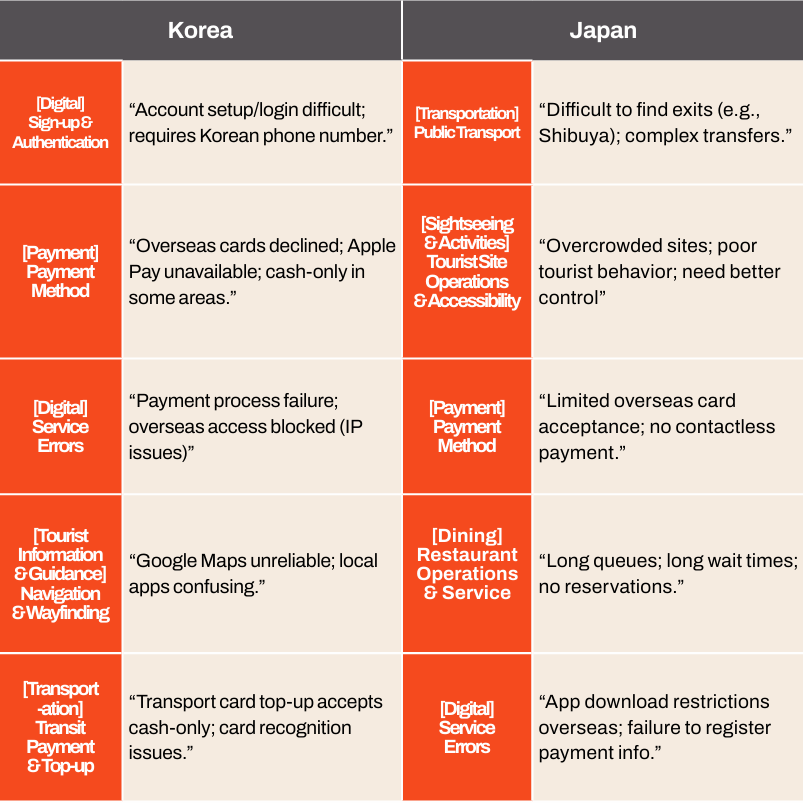
The difference becomes most vivid through actual tourist experiences. Before arriving in Korea, travelers may find apps blocked by overseas IP addresses, hit payment walls when booking trains, or get stopped at sign-up for requiring a Korean phone number. After arriving, Google Maps works poorly, domestic alternatives struggle to match English and Korean place names, and transit cards often can only be topped up with cash — while foreign cards are regularly declined at shops. From the very first step, tourists find themselves cycling through the same frustrations repeatedly.
Japan presents a contrasting picture. The preparation phase is largely friction-free, with most services accessible without issue — but constraints emerge once travelers are actually on the ground. Navigating to accommodations or attractions means contending with a dense web of train lines and exits, where simply choosing the right route can be a challenge in itself. Popular sites and restaurants routinely draw waits of two hours or more, and advance reservations are often unavailable or unnecessary, with on-site queuing effectively mandatory — adding real pressure to any itinerary. This is less a story of being locked out of services and more one of complexity and congestion grinding tourists down over the course of their stay. As overtourism concentrates demand in specific areas, this dynamic only worsens, leaving travelers to absorb a steady accumulation of minor frustrations that adds up to a high level of fatigue by the end of the trip.
[Table 3] Sample Posts of Inconvenience Experiences by Subcategory among Tourists Visiting Korea and Japan
Gap Analysis: Digital Barriers Eating Away at Offline Strengths
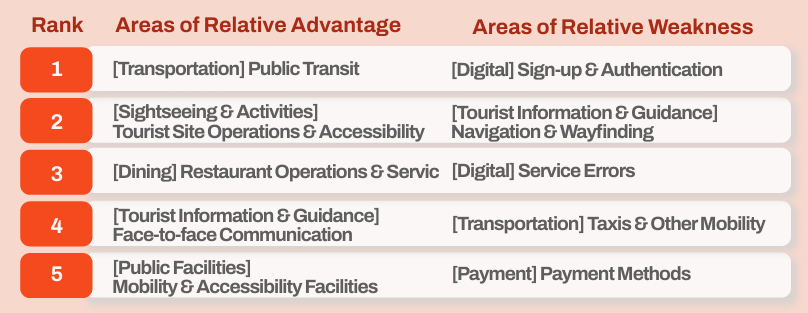
To compare the relative level of tourist inconvenience between the two countries, this study calculated the gap in complaint share for each subcategory (Gap = Japan – Korea). A larger positive value indicates an area where Korea performs relatively better; a smaller or negative value flags a relative weakness where Korea sees disproportionately more complaints.
The results show that Korea holds a clear advantage over Japan in areas tied to physical infrastructure and on-the-ground service — including public transportation, tourist site operations and accessibility, dining, face-to-face communication, and mobility facilities. This suggests that Korea has secured a solid level of convenience and efficiency in the actual lived experience of visiting. Korea's famously fast-paced service culture — dense transit networks, compact and walkable tourist areas, and quick service — appears to be working in its favor when it comes to the on-site experience.
On the other hand, Korea shows relative weakness in digital service sign-up and authentication, navigation and wayfinding, digital service errors, taxis and other mobility services, and payment methods — all areas where complaint shares run higher than Japan's. This is not a reflection of Korea's digital infrastructure being underdeveloped; rather, it stems from systems being designed primarily for domestic users. Even when accessing the same services as Korean nationals, foreign tourists hit additional barriers at every turn — login requirements, phone-based identity verification, and payment authentication — and these obstacles begin stacking up from the very start of the trip.
This structural gap has a damaging effect on the overall flow of the Korea travel experience. Korea has genuine strengths: strong destination appeal built on K-content, and competitive on-the-ground performance across transportation, tourist sites, and service. But tourists encounter repeated friction before they ever get to enjoy any of it. Korea is not a country lacking in things to see and do — it is one where unnecessary barriers stand between the tourist and the experience, quietly undermining its own strengths before the journey even properly begins.
[Table 4] Korea's Areas of Relative Advantage and Weakness Based on Gap Analysis Results (Top 5 Each)
Sentiment Analysis: Why Tourists Feel Angrier in Korea
Where inconvenience occurs matters — but so does how hard it hits. The same frustration can be a passing annoyance for one traveler and a trip-defining memory for another. Beyond how often friction arises, what matters equally is how deeply it affects tourists emotionally. This section therefore pairs frequency analysis with sentiment analysis to capture not just the volume of complaints, but the emotional intensity behind them.
The Sentiment Index: A 'Thermometer of Frustration'
Sentiment analysis was conducted using VADER (Valence Aware Dictionary and Sentiment Reasoner), a widely used method in social data analysis, producing a sentiment score between -1 and 1 for each segment. VADER calculates the positive and negative intensity of words in a sentence using a pre-built sentiment lexicon, and is particularly well-suited to the short, conversational language typical of social media and online reviews. It also accounts for contextual cues such as emphasis, capitalization, exclamation marks, adverbs, and negations — allowing it to capture emotional nuance more precisely than simple word-frequency approaches. Given this study's focus on negative experiences, only segments classified as negative in sentiment were retained for final analysis.
The resulting negative sentiment intensity score (absolute value, 0–1) functions as a kind of frustration thermometer. Scores near 0 reflect mild complaints — a slight inconvenience, a passing irritation. Scores near 1 signal intense negative emotion: the kind of rage, humiliation, or deep disappointment that colors an entire trip. Scores for each category were calculated as the average across all segments within that category, making it possible to identify high-intensity friction points that may be infrequent but leave a disproportionately strong emotional mark.
[Fig. 2] Comparison of Negative Sentiment Intensity by Major Inconvenience Category among Tourists Visiting Korea and Japan
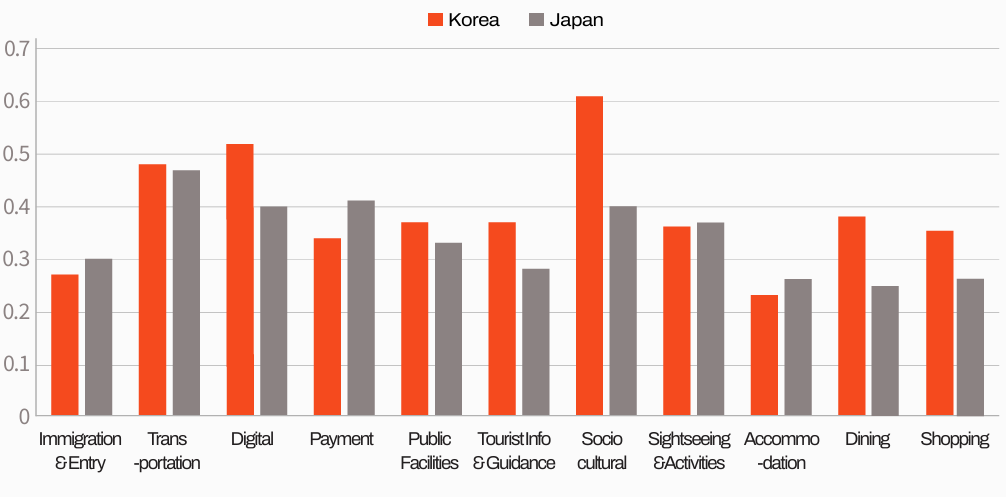
Looking at sentiment scores across major categories, the Korea travel experience tends to register more intense negative emotion than Japan's overall. Of the eleven major categories, Korea scored higher in negative sentiment intensity in seven, with some showing a substantial gap between the two countries.
Specifically, Korea recorded high sentiment intensity in sociocultural experiences (0.61), digital services (0.52), and transportation (0.48), with dining (0.39) and tourist information and guidance (0.38) also showing notably larger gaps relative to Japan. Japan, by contrast, showed a more evenly distributed and generally milder emotional profile, with only a handful of categories — immigration (0.30), payment (0.41), sightseeing and activities (0.37), and accommodation (0.26) — scoring higher than Korea. In other words, even when Japan does generate frustration, it tends not to escalate emotionally in the same way.
Top Sentiment Intensity Items: Discriminatory Hospitality (Korea) vs. Physical Fatigue (Japan)
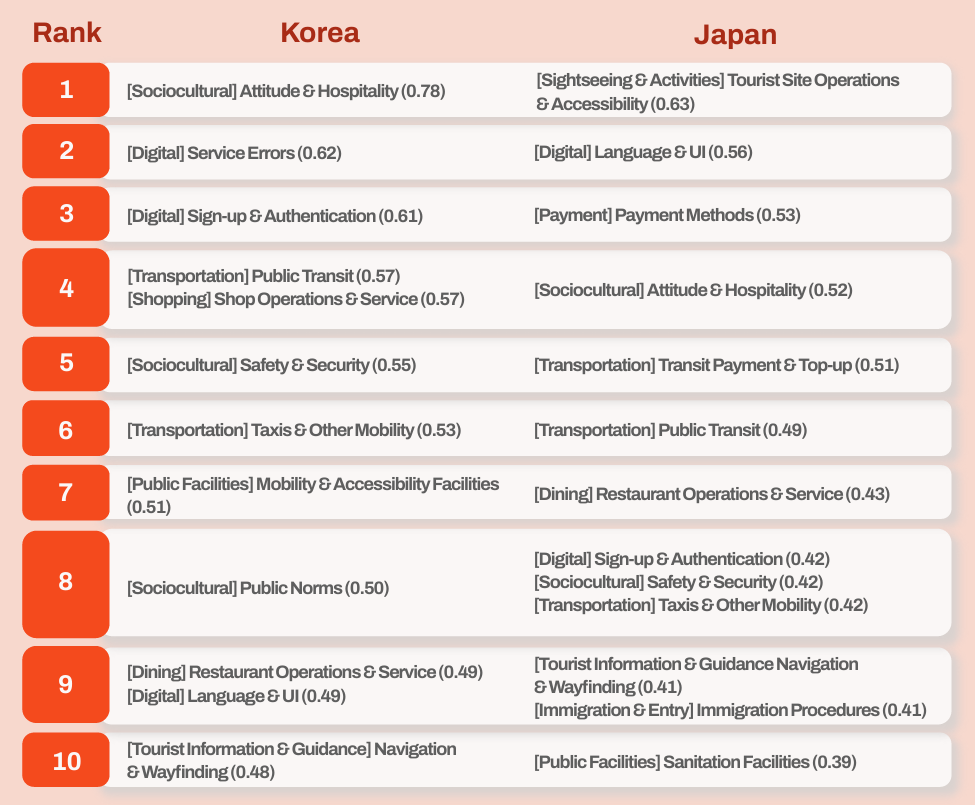
At the subcategory level, Korea shows a pattern of particularly intense emotional reactions in specific areas. Among the top ten items by sentiment intensity, three fall under sociocultural experiences (attitude and hospitality, safety and security, public norms), two under digital services (service errors, sign-up and authentication), and two under transportation (public transit, taxis and other mobility).
The single most striking finding is the sociocultural — attitude and hospitality score of 0.78, the highest in the entire dataset. Accounts of tourists receiving unwelcoming looks or unfriendly treatment for being foreign recur throughout the data. Some report being turned away from establishments due to the language barrier; others describe taxi drivers refusing foreign passengers or providing noticeably poor service. This kind of exclusionary behavior triggers a profound sense of alienation and humiliation: the feeling of not being welcome. Safety and security (0.55) ranks close behind, with tourists describing unwanted attention in nightlife areas like Hongdae and Itaewon, and aggressive taxi driving behaviors — speeding, red-light running — that register as genuinely frightening rather than merely inconvenient. Both scores reflect the same underlying dynamic: what makes these experiences hit so hard is the gap between the warm, emotionally rich image of Korea that tourists absorb through K-dramas, and the cold or threatening reality they encounter on the ground. When that romanticized expectation meets exclusion or fear, the emotional fallout is severe.
Digital services also stand out as a high-intensity area. The simultaneous appearance of service errors (0.62) and sign-up and authentication (0.61) near the top of the rankings signals that these issues go well beyond usability frustration. Repeatedly hitting walls during login, identity verification, and payment feels less like "this is inconvenient" and more like being tied up in front of a meal you cannot eat — a complete denial of access that generates emotional exhaustion from the very start of the trip. Public transportation complaints (0.57), while individually minor, contribute to a constant low-level tension throughout the journey that compounds over time.
Japan's profile looks quite different. Rather than sharp emotional spikes in specific areas, frustrations tend to recur across a wider range of categories. The highest sentiment intensity item is tourist site operations and accessibility (0.63) — a score that reflects less the difficulty of getting in and more the physical exhaustion of navigating overcrowded spaces and endless queues. In popular areas like Shinjuku and Shibuya, long waits are simply the norm, and without advance reservations, on-site queuing is effectively mandatory. Digital service language and UI also rank highly, with tourists frequently struggling to parse unclear or awkward English instructions. Payment is another point of confusion — Suica via Apple Pay, for instance, works in most situations but fails unpredictably in others, catching first-time visitors off guard.
Ultimately, the difference in kind is as important as the difference in degree. Japan's queue fatigue is a story of physical depletion and inconvenience. Korea's discriminatory hospitality score of 0.78 is something else entirely — closer to a personal affront, and an emotional severing from the destination itself.
[Table 5] Top 10 Subcategories by Negative Sentiment Intensity of Inconvenience Experienced by Tourists Visiting Korea and Japan
Gap Analysis: Beyond Physical Infrastructure, Toward Empathy
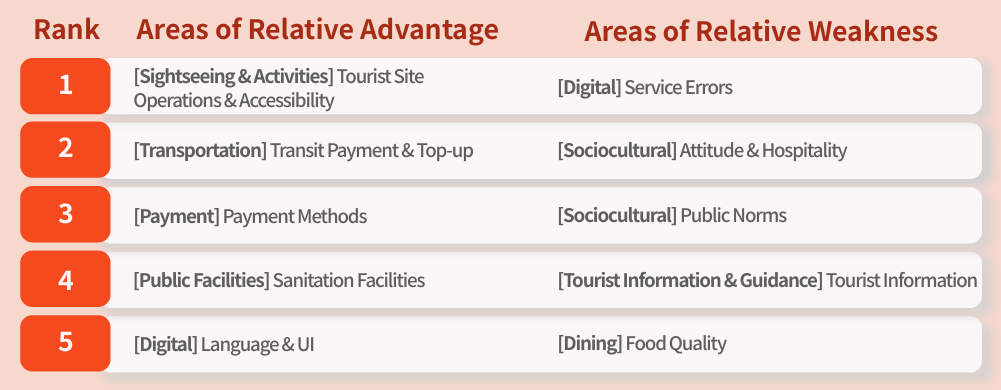
The sentiment intensity gap analysis (Japan – Korea, absolute values) shows that Korea registers lower negative sentiment than Japan in areas such as tourist site operations and accessibility, transportation payment and fares, payment methods, sanitation facilities, and digital language and UI — suggesting that Korea delivers a relatively stable experience on the physical infrastructure front.
Korea's negative sentiment intensity runs significantly higher, however, in digital service errors, attitude and hospitality, public norms, and tourist information and guidance — all of which emerge as areas of serious relative weakness. What these items share is that they go beyond functional failure: they combine repeated frustration during use, unpleasant social interactions, and a sharp gap between expectation and reality, leaving a strong emotional imprint.
At this point, two distinct types of inconvenience come into view. One accumulates gradually through repeated friction over the course of a trip (the Japan pattern); the other strikes once and damages the entire impression of the journey (the Korea pattern). Being unable to complete identity verification without a Korean phone number may eventually fade into a minor travel anecdote — but feeling personally rejected or dismissed by another person is a wound that lingers, and one that fuels negative word-of-mouth.
This has clear implications for policymakers and industry stakeholders. Improving tangibles — multilingual signage, wider Wi-Fi coverage — matters, but it is not enough. As SERVQUAL makes clear, tourist satisfaction is not determined by physical convenience alone. Experiences of empathy and responsiveness at the point of contact can shape how a trip is remembered far more powerfully than any facility upgrade. No matter how well-designed the infrastructure, the moment a foreign tourist feels disrespected or finds their frustration met with indifference, the quality of the entire experience deteriorates sharply. This calls for more than system fixes — it requires a genuine shift in awareness among everyone who interacts with tourists, from restaurant owners to transport workers, along with practical training to build the empathetic, responsive attitudes that SERVQUAL identifies as central to service quality. Empathy and responsiveness at the point of contact are no longer supplementary service elements; they are core determinants of national tourism competitiveness — and their absence poses a real threat to the foundation of the K-tourism brand.
[Table 6] Korea's Areas of Relative Advantage and Weakness Based on Gap Analysis Results (Top 5 Each)
Recommendations: A Multidimensional Strategy for a Seamless Journey
Building on the findings above, the goal is not simply to catalogue the inconveniences foreign tourists experience in Korea, but to systematically identify which areas demand priority attention and what direction responses should take. Considering both the frequency of friction and the emotional intensity with which it is felt provides a more complete picture of the impact on tourist experience — and a clearer basis for policy and industry action. Taken together, the Reddit data analysis points to two overarching priorities: lowering the digital barriers that tourists must navigate before they can access what Korea has to offer, and minimizing the sociocultural friction that arises from the gap between high expectations and reality. The core problem, in other words, is not a shortage of compelling tourism content — it is the inadequacy of the connective infrastructure that allows foreign visitors to reach and enjoy that content smoothly.
[Fig. 3] Complaint Share and Negative Sentiment Intensity by Inconvenience Type among Tourists Visiting Korea
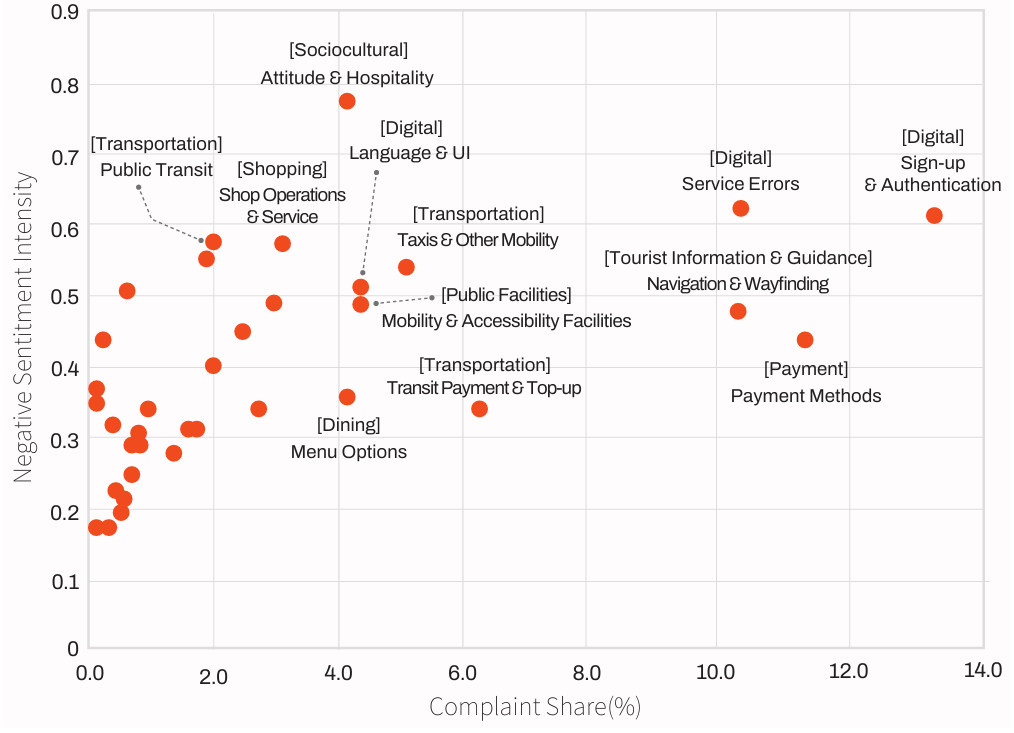
When complaint frequency and sentiment intensity are examined together at the subcategory level, foreign tourist inconvenience is found to concentrate in a handful of core areas. Sign-up and authentication (13.1%, 0.61), service errors (10.4%, 0.62), navigation and wayfinding (10.3%, 0.48), and payment methods (11.5%, 0.44) all show both high mention rates and strong negative sentiment, identifying them as the most widely and repeatedly shared pain points among tourists. Because these are experienced by large numbers of visitors across multiple occasions, they represent structural problems that persistently erode overall tourism satisfaction — what might be called "recurring friction."
By contrast, attitude and hospitality (4.1%, 0.78), shop operations and service (3.2%, 0.57), safety and security (1.9%, 0.55), and taxis and other mobility services (4.8%, 0.53) appear less frequently but carry high emotional intensity — making them "high-impact friction" points that, when they do occur, leave a strong and lasting negative impression on the overall travel experience. Where recurring friction gradually wears tourists down over the course of a trip, high-impact friction can sour a tourist's entire perception of a destination from a single encounter.
[Fig. 4] Complaint Share × Negative Sentiment Intensity Matrix for Inconvenience Types in Korea Tourism
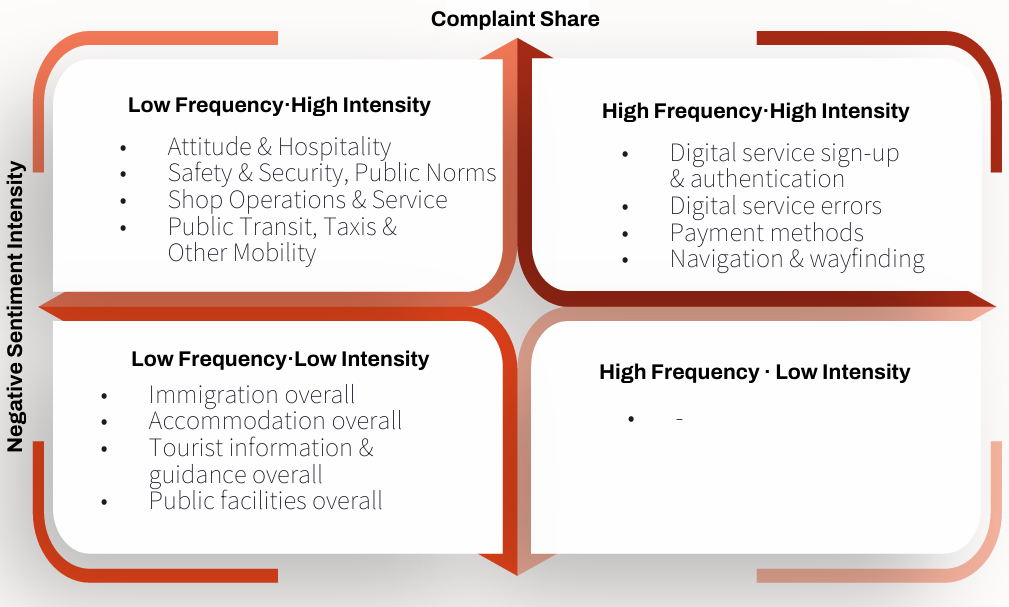
Reframing inconvenience types through the lens of the tourist journey also helps clarify how the timing of friction shapes its overall impact. Sign-up and authentication issues, digital service errors, and navigation difficulties tend to arise during the trip planning stage or early in the stay, functioning as entry barriers that block tourists from accessing the infrastructure and services they need before they can even begin exploring. These early-stage obstacles have a cascading effect — hampering movement, spending, and information-gathering throughout the rest of the trip — which is precisely what makes them a high policy priority. Regardless of the quality of the content waiting on the other side, barriers at the entry stage preemptively suppress overall satisfaction before the experience has properly begun.
Attitude and hospitality issues and public norm violations, on the other hand, tend to register most strongly during the middle or later stages of a trip, or in retrospect when tourists reflect on the experience as a whole. Though they occur less frequently, their emotional impact is considerably higher — and the impressions they leave tend to be the ones that stick.
[Fig. 5] Key Inconveniences by Stage of the Korea Travel Journey
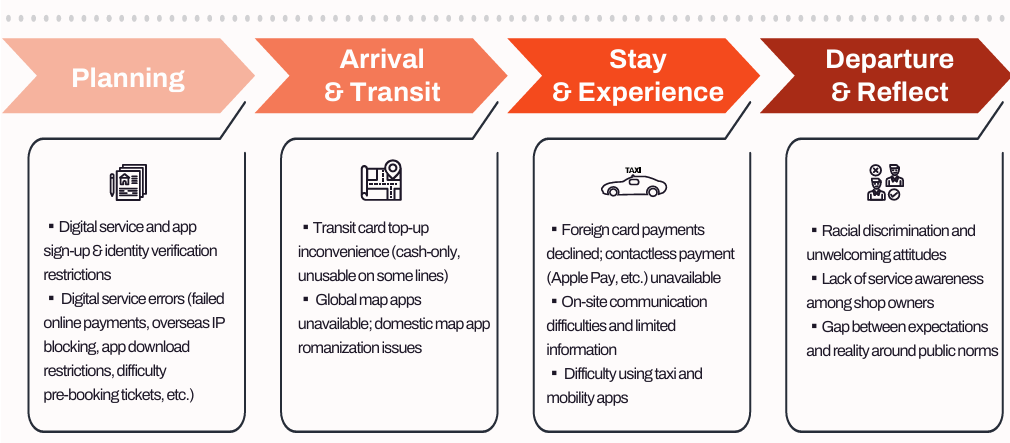
Taken together, Korea's inbound tourism friction follows a layered structure: systemic issues that accumulate through repetition, lower-frequency experiences with disproportionate emotional impact, and a broader range of minor inconveniences. Drawing on a frequency-sentiment matrix, this study proposes a three-tier improvement framework for policymakers and industry stakeholders. The goal is not to patch individual pain points after the fact, but to reconceive the foreign tourist experience as a single connected journey — shifting from a provider-centric model toward a "Partner in Life" service ecosystem that supports visitors throughout their entire stay.
Quick Wins (Short-Term): Removing Friction at the Entry Gate
Quick-win items are the small but consequential friction points that arise during trip planning or immediately upon arrival — areas where meaningful improvement is achievable in a short timeframe without major investment or structural overhaul. Digital service errors, language and UI issues, tourist information and signage, and navigation difficulties all cluster at this early stage. Excessive geo-blocking of overseas IP addresses, inaccurate or unintuitive English translations, and inconsistent romanization across airports and subway stations may each seem minor, but together they raise the barrier to entry right when first impressions are being formed. Crucially, most of these issues can be addressed by refining existing systems from a foreign-user perspective, rather than building new infrastructure from scratch.
Policy and Industry Actions
· Multilingual standardization of public and platform UI/UX: The Ministry of Culture, Sports and Tourism and local governments should establish clear multilingual signage standards, while map and booking platforms should audit their UI through the lens of foreign user flows. Inconsistent romanization on transit transfers and at major tourist sites should be corrected as a priority.
· Reducing overseas access errors and streamlining entry systems: Platform operators should address recurring errors for overseas users and ease overly restrictive geo-blocking policies so tourists can make reservations and payments before they arrive. Expanding group K-ETA application limits to reduce immigration bottlenecks should also be pursued in parallel.
· Multilingual SOS reporting within mobility apps: Major ride-hailing apps used by foreign tourists — including Uber (UT) and Kakao T — should prominently feature multilingual reporting and SOS buttons on their main screens, covering reckless driving, fare disputes, and deliberate detours. This would provide psychological reassurance and enable immediate response when problems arise.
These changes can be implemented quickly and would go a long way toward stabilizing the early entry experience — building the trust and confidence that set the tone for the rest of the trip.
Mid-Term: Achieving Global Compatibility for a 'Digital Galápagos'
Mid-term priorities cover the core bottlenecks — sign-up and authentication, payment methods, and transit card top-up systems — that score high on both complaint frequency and sentiment intensity. These cannot be resolved by any single company or ministry; they require cross-governmental regulatory reform and system-level integration. The problem runs deeper than interface design: the systems themselves are structurally built around domestic users. Restrictions on foreign card payments, cash-dependent transit top-ups, and phone-number-based identity verification may each seem like minor inconveniences, but they recur at every stage of movement and spending, generating persistent friction throughout the trip. What is needed is a universal design approach to digital services — one that accommodates the diverse technological environments of visitors from around the world.
Policy and Industry Actions
· Building a universal Digital ID infrastructure for tourists: Telecoms and platform operators should develop a passport-based "short-term simplified authentication Open API" for foreign visitors, guaranteeing full access to digital services without requiring a Korean carrier subscription.
· Opening the financial and mobility ecosystem across borders: The Financial Services Commission, card issuers, and payment gateway operators should expand the acceptance and compatibility of foreign-issued cards. Regulatory reform to allow major platforms such as Kakao Pay and Naver Pay to link with overseas credit cards and Apple Pay is particularly urgent. The cash-dependent transit top-up model should also be phased out in favor of contactless EMV and mobile charging systems.
Improvements in this area will take time to show visible results, but reducing the recurring friction of authentication, currency exchange, and top-up across shopping, transit, and booking will meaningfully expand tourist spending and raise the fundamental usability of Korea as a destination.
Long-Term: Building an Inclusive Hospitality Culture Beyond Physical Infrastructure
Long-term priorities cover the "high-impact" experiences that are relatively infrequent but capable of redefining a tourist's entire impression of a trip. Attitude and hospitality, public norms, and shop operations fall into this category — areas where a single exclusionary interaction can do lasting damage to Korea's tourism brand. A cold reception that makes a visitor feel unwelcome for being foreign, or being effectively turned away from a restaurant due to a language barrier, leaves a mark that lingers long after the trip. For tourists who arrived expecting the warmth and dynamism of Korea they encountered through K-dramas, the gap between expectation and reality only amplifies the disappointment. If digital friction leaves visitors thinking "this destination is inconvenient," exclusionary or discriminatory treatment leaves them thinking "I don't want to come back" — making it far more damaging in the long run. The focus here must be on building a sociocultural operating environment that consistently maintains a baseline quality of experience at every touchpoint where tourists and locals meet.
Policy and Industry Actions
· Applying inclusive service design at tourist touchpoints: Local governments and tourism industry associations should distribute multilingual and non-verbal communication guides to accommodation, restaurant, and taxi workers. To reduce the sense of rejection that language barriers can create, subsidies should be provided for accessible tools — multilingual QR menus and AI real-time translation devices — that can be used even by merchants with limited English. District-level service monitoring, combined with incentives for outstanding examples, can encourage voluntary participation.
· Sustainable local tourism and overtourism prevention: Taking Japan's overtourism experience as a cautionary tale, Korea should build early-warning capacity monitoring systems for high-traffic destinations such as Seoul and Jeju, ensuring that residents' daily lives and tourist flows do not come into conflict. A tourism model designed for coexistence between local communities and visitors should be the goal.
Fundamental shifts in sociocultural awareness do not happen overnight. But when care that transcends language barriers, human warmth that compensates for system limitations, and an attitude that treats foreign visitors not as exceptional guests but as fellow users of shared spaces become the norm — that is when Korean tourism will move beyond impressive hardware to complete the national brand that Korea deserves to be.
Conclusion: From 'a Country Worth Visiting' to 'a Country Worth Remembering and Returning to'
The inconveniences foreign tourists experience in Korea are not isolated complaints about an unfriendly waiter or a broken app button. They are a reflection of how flexibly Korea's social and economic systems can accommodate outside visitors — and a structural outcome of a closed digital ecosystem combined with a hospitality culture that has yet to fully mature. In this sense, the friction tourists encounter today is less a problem of specific service touchpoints and more a mirror held up to the openness and inclusivity of Korea's tourism system as a whole.
Where tourism competitiveness once rested on the uniqueness of a destination's landscapes or cultural heritage, it is now determined by how seamlessly tourists can enter a destination and immerse themselves in its everyday life — without psychological or physical barriers. The question has shifted from "what do we show visitors?" to "how frictionlessly can they experience it?" No matter how compelling the content, how striking the cityscape, or how advanced the IT infrastructure, a destination cannot compete in the experience economy without intuitive digital connectivity, reliable payment and transit systems, and genuine human warmth.
Korea has already secured a place in the minds of potential visitors worldwide as one of the most desirable destinations — a promise built through dramas, music, food, and the aesthetic of everyday urban life. But the moment tourists step out of the arrivals hall, that promise is tested: digital authentication barriers, foreign card restrictions, cash-dependent transit systems, and the cold reception that language barriers can produce all reveal how quickly the gap between expectation and reality can open up. And when expectations are high, disappointment hits harder. This is the point at which tourist inconvenience crosses into cognitive dissonance and emotional withdrawal — not merely "this was inconvenient," but something closer to a sense of betrayal at the gap between the Korea they imagined and the Korea they found.
The core finding of this study is clear. Korea's tourism challenge is not a shortage of attractions — it is that the entire process of accessing, experiencing, and remembering those attractions has not been designed with foreign visitors in mind. Recurring friction points — authentication, payment, navigation, service errors — repeatedly interrupt the flow of the trip. High-impact experiences — exclusionary attitudes, public norm violations, unwelcoming service — can collapse a tourist's overall impression from a single encounter. The former breaks the rhythm of travel; the latter damages the memory of it entirely.
Inbound tourism policy can no longer be driven solely by supply-side targets like "30 million visitors by 2029." What matters is not how many people arrive, but how many leave having experienced Korea without unnecessary friction, with genuine satisfaction, and with a desire to return. As competitors across Asia — China, Hong Kong, Thailand and others — accelerate their efforts to open digital payment systems, build foreign-friendly authentication frameworks, and develop integrated tourism infrastructure, Korea can no longer afford systems that work well only for domestic users. A universal tourism infrastructure compatible with global standards is needed — one where foreign visitors can use public transit, order food, make payments, and communicate naturally without prior preparation or excessive stress. Alongside this, a culture of inclusive hospitality that treats foreign visitors not as unfamiliar outsiders but as guests and fellow participants in shared space must take root across society.
Tourism, ultimately, is not the consumption of a destination — it is the experience of how a society welcomes those who arrive as strangers. When these improvements accumulate, Korea can become more than a vivid media fantasy: a country that works smoothly in the reality of a foreign tourist's journey, a country that can be trusted, and a country that stays with you long after you leave. Not just a place worth visiting once, but a place worth remembering and returning to without hesitation. The future of Korean tourism lies not in producing more content, but in making the most of what already exists — and ensuring that at the end of the experience, what remains is something warm.
To reference this article, please use the following citation: “Hyo Won Yoon, Soocheong Jang, Kyuwan Choi(2026). A Structural Analysis of Tourist Inconveniences in Korea: A Reddit-Based Korea-Japan Comparison, Yanolja Research Insights, Vol.41.”
References:
Oliver, R. L. (1980). A cognitive model of the antecedents and consequences of satisfaction decisions. Journal of Marketing Research, 17(4), 460–469.
Parasuraman, A., Zeithaml, V. A., & Berry, L. L. (1985). A conceptual model of service quality and its implications for future research. Journal of Marketing, 49(4), 41–50.
Parasuraman, A., Zeithaml, V. A., & Berry, L. L. (1988). SERVQUAL: A multiple-item scale for measuring consumer perceptions of service quality. Journal of Retailing, 64(1), 12–40.
[Appendix A] Complaint Share by Type of Inconvenience among Foreign Tourists Visiting Korea and Japan
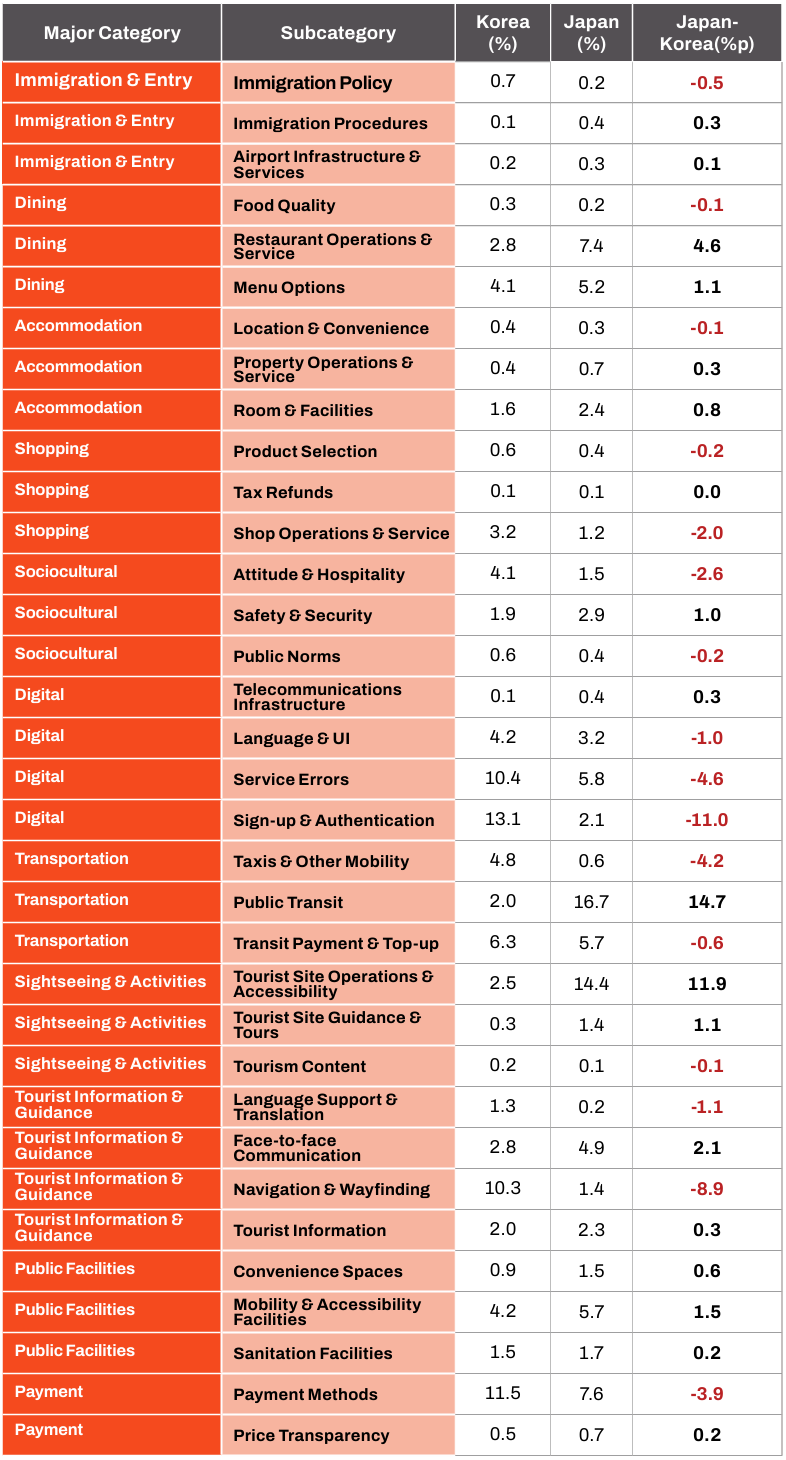
Note: Negative values of 'Japan – Korea' indicate areas of relative weakness for Korea, while positive values indicate areas of relative advantage. A larger absolute value reflects a greater gap between the two countries.
[Appendix B] Negative Sentiment Intensity by Type of Inconvenience among Foreign Tourists Visiting Korea and Japan
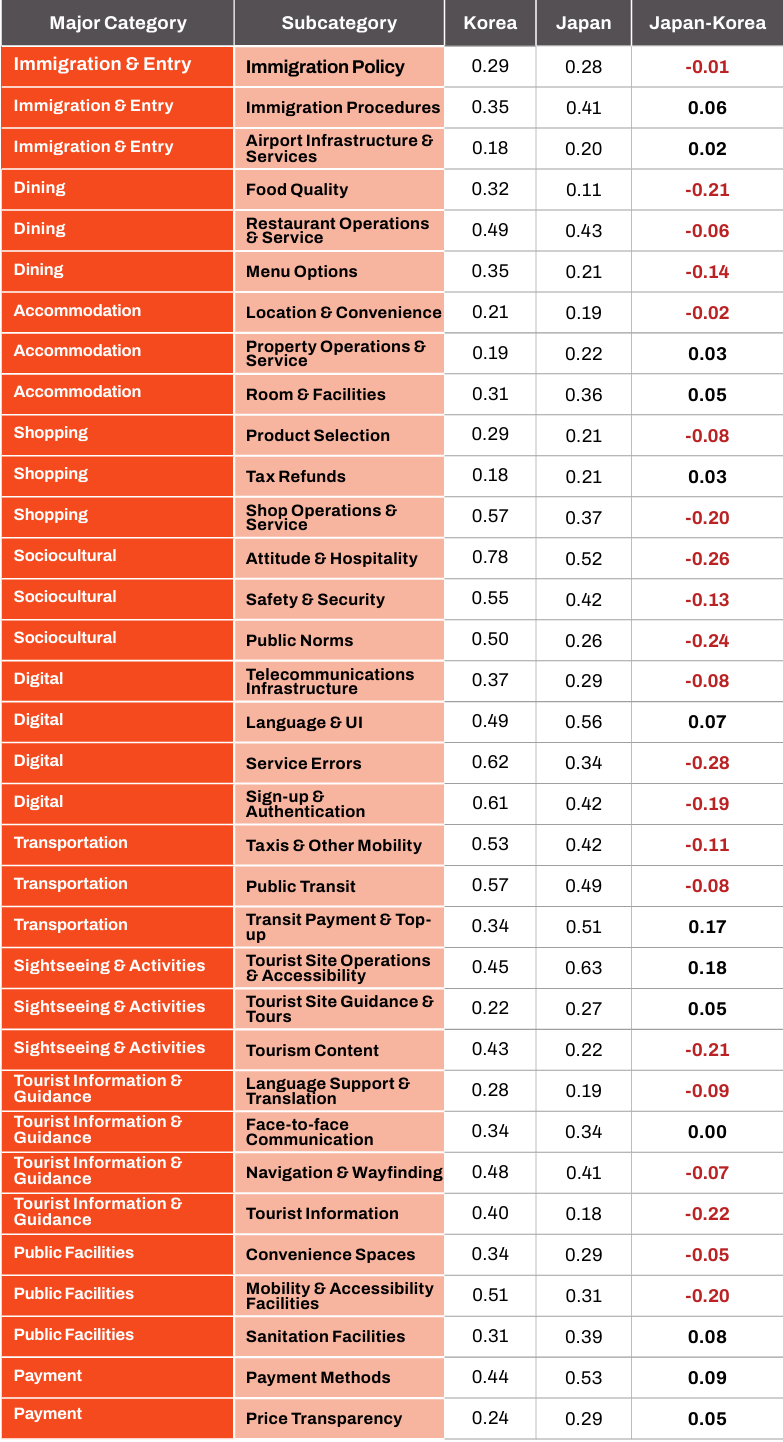
Note: Negative values of 'Japan – Korea' indicate areas of relative weakness for Korea, while positive values indicate areas of relative advantage. A larger absolute value reflects a greater gap between the two countries.
 Prev
Prev  Back
Back 