
Vol. 32: Motivations for Overseas Travel and Strategies for Revitalizing Domestic Tourism in Korea
- Reg Date
- 2025.10.22


Motivations for Overseas Travel and Strategies for Revitalizing Domestic Tourism in Korea: Focusing on the Travel Psychology of Korean Tourists
Suckwon Hong, Principal Researcher at Yanolja Research / [email protected]
SooCheong Jang, Professor at Purdue University & Director at Yanolja Research / [email protected]
Kyuwan Choi, Professor at Kyung Hee University & Director H&T Analytics Center / [email protected]
For Koreans, travel is no longer a special event; it has become deeply ingrained as part of everyday life. Nevertheless, recent data show a clear structural shift in travel spending away from domestic trips towards overseas destinations.
As the pent-up demand for overseas travel during the COVID-19 pandemic surged afterward, the number of outbound travelers reached 28.68 million in 2024, fully recovering to pre-pandemic levels. Considering that 14.56 million departures were recorded in the first half of 2025 alone, the annual number of overseas trips this year is almost certain to reach a record high. This enormous trend translated into an economic outcome: a tourism trade deficit of roughly USD 10 billion. The fact that Korean tourists spent a total of around USD 26 billion overseas indicates that if even a fraction of this enormous spending had been captured domestically, it could have generated tremendous economic added value.
By contrast, only 16.37 million foreign tourists visited Korea in 2024—93.5% of the pre‑pandemic level— and inbound tourism growth has not kept pace with the explosive rise in outbound demand. This imbalance in the recovery of inbound and outbound tourism deepens the structural tourism trade deficit. Contributing factors include the aggressive expansion of low‑cost carriers on international routes and the widespread adoption of online travel agencies, which have dramatically lowered both the physical and psychological barriers to overseas travel. In particular, the perception that “for the same cost, one can experience something newer and more exotic abroad” acts as a powerful driver accelerating the migration to overseas travel.
Korea has thus emerged as a true “overseas travel powerhouse,” with more than half of the population travelling abroad each year. The share of departures relative to the population exceeds that of the United States and is far higher than in Japan or China. Measured solely by enthusiasm for leisure‑motivated overseas trips, Korea ranks among the top countries in Asia.
This phenomenon raises a serious challenge that goes beyond a crisis in the domestic tourism industry — it is a critical national economic issue that must be addressed. The central question has now become how to redirect the surging demand for overseas travel back into the domestic market and convert the massive outflow of foreign currency into domestic consumption. Accordingly, this Insights report aims to conduct an in-depth analysis of the fundamental motivations driving Koreans to choose overseas travel and their perceptions of domestic travel. Drawing on survey data of recent overseas travellers, it provides a detailed diagnosis of consumers’ psychological and experiential factors, offering an objective perspective on the current realities faced by domestic tourism. Ultimately, the goal of this report is to identify strategic solutions that will elevate domestic travel from being a substitute for overseas trips to becoming a top-of-mind, inherently appealing first choice for travelers. It is expected that these efforts will serve as a key driver in revitalizing both the stagnant domestic tourism sector and the regional economy.
A Data-Driven Look at the Migration of Demand: Why Do Koreans Head Overseas?
The shift of travel demand from domestic to overseas destinations is not merely a passing trend; it represents a large structural movement driven by generational and value‑related changes. Analyzing the scale and characteristics of this migration through data is the first step in grasping the essence of the challenges facing domestic tourism. The following analysis reveals a clear generational divide in travel preferences and suggests a fundamental distrust in the value of domestic trips
Generational divide: younger generations lean overseas
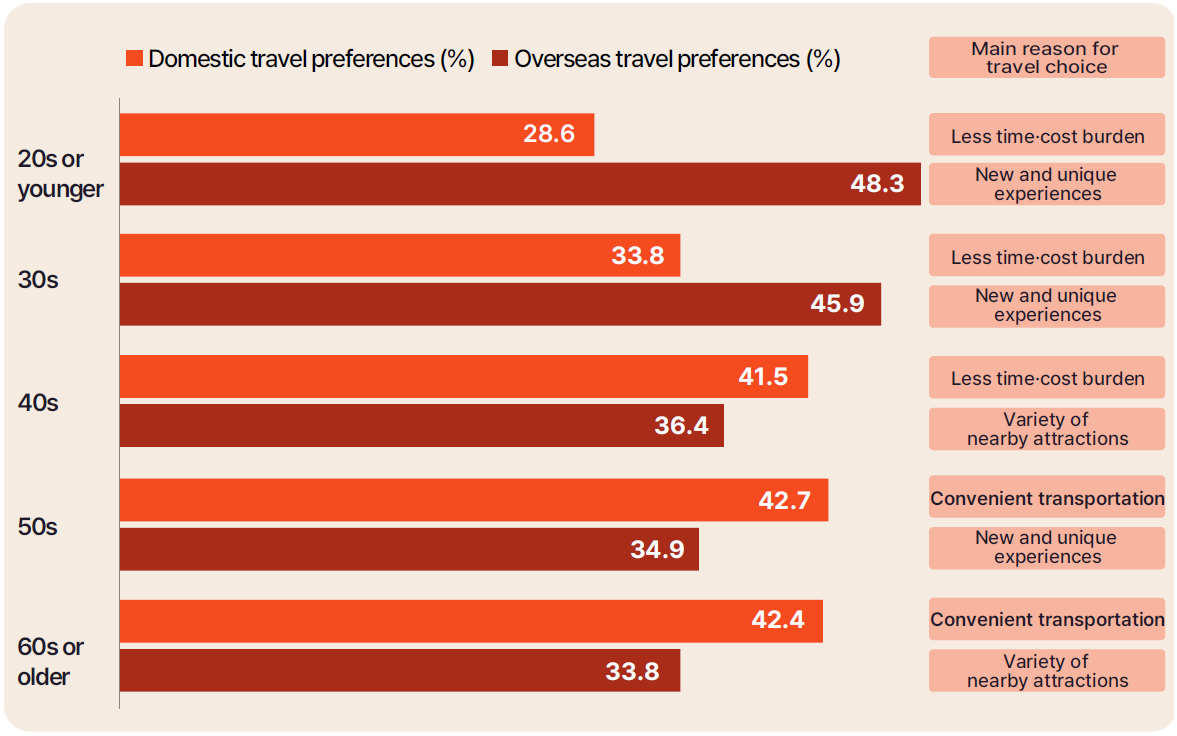
The most striking point is the pronounced generational gap in travel preferences. According to a survey by the the Federation of Korean Industries in July 2025, overall domestic travel preference (39.0%) and overseas travel preference (38.4%) appear balanced. However, disaggregating the data by age exposes a serious warning sign for the future of domestic tourism.
Among respondents in their twenties or younger, the preference for overseas travel reached 48.3%, nearly 1.7 times higher than the 28.6 % who preferred domestic travel. Respondents in their thirties likewise favored overseas travel (45.9%) over domestic travel (33.8%). By contrast, those in their fifties (42.7% domestic vs 34.9% overseas) and those aged sixty or older favored domestic trips. This data indicates that the current domestic tourism market is sustained largely by the preferences of middle-aged and older generations, while younger generations — the key drivers of the future market — have already shifted their interest decisively toward overseas travel. Such trends clearly demonstrate a structural risk, as the outflow of travel demand is likely to accelerate further over time.
[Figure 1] Preferences for domestic vs. overseas travel by generation and primary reasons for choice
Source: The Federation of Korean Industries, reconstructed by Yanolja Research
This generational divide is more than a mere difference in travel preferences — it is clear evidence that the domestic tourism industry is failing to secure its future core customer base. If domestic travel fails to position itself as an appealing option during the formative years when younger generations are shaping their travel habits and values, the likelihood that they will prefer domestic trips later in life, as middle-aged or older adults, will remain extremely low. In other words, as today’s younger generations become accustomed to and trained in overseas travel, it will become increasingly difficult to redirect their interests back to domestic destinations in the future. Ultimately, the current market structure is equivalent to handing over the long-term customer lifetime value of the domestic tourism market to foreign markets. Therefore, addressing this issue is not merely a matter of short-term revenue growth but a top strategic priority for ensuring the long-term survival and sustainability of the industry.
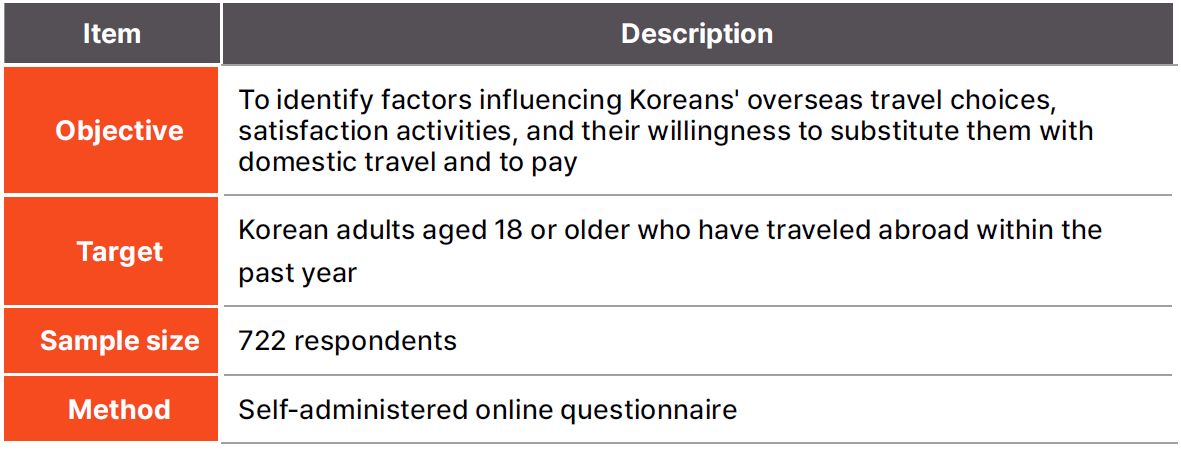
In order to conduct deeper analysis, Yanolja Research carried out a supplementary survey to examine the fundamental reasons Koreans choose overseas travel and to assess the potential substitutability of domestic trips. In particular, the survey aimed to quantify whether consumers assign similar value to domestic travel, and whether they are willing to spend comparable amounts. This provided a practical foundation for strategy development.
[Table 1] Survey design
Gap in value perception: open hearts and closed wallets
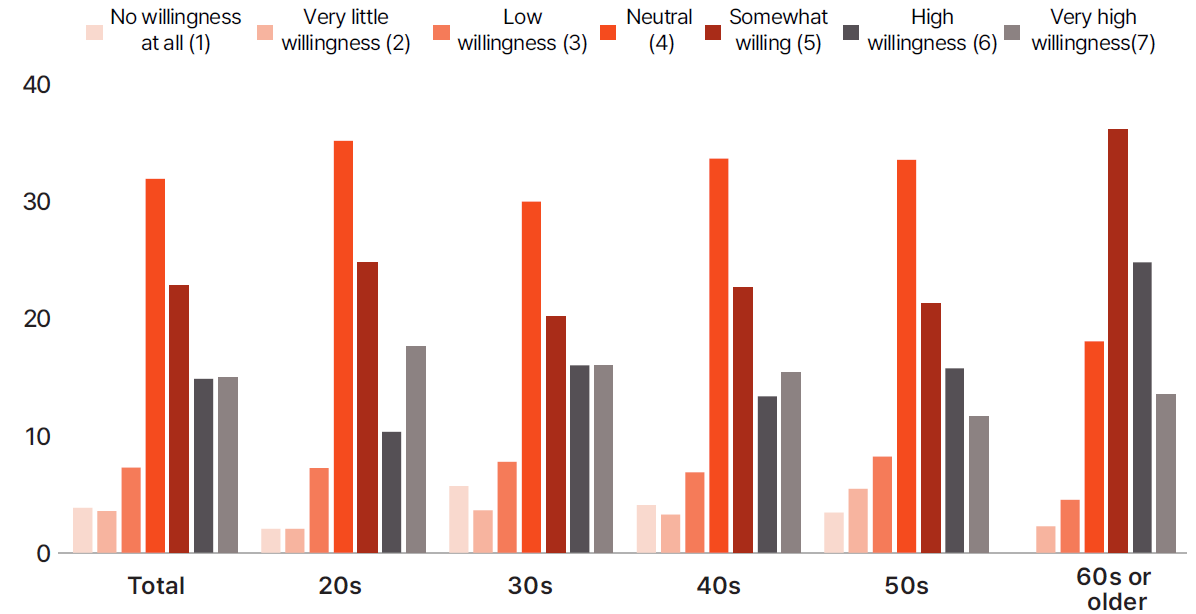
When overseas travellers were asked whether they would be willing to choose domestic trips instead of another overseas trip in the future, more than half expressed a positive intention (scoring 5 or higher on a 7‑point scale). Particularly high positive responses among those aged sixty or over suggest that psychological resistance to domestic travel is low and that there is significant potential for conversion of demand
[Figure 2] 'Would you be willing to choose domestic travel instead of overseas travel in the future?‘ (Unit: %)
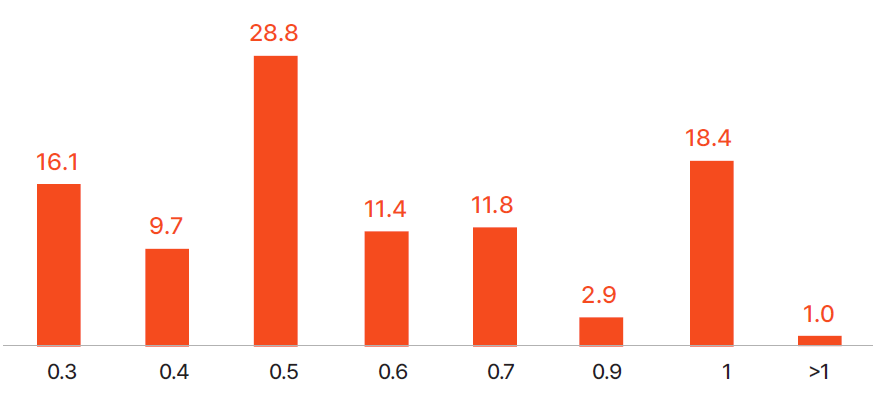
Even so, a stark contrast emerges when respondents are asked about their willingness to spend. Most said they would allocate only 30–50% of the amount they had spent on overseas trips to domestic travel. Only 18 % were willing to spend the same amount, and just 1% would spend more. Actual spending data confirm this disparity: while the average expenditure per overseas trip was about KRW 1.982 million, the average per domestic trip was about KRW 543,000—roughly one‑quarter.
These data clearly show that the core problem facing domestic tourism is not price per se but deep scepticism about value for money. Psychologically, consumers keep the door open to domestic travel, but when they open their wallets they assign it less than half the value of an overseas trip. The prevailing perception is that domestic trips do not provide experiences commensurate with their cost.
Therefore, the challenge for the domestic tourism industry is not simply to cut prices but to create unique experiential value for which consumers are willing to pay, and to convincingly demonstrate that value.
[Figure 3] Distribution of willingness to pay for domestic travel compared to overseas travel (Unit: %)
Psychology of Choosing Overseas versus Domestic: Imbalance between "Experiential Value" and "Willingness to Pay"
The shifts in demand and the gap in perceived value are deeply rooted in consumers’ psychology. Koreans do not choose overseas trips over domestic ones simply because of cost comparisons. Rather, the fundamental value they seek from travel differs. Overseas travel is perceived as an “experiential investment,” whereas domestic travel is viewed as “functional consumption.” This difference in psychological framing is the main cause of the imbalance in willingness to pay.
Pursuit of experiential value in overseas travel: 'newness' as the essence of travel
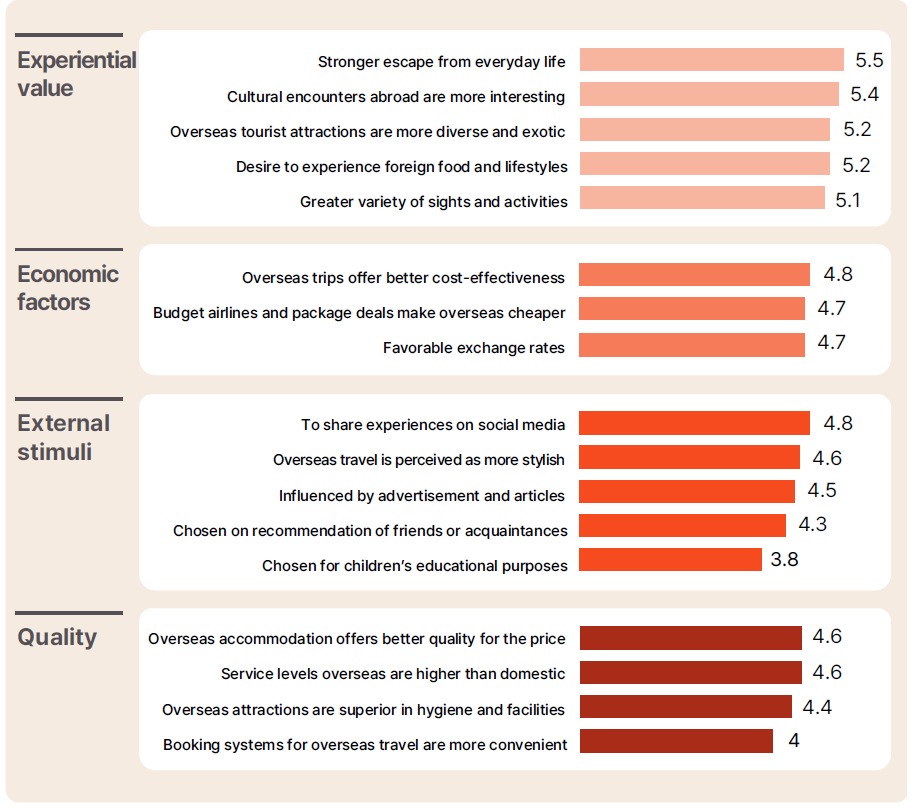
The strongest driver of overseas travel is the desire for experiential value. Survey results show that the reasons most often cited for choosing overseas trips were “to have new and unique experiences” (39.1%) and “because there are more diverse and exotic attractions” (28.1%). These reasons far outweighed economic or convenience‑related factors, clearly indicating that consumers prioritise the quality and diversity of experience.
When measured on a 7‑point scale, the top motivations for overseas travel were: “stronger sense of escaping everyday life” (5.5 points), “more interesting cultural encounters” (5.4 points), and “more diverse and exotic tourist attractions” (5.2 points). By contrast, economic factors such as “overseas travel offers better cost‑effectiveness” (4.8 points) and external incentives like “to have experiences worth sharing on social media” (4.8 points) ranked lower.
This suggests that consumers view overseas trips not as simple holidays but as opportunities to discover a new self and gain intellectual and emotional stimulation in unfamiliar environments. The unique memories and stories created through travel become intangible assets that provide long‑term satisfaction, and consumers are prepared to pay more for this value.
[Figure 4] Factors influencing the choice of overseas travel
Pursuit of functional convenience in domestic travel: familiarity as a substitute
By contrast, the reasons for choosing domestic travel focus on functional and practical considerations. According to the Federation of Korean Industries survey, the leading reasons for preferring domestic trips were “less burden on time and cost” (32.8%), “ease of travel” (30.1%) and “no language or cultural barriers” (9.4%). All of these factors fall under the categories of convenience and efficiency.
This psychological framing positions domestic trips not as objects of aspiration but as realistic alternatives: a second‑best choice when time or budget is limited, or a safe option with no risk of failure. As long as domestic travel remains within the realm of functional consumption, consumers will naturally seek to minimize spending, and the motivation to pay higher prices for experiences will be low because they do not expect experiential value.
Ultimately, in the minds of consumers, overseas and domestic trips occupy different competitive arenas. Overseas trips are seen as “investments in memories,” whereas domestic trips are seen as “purchases of convenience.” Unless this fundamental perception is overcome, the gap in willingness to pay will be difficult to close. The core task for domestic tourism is not to persuade consumers through marketing slogans but to redesign the product itself—shifting domestic trips from the realm of functional consumption to that of experiential investment.
Travel as social capital: the influence of SNS and sharing culture
Another major factor reinforcing overseas preferences among younger generations is social media culture. For these travellers, travel goes beyond personal experience. It becomes a social act of sharing, communicating, and expressing one’s identity with others. Exotic cultures, foreign landscapes, and unique foods become attractive content for SNS feeds, and the process of sharing them is an important part of the travel experience.
In this context, overseas trips provide much higher social capital than domestic ones. Because domestic destinations are often perceived as “places we always go” with familiar scenery, the content they generate is less distinctive and struggles to attract attention on SNS. By contrast, overseas trips inherently guarantee novelty and a break from everyday life, thus offering greater social value. The mindset of “if the cost is the same, I’d rather go somewhere new” is linked not only to a desire for diverse experiences but also to a desire to display and have one’s tastes and experiences recognized. In an era when travel is consumed as a social experience, if domestic destinations cannot increase the appeal of their content, it will become even harder to entice younger travellers back.
Roots of Distrust in Domestic Travel: Price, Content, and Structural Contraints
The psychological background behind consumers assigning low value to domestic travel is grounded in concrete and practical grievances about domestic tourism products and the market structure. The perception that domestic trips are “not worth spending money on” is not an unfounded prejudice. It stems from repeated negative experiences across three dimensions—price, content, and variety of choices. These factors interact to form a vicious cycle that amplifies distrust of domestic trips.
Price-Quality mismatch and the collapse of trust
The biggest cause of dissatisfaction with domestic travel is the decline in value for money. In the Federation of Korean Industries survey, 45.1% of respondents cited “prices at tourist destinations are too high” as the most significant complaint. This is not simply about absolute price levels. It reflects the value mismatch of paying high prices but not receiving commensurate quality and experiences. Dissatisfaction with accommodation prices reached 69%, and dissatisfaction with food and beverage prices was also high at 41%, indicating that distrust is concentrated around core elements of the trip.
[Figure 5] Complaints about domestic travel (Unit: %, Multiple responses allowed)
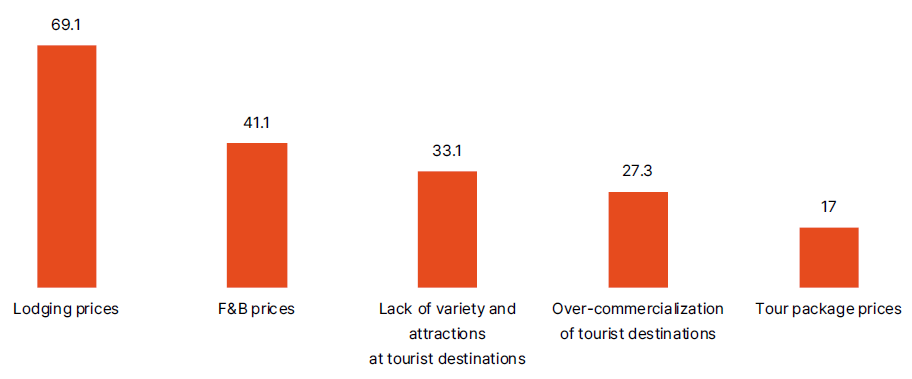
Even though accommodation and food prices at major domestic tourist spots have reached levels similar to or higher than those at well‑known overseas destinations, repeated issues such as ageing facilities, monotonous services, and high season surcharges have seriously undermined consumer trust. In particular, local practices such as charging “rip‑off” prices during peak seasons have spread negative perceptions beyond individual businesses to the entire domestic tourism ecosystem. These experiences entrench the perception that domestic travel is a losing proposition and provide a strong motive for choosing overseas destinations when planning the next trip.
Lack of distinctive content and homogenization of experiential products
The second core problem is the lack of distinctive tourist content. In the survey, 28.2% of respondents cited this as a major complaint about domestic trips. This reflects the perception that most domestic travel activities are limited to a few patterns—dining, viewing natural scenery, and visiting cafes—and that there is a shortage of deep experiences that capture the unique identity and stories of each region.
In the Federation of Korean Industries survey, domestic travel outperformed overseas travel only in three areas: transportation accessibility, tourist facilities, and food. In eight other experience‑related categories—natural landscapes, historical and cultural resources, festivals and events, hands‑on programs, shopping, and more—overseas destinations were rated superior. This does not mean Korea lacks excellent resources. Rather, it points to a lack of ability to process these resources into attractive content and design differentiated experiences. Many tourist destinations across the country replicate similar commercial facilities and programs, meaning that wherever travellers go they have similar experiences. This fails to satisfy the intrinsic desire for “newness” that drives travel.
The vicious cycle of tourism concentration and limited choices
The third problem is the concentration of tourism demand in particular regions. When planning domestic trips, travellers tend to focus on a handful of destinations—Seoul, Busan, Gangwon State and Jeju Island—because they lack reliable information about exploring new places. Even those who wish to discover new destinations often revert to familiar places due to lack of information, transportation difficulties, and a lack of things to do.
This concentration creates a vicious cycle. First, overcrowding reduces the quality of the experience in popular areas. Second, excessive demand inflates prices and intensifies the value mismatch. The recent sharp decline in satisfaction and interest in Jeju Island is a clear example. Third, unpopular regions struggle to attract tourists, losing the impetus for infrastructure investment and content development, which further widens regional disparities. Ultimately, consumers are forced to choose between “expensive and crowded” places and “places with nothing to do,” reducing the overall attractiveness of domestic travel.
These three problems—price trust, content appeal, and structural limitations—are not isolated issues but are closely interlinked. The absence of distinctive content drives concentration in particular regions; this concentration fuels price bubbles and lowers satisfaction; and low satisfaction discourages investment in new content. Breaking this cycle requires simultaneous and integrated approaches on all three fronts.
Redesigning Experiential Value: Strategies to Make Domestic Travel an Object of Desire
To resolve the entrenched distrust and undervaluation of domestic travel, efforts must go beyond controlling prices or improving infrastructure. The essence of the travel product—its “experiential value”—must be fundamentally redesigned. Domestic trips need to be elevated to an “object of aspiration” with inherent appeal, not seen as an inferior substitute or complement to overseas travel. Based on the preceding diagnosis, this section proposes directions for boosting the value of tourist destinations and products to transform domestic travel into a top‑of‑mind choice. The key is shifting the paradigm from hardware‑focused development to software‑focused value creation that leverages regional uniqueness.
[Figure 6] Three strategies for redesigning the experiential value of domestic travel
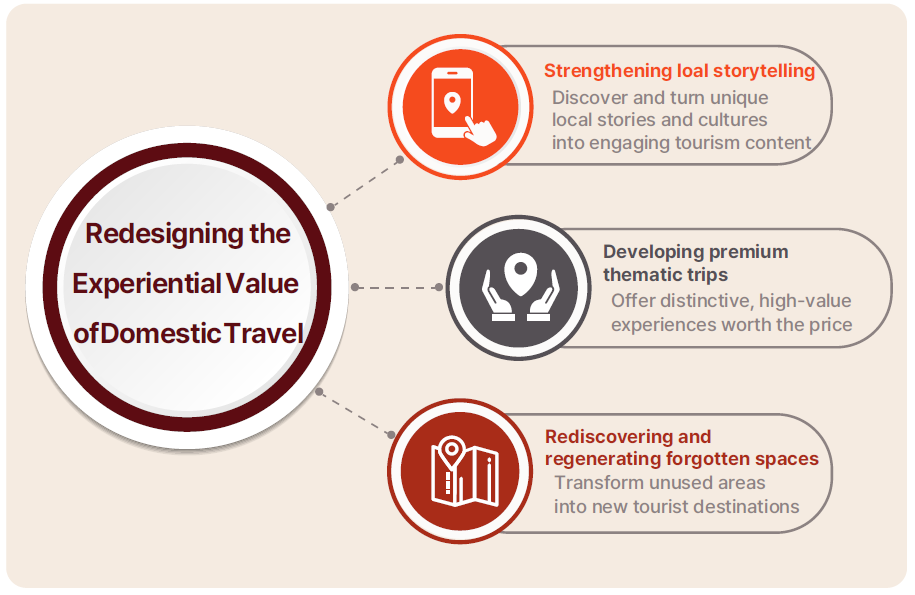
Strategy 1: Strengthening local storytelling — transforming familiar spaces into new experiences
The first strategy involves discovering the unique stories and culture contained within each region and reorganizing them into immersive content. This is the most effective way to solve the content deficit problem. Even places that feel familiar can be completely transformed when their historical narratives, the lives of local people, and cultural contexts are woven together.
Successful precedents already exist. In Andong, Gyeongsangbuk-do, Jinmaek Soju has revived the historic tradition of wheat-based soju brewing, turning Menge Village—home to its fields and distillery—into a model destination that maximizes both locality and experiential value. In Gochang, Jeonbuk State, the Gochang City Wall Story Tour goes beyond a simple fortress walk by dramatizing the history of its construction, deepening visitors’ emotional engagement. Kangkangee Arts Village in Yeongdo-gu, Busan, transformed the remnants of Korea’s declining shipbuilding industry into a vibrant cultural district through public art, while Daejeon’s “Bread Pilgrimage” around Sungsimdang Bakery reimagined the city’s milling and baking heritage into a new urban narrative.
Such approaches strengthen regional identity without large capital investment and provide travellers with deep intellectual and emotional satisfaction. They also instil pride among residents, laying the foundation for sustainable tourism. The key is not creating something entirely new but rediscovering the value of what already exists and curating it in an attractive way.
Strategy 2: Developing premium thematic trips — creating experiences worth paying for
The second strategy directly tackles the “price–quality mismatch.” Instead of cutting prices, develop premium themed trips that offer differentiated value worthy of higher prices. Such products prove that extraordinary experiences comparable to overseas trips are possible in Korea and break the stereotype that domestic travel should be cheap.
KORAIL Tourism Development’s rail cruise “Haerang” is a successful example: it turned a train into a travelling luxury hotel offering accommodations and services comparable to those of a top‑tier hotel, yet it remains immensely popular despite its high price. Similarly, customized small‑group trips that delve deeply into themes such as gastronomy, art, history, architecture, wellness, or outdoor activities can target customers who are willing to pay more.
To appeal to the tastes of Millennials and Generation Z, unique themes should be actively developed—such as “K‑pop concert tours,” “pilgrimages to filming locations of K‑content,” “Instagrammable photography tours,” or “local Michelin dining tours.” These premium products must not merely be expensive trips; rather, they should combine expert curation with exclusivity to instil the perception that they provide “time that money cannot buy.” Expanding the spectrum of domestic travel in this way will create a high‑value market.
Strategy 3: Rediscovering and regenerating forgotten spaces — creating new anchor destinations
The third strategy addresses the problem of tourism concentration by transforming under‑utilized spaces with potential into new tourism hubs. Disused industrial sites, abandoned schools and derelict buildings throughout the country should be seen not as neglected assets but as opportunity spaces where new value can be created through creative ideas.
The Dongpirang village in Tongyeong transformed a run‑down hillside district into a national attraction decorated with murals, revitalizing the local economy. Gokseong train village in Jeollanam-do converted an abandoned railway line into a driving force for the regional economy. Such space‑regeneration projects provide visitors with fresh and unique attractions, breathe new life into communities, and help disperse demand away from already popular destinations, thereby diversifying choices.
Local governments should build databases of unused spaces and proactively support creative use of them through institutional support and deregulation. Rediscovering forgotten spaces is not simply about creating one more tourist site. It can become a sustainable development model that preserves local history and natural landscapes while opening up future possibilities.
Building a Sustainable Tourism Ecosystem: Implementation through Public-Private Partnership
For the experiential value redesign strategies to lead to overall improvements across the domestic tourism ecosystem, a seamless living system that organically combines private creativity and public support is essential. When public–private collaboration functions effectively in areas such as content development, infrastructure, institutional reform, and marketing, a new experience‑centric domestic travel industry can secure a foundation for sustainable growth. Government’s role is not to act as a “player” creating content, but as an active “facilitator” who builds the “playing field” and operates fair rules so that the private sector can flourish.
Establishing regional tourism governance
The prerequisite for building a sustainable regional tourism ecosystem is for regions to secure endogenous development capacity within the broad policy framework set by central government—that is, the capacity to discover and translate their own unique attractions into tourism products. The key mechanism to achieve this is to strengthen the functional expertise and real execution authority of Destination Management Organisations (DMOs) comprising local governments, relevant agencies, residents, and industry. As strategic hubs for regional tourism, DMOs should incubate creative business models in the private sector and lead joint marketing and total quality management. The Ministry of Culture, Sports and Tourism’s “Tour Dure” project is a model of successful bottom‑up public–private cooperation in building resident‑led tourism businesses; nationwide expansion of such approaches is needed.
Recently, the government has pursued the creation of two or three mega‑tourism regions linking multiple local governments to diversify tourism demand away from the Seoul metropolitan area and create new markets. While the aim is to avoid fragmented approaches by individual DMOs and achieve economies of scale, there is a risk of losing momentum during implementation because of complex interests among many municipalities.
To ensure the effective implementation of this policy, it appears necessary to adopt a “Hub-and-Spoke” strategy as a fundamental framework. This approach concentrates resources and transport networks on key hubs, which are then connected radially to multiple surrounding nodes (spokes) to maximize overall network efficiency. Applied to a metropolitan-scale tourism zone, the hub would serve as a gateway city equipped with excellent accessibility and infrastructure, while each spoke would function as a specialized destination characterized by unique themes such as nature, history, or gastronomy, organically linked to the hub. This strategy enhances governance efficiency by clearly dividing roles — the hub oversees regional marketing and transport coordination, whereas the spokes focus on quality management of their distinctive tourism content. As a result, the complex structure of large-scale regional governance is simplified, improving overall execution capacity. A successful benchmark case can be found in Japan’s Setouchi Regional DMO, where seven prefectures jointly implemented unified branding and transportation integration (the hub) while co-developing cross-regional tourism products (the spokes) that transcend administrative boundaries.
In sum, qualitative upgrading and quantitative growth of the domestic tourism market require a multi‑layered regional tourism governance structure in which the central government, local governments and the private sector create synergies. To ensure that such governance translates into tangible results, resources must be allocated and linked efficiently under clear operational frameworks like the hub‑and‑spoke model.
Transport and infrastructure investment cooperation: enhancing physical accessibility and regulatory innovation
The market value of attractive tourism content is determined by physical accessibility. Public authorities therefore need to strategically invest in “last‑mile mobility” connecting key transport nodes such as KTX stations and airports with potential tourist destinations. In particular, to address accessibility issues in areas lacking transport infrastructure, flexible transport systems such as on‑demand shuttles or circulating buses should be introduced through public–private partnerships with mobility platforms. Minimizing travel friction costs is a fundamental precondition for enhancing the overall value of the tourism experience.
In addition, regulatory innovation is required to institutionalize sharing‑economy models such as home‑sharing, thereby removing unnecessary restrictions on accommodation. Expanding legal acceptance of models like home‑sharing not only diversifies accommodation options for travellers but also makes efficient use of idle assets and contributes to increased income for local residents and the revitalization of regional economies.
Content industry and global marketing integration: an approach based on K-content IP
The global influence of K‑content offers unprecedented opportunities for Korea’s tourism industry. Filming locations for dramas and movies should be developed beyond simple visit spots into narrative‑based experiential tourism products and promoted comprehensively in conjunction with online travel agencies. To this end, government should create a tourism data ecosystem by expanding the openness of public tourism‑related data, allowing innovative business models to emerge. Furthermore, a data‑driven precision‑targeting marketing system should be established by combining public data with customer data held by private companies, converting latent demand into actual visits. Themed products that span multiple regions—such as a “national bread pilgrimage pass”—can increase length of stay and spending by transcending administrative boundaries. Conversely, the lack of key infrastructure such as dedicated arenas to meet global demand for K‑pop performances is a serious constraint, and urgent investment is needed to support the sustainable spread of K‑content..
Incentives for institutional reform and restoring trust: building trust capital and feedback systems
The emergence of new fusion‑tourism industries requires flexible expansion of existing legal frameworks. New types of businesses, such as experiential tourism, should be incorporated into the Tourism Promotion Act to provide institutional stability and support their sustainable growth. Policy incentives should also be designed—such as tax benefits for using unused spaces for tourism facilities, financial support for promising tourism venture firms, and matching‑fund programs to attract private investment in regional festivals—to act as priming pumps for private investment.
However, the bedrock of all these policies is the restoration of market trust. To resolve chronic distrust of pricing, authorities must strengthen constant monitoring and introduce strong measures to ensure price transparency—such as awarding “fair price certification” to excellent operators—so that consumers can feel secure when spending. Ultimately, to ensure that institutional reforms and incentives are effective, an organic performance management and feedback system—covering planning, implementation, and evaluation—must be established jointly by central and local governments.
Conclusion: Reasons to Travel Korea Again: The Answer Lies in "Experiential Value"
The demand for travel by Koreans has not declined; it has merely shifted overseas. Therefore, the challenge for domestic tourism is not to create new demand but to bring back the massive existing demand whose destination has changed. Slogans such as “choose domestic trips instead of going overseas” and marketing appeals to patriotizm are no longer effective. The essence of the solution lies in making consumers voluntarily feel that “domestic travel is as attractive as, or more attractive than, overseas trips.”
As analyzed in this report, domestic trips are currently perceived in the minds of consumers as “functional consumption” rather than “experiential investment.” This perception inevitably stems from structural problems: low value relative to price, homogenized content and limited choices. Unless these fundamental issues are addressed, the flow of travellers abroad cannot be reversed. The goal is to elevate domestic trips from a “substitute or complement” to overseas travel to a “first choice” competing on equal footing.
This goal is attainable. Korea already possesses world‑class cultural heritage, diverse natural environments, unique K‑content and outstanding safety and convenience. If we combine these assets with creative storytelling to imbue regions with unique narratives, design differentiated premium experiences, and regenerate dormant spaces into new destinations, domestic travel can offer entirely new levels of value.
Future domestic tourism should look like this: travellers visit Gangwon State not just because it is nearby but to join a special makgeolli brewing workshop run by local artisans. A declining industrial city in Chungcheong Province transforms its historic factories into art galleries and performance venues, becoming the hippest cultural space for spending a weekend. A night in a quiet hanok is valued not merely as an expensive stay but as an exclusive experience of Korean unique aesthetics and a journey through time unavailable anywhere else in the world. Our country’s beautiful natural scenery—mountains, seas and islands—also becomes a cherished asset that creates unique experiential value.
The ultimate reason to “travel Korea again” depends on how well we discover and recreate the tangible and intangible value we already possess. Successful execution of this strategic vision will not only improve the tourism trade balance; it will infuse vitality into local economies threatened by depopulation, create quality jobs and foster national pride in our cultural heritage.
Travellers no longer simply want to go “farther”; they want to experience “something new.” When consumers feel that “wonderful travel is fully possible without leaving the country,” the resignation of “it’s okay, I guess” will turn into the aspiration of “it has to be here.” At that moment, domestic tourism will usher in a new era of revival.
*To reference this article, please use the following citation: "Suckwon Hong, SooCheong Jang, and Kyuwan Choi. (2025), Motivations for Overseas Travel and Strategies for Revitalizing Domestic Tourism in Korea: Focusing on the Travel Psychology of Korean Tourists, Yanolja Research Insights, Vol. 32."
 Prev
Prev  Back
Back 