
Brief
Vol.13 Analysis of Korea's Inbound and Outbound Tourism Performance for Q1 2026
- Reg Date
- 2026.05.13


Analysis of of Korea's Inbound and Outbound Tourism Performance for Q1 2026
Inbound Tourism Performance
Number of Foreign Tourists: Entering a Growth Phase, Recording 4.74 Million in Q1 '26
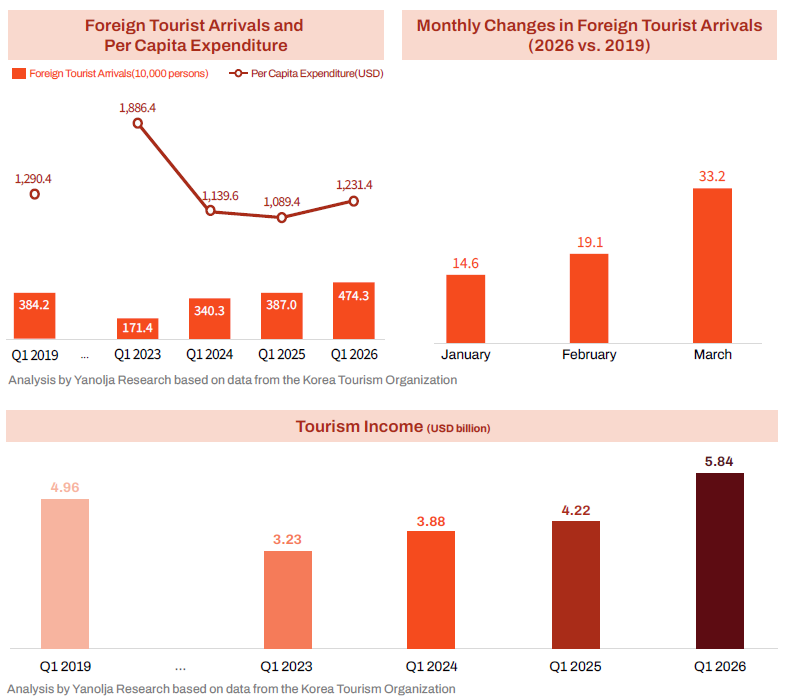
- In the first quarter of 2026, the number of foreign tourists visiting Korea reached approximately 4.743 million, achieving an all-time high. Korea's inbound market, which entered a phase of structural expansion after achieving full normalization in 2025, recorded an overwhelming growth rate in Q1 this year, up 22.6% year-on-year (YoY) and 23.4% compared to the same period in 2019. Notably, the monthly growth rates compared to 2019 accelerated significantly—14.6% in January, 19.1% in February, and 33.2% in March—clearly demonstrating a sharp upward trajectory.
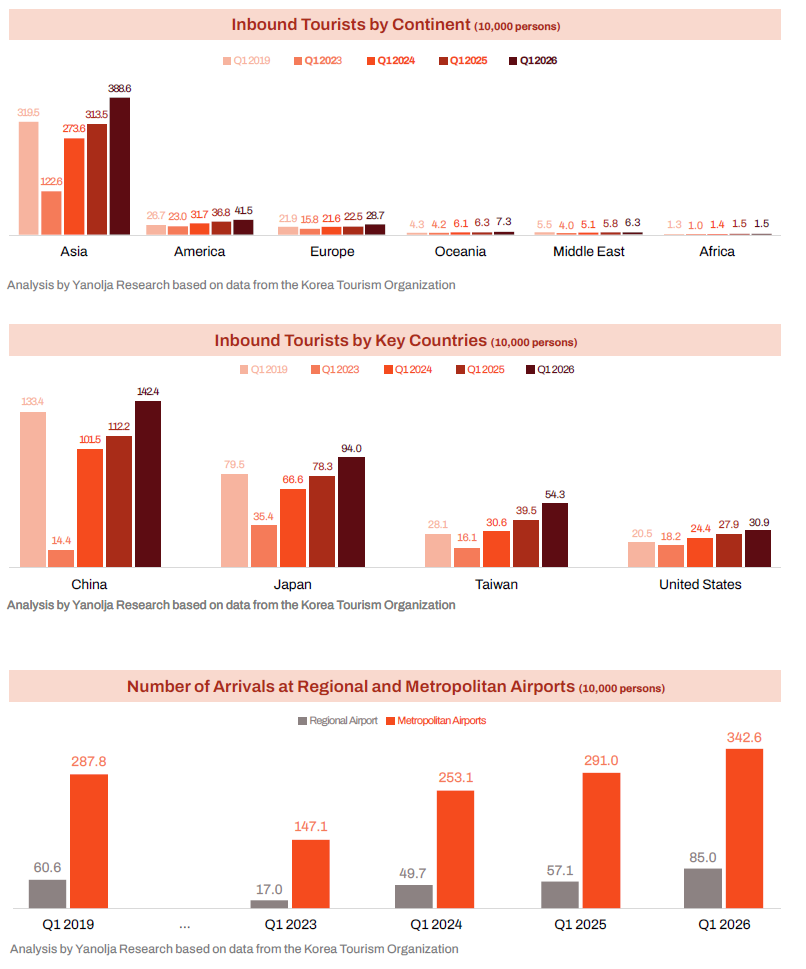
- By continent, both Asian and non-Asian markets grew, reinforcing a solid trend of global diversification. The Asian market reached 3.886 million tourists, a 21.6% increase compared to Q1 2019. Non-Asian markets also maintained high growth rates: the Americas at 415,000 (+55.1%), Europe at 287,000 (+30.7%), and Oceania at 73,000 (+67.1%). The continuous, explosive growth in the Americas and Oceania indicates that the Korean inbound market is shifting away from its reliance on neighboring countries and expanding into a global demand base.
- By country, China solidified its status as the No.1 market with 1.424 million tourists, excedding its 2019 performance by 6.8% for the first time in a first quarter since the COVID-19. Japan attracted 0.94 million tourists, recording an 18.3% increase compared to 2019. Taiwan (0.543 million, +93.1%) and the United States (0.309 million, +51.0%) accelerated their high growth trends from the previous year into Q1, proving they have firmly settled into a structural growth path.
- The diversification of entry routes was also prominent. The number of arrivals through airports in the Seoul metropolitan area reached 3.426 million, up 19.0% compared to 2019. Meanwhile, arrivals through regional airports jumped by 40.1% to approximately 850,000. The fact that the growth rate of regional airports was more than double that of the metropolitan area indicates that tourism to Korea is breaking away from its concentration on Seoul and evolving into a decentralized demand model that drives regional revitalization.
- However, geopolitical risks following the outbreak of the US-Iran war in late February this year are expected to act as a major variable moving forward. Due to sharp increases in aviation fuel prices and supply-demand imbalances, consecutive international flight cancellations and suspensions have occurred in April and May. Consequently, careful monitoring is required to assess the impact of these negative factors on inbound tourism demand for the second quarter of this year.
Tourism Revenue: Total Revenue Exceeded 2019, But Per-Capita Spending Has Not Fully Recovered
- Driven by the remarkable quantitative growth of foreign visitors, total tourism revenue in Q1 reached $5.84 billion (+17.8%). However, the average spending per capita stood at $1,231.4, falling short of the 2019 level ($1,290.4). While this is encouragingly higher than the same period last year (approx. $1,089) and the 2025 annual average ($1,155.8), a 4.6% gap must still be closed to achieve a full recovery.
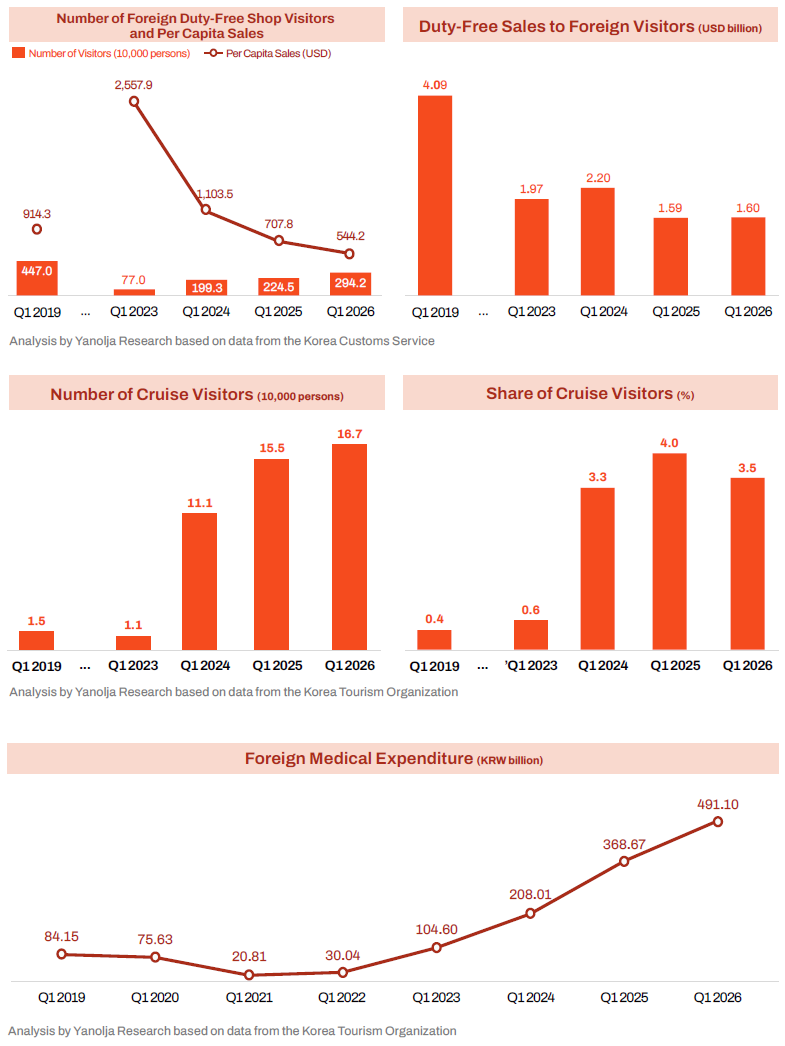
- The primary reason for the decline in average spending is the sluggish performance of duty-free shops. Compared to the first quarter of 2019, the number of duty-free shop customers plummeted from 4.47 million to 2.94 million, while per-capita sales sharply decreased from $914.3 to $544.2. This double hit resulted in a massive contraction of total duty-free revenue, shrinking the market to the scale of $1.6 billion. Additionally, a 10.9-fold surge in cruise arrivals (167,000 visitors)—who typically have shorter stays and lower spending capacity—exerted downward pressure on the overall average spending.
- Nevertheless, the 13% rebound in per-capita spending compared to the same period last year is a positive sign. The strongest driver behind this rebound is the growth of medical tourism. Foreign medical spending skyrocketed 5.8 times, from 84.15 billion KRW in Q1 2019 to approximately 491.1 billion KRW in 2026, clearly demonstrating that high-value-added tourism demand is establishing itself as a new breakthrough for profitability improvement.
Outbound Tourism Performance
Outbound Travelers: Surpassing 8.33 Million to Break All-Time Q1 Record
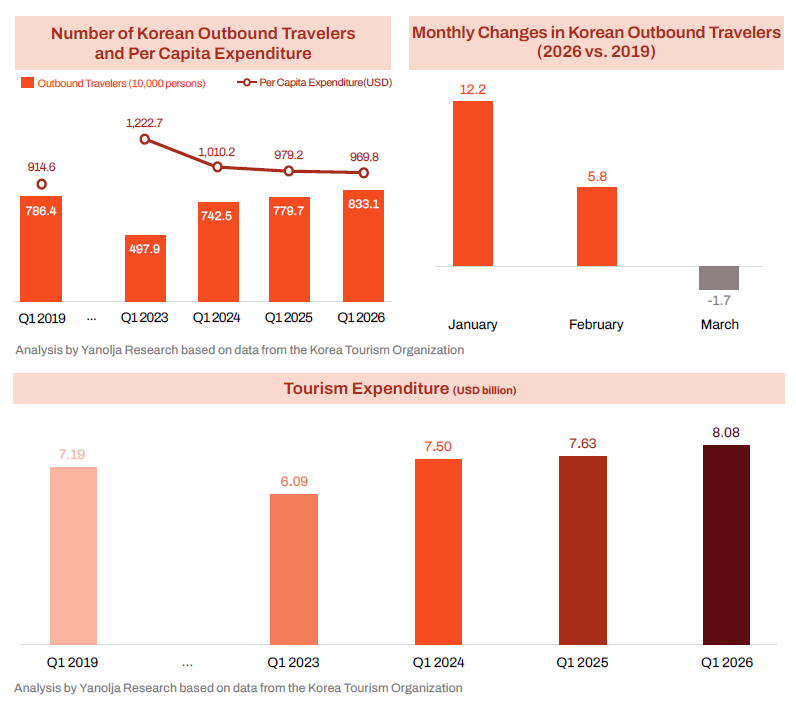
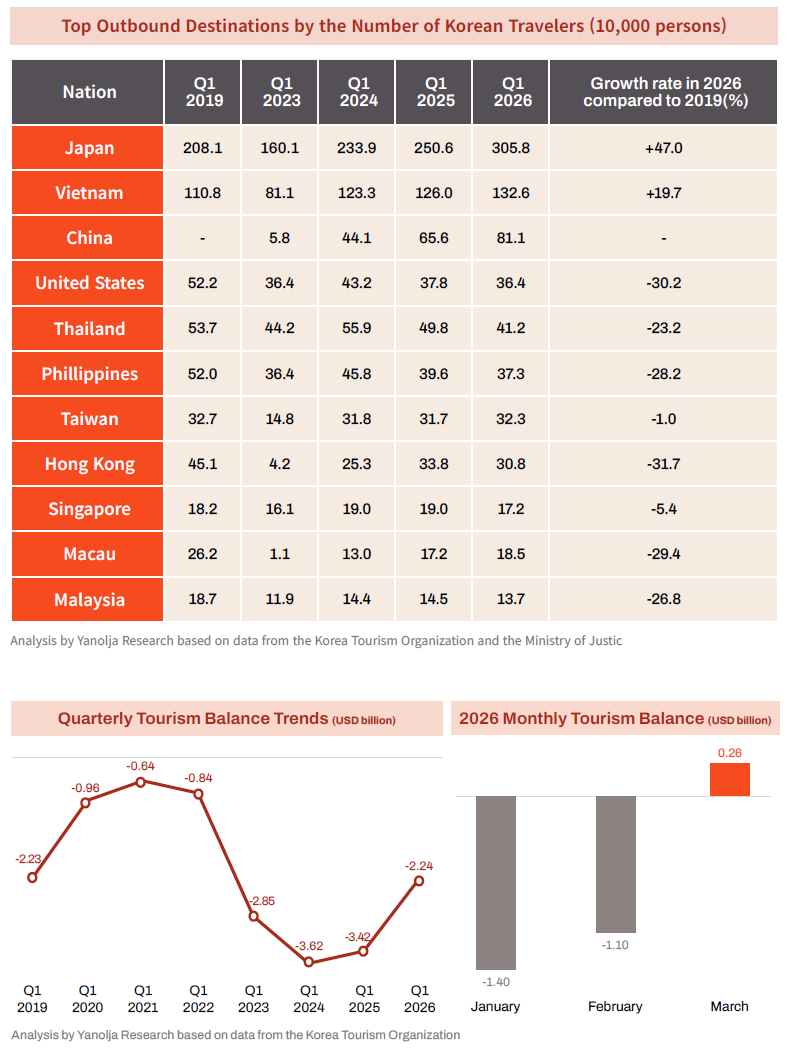
- In the first quarter of 2026, the number of outbound Korean travelers reached a total of 8.331 million, representing a 5.9% increase compared to the first quarter of 2019 (7.864 million) and breaking the all-time quarterly record. However, a closer look at the monthly trends reveals a distinct downward inflection point; the growth rate slowed down in January (+12.2%) and February (+5.8%) before turning into a 1.7% decline in March. This shift is analyzed as a contraction in overseas travel sentiment, driven by a combination of skyrocketing oil prices and airfares following the US-Iran war, alongside a prolonged high exchange rate environment.
- Amid rising cost pressures, there was a clear preference for closer, cost-effective destinations. In particular, visitors to Japan increased by 47.0% compared to 2019 to reach 3.058 million in Q1 2026, single-handedly driving the outbound market. Vietnam (1.326 million, +19.7%) and China (811,000), which continues its steady recovery, also provided robust support to the overall outbound demand.
- In contrast, other major destinations suffered sluggish performance and failed to recover to their 2019 levels. This downturn was evident in the United States (0.364M, -30.2%), Thailand (0.412M, -23.2%), the Philippines (0.373M, -28.2%), Hong Kong (0.308M, -31.7%), Macau (0.185M, -29.4%), and Malaysia (0.137M, -26.8%).
Tourism Expenditure
- The overall scale of tourism expenditures expanded as the increase in outbound travelers coupled with a rise in per-capita spending. Per-capita expenditure grew from $914.6 in the first quarter of 2019 to $969.8 in 2026. Furthermore, due to the impact of the high exchange rate—which averaged 1,469 KRW per USD in the first quarter—expenditures converted into Korean Won surged by approximately 38% compared to 2019. Consequently, total tourism expenditures for the first quarter reached a massive $8.08 billion.
Tourism Balance: Persistent Quarterly Deficit with a Dramatic Turnaround in March
- Despite the growth in tourism revenue driven by the surge in foreign visitors, total outbound expenditures still outpaced revenue, resulting in a tourism deficit of $2.24 billion for the first quarter of 2026. Although the size of this quarterly deficit has been gradually shrinking compared to Q1 2024 (-$3.62 billion) and Q1 2025 (-$3.42 billion), it remains stagnant at roughly the same level seen in 2019 (-$2.23 billion).
- However, the tourism balance achieved a dramatic turning point in March by recording a surplus of $260 million, marking the first positive balance in 11 years and 4 months. This turnaround is interpreted as a result of revenue offsetting expenditures; as geopolitical risks from the US-Iran conflict and the pressure of a surging exchange rate hit in March, the number of Korean outbound travelers flipped into a decline compared to 2019, while the influx of foreign tourists maintained its upward momentum. With external headwinds such as high exchange rates and rising airfares expected to persist into the second quarter, close attention is being paid to whether this monthly surplus can stabilize into a quarterly upward trend.
Impact Analysis of China's Travel Restrictions on Japan
- While the Korean tourism industry achieved a significant milestone in the first quarter of 2026 by turning a tourism balance surplus in March, it still faces the fundamental challenges of improving the inbound market structure and establishing a stable tourism balance. Amid these conditions, the ongoing repercussions of the China-Japan diplomatic conflict that erupted in November 2025 (hereafter referred to as "Han-il-ryeong") are reshaping the East Asian tourism landscape. This serves as a key external variable in exploring the possibility of mitigating the tourism trade imbalance in South Korea.
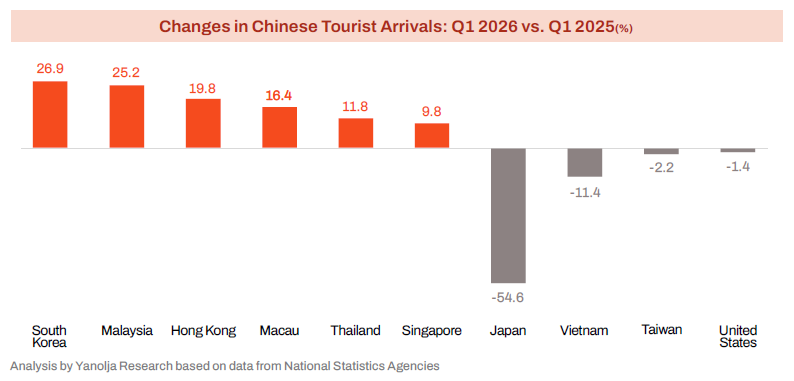
- The full-scale impact of China's travel restrions on Japan has led to a conspicuous plunge in Chinese tourists visiting Japan. The number of Chinese visitors to Japan had previously shown explosive growth, rising from 1.328 million in Q1 2024 to 2.365 million in Q1 2025. However, demand contracted sharply following the escalation of bilateral tensions in November 2025. Consequently, the number of Chinese tourists to Japan in Q1 2026 reached only 1.074 million, a steep decline of 54.6% year-on-year.
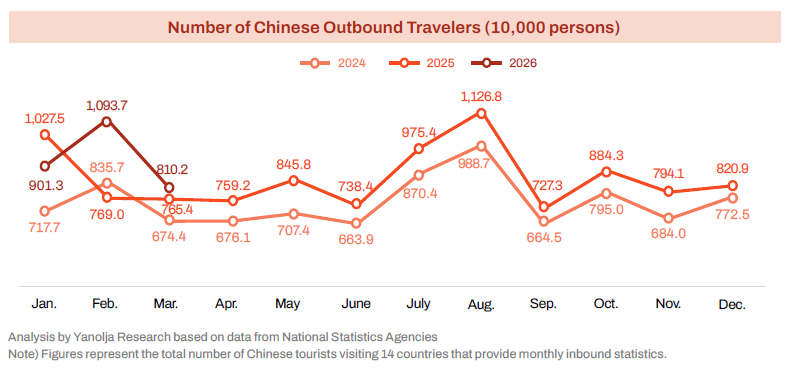
- Notably, despite the sharp drop in Japan-bound demand, the overall Chinese outbound market maintained a moderate growth trend. Although the growth pace slowed compared to the previous year’s steep increase (+15.0%), the total volume of Chinese outbound travelers in Q1 2026 reached 28.052 million, a 9.5% increase from the 25.619 million recorded in the same period last year. While monthly fluctuations were significant due to the timing of Chinese New Year holidays, the quarterly data suggests that Chinese demand for overseas travel remains robust.
- As the total volume of Chinese outbound travel remained steady while the Japan route—previously a primary destination—shrunk significantly, a "reflective benefit" emerged as diverted demand flowed into alternative nearby destinations like South Korea. In the first quarter of 2026, Chinese visitors to Korea reached 1.424 million, marking a 26.9% increase year-on-year and boosting Korea’s share within the Chinese outbound market from 4.4% to 5.1%. Notably, South Korea’s growth rate of 26.9% significantly outpaced the overall Chinese outbound average of 9.5%, as well as the performance of major Asian competitors such as Hong Kong (+19.8%) and Macau (+16.4%). These figures provide objective evidence that South Korea is substantially benefiting from the displacement of Chinese tourism demand caused by the travel restrictions on Japan.
 Prev
Prev  Back
Back 