
[PR] Yanolja Research Successfully Hosts Seminar on Global Festival Attractiveness Assessment
- Reg Date
- 2026.06.17
Yanolja Research Successfully Hosts Seminar on Global Festival Attractiveness Assessment
Introducing a New Visitor-Centric Evaluation Framework for 560 Festivals Worldwide
Yanolja Research (Director: SooCheong Jang), a research institute specializing in the travel and tourism industry, hosted the 2026 Global Festival Attractiveness Assessment seminar on June 8 at the International Conference Hall of the Seoul Global Center and unveiled for the first time the Global Festival Attractiveness Index (GFAI), also known as the Yanolja Festival Index, which compares and evaluates the competitiveness of major festivals around the world from a visitor perspective.
By analyzing what kinds of emotional experiences festivals provide to actual visitors and how those experiences diffuse across online platforms, Yanolja Research proposed a new framework that evaluates festivals not merely as local events or subsidiary elements of tourism destinations, but as independent units of tourism competitiveness.
Review of 1,436 Festivals Across 198 Countries; In-Depth Evaluation of 560 Festivals
This study was jointly conducted by Yanolja Research, Purdue University’s CHRIBA Research Institute, and the H&T Analytics Center at Kyung Hee University.
The research team established a global festival database covering 198 countries and conducted a pilot analysis of 1,436 festivals before selecting 560 festivals for in-depth evaluation. In particular, the study incorporated 14 major global languages, including English, Spanish, Japanese, and Korean, and applied a Transformer-based multilingual AI Sentiment Analysis model. Through this approach, the study reduced evaluation bias associated with specific language groups or Western-centric perspectives and more broadly reflected the authentic voices of global travelers and festival participants.
The Yanolja Festival Index Measures Both Attractiveness and Reputation
The Yanolja Festival Index consists of two core dimensions. The first is Festival Attractiveness, which measures the intensity of positive emotional responses toward a festival. The second is Festival Reputation, which evaluates how frequently a festival is mentioned and how widely it diffuses across different linguistic communities.
Based on these two dimensions, the research team further categorized festival competitiveness into three dimensions: Core Content Experience, Atmosphere & Emotion, and Operational Convenience & Infrastructure. More specifically, the framework incorporates ten indicators, including signature programs, performances, unique identity, on-site energy, cultural symbolism, facilities, crowd management, accessibility, and economic feasibility.
Delivering the first keynote presentation, SooCheong Jang, Director of Yanolja Research and Professor at Purdue University, explained the theoretical background and analytical methodology behind the development of the index and emphasized that “the competitiveness of festivals can no longer be evaluated solely by the number of on-site visitors.” Professor Jang added, “Today’s global festivals grow through a mechanism in which participants share the emotions and experiences they feel on-site through online platforms, which in turn stimulate travel intentions among global travelers. Festival attractiveness is transformed into global competitiveness only when the quality of experience is combined with emotional diffusion.”
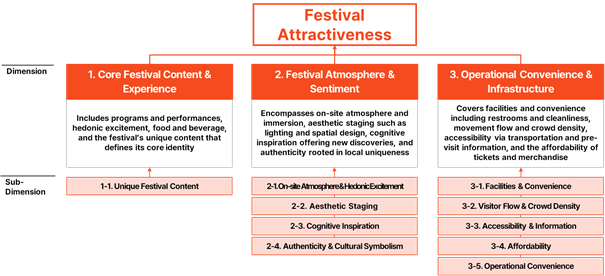
Figure: Components of the Yanolja Festival Index
Coachella Ranked No. 1 Globally: Strong Diffusion Power of Music Festivals Confirmed
Delivering the second keynote presentation, Professor Kyuwan Choi of the College of Hotel & Tourism Management at Kyung Hee University unveiled the inaugural global festival rankings based on the Yanolja Festival Index.
The Coachella Festival, one of the most representative music and arts festivals in the United States, ranked first overall in the 2026 Global Festival Attractiveness Index. Coachella received high evaluations for its overwhelming volume of mentions, Global Language Diversity, and strong brand recognition.
Japan’s Summer Sonic Festival and Rock in Japan Festival ranked second and third, respectively, while Spain’s Mad Cool Festival ranked fourth.
Music festivals occupied a significant share of the top positions, confirming that large-scale festivals centered on music and live performances possess strong diffusion power within the global social media environment.
Seven Japanese Festivals Enter the Global Top 20: Strong Performance Across Traditional and Contemporary Content
Japan demonstrated particularly strong performance in the rankings. The country placed seven festivals within the overall Top 20, including Summer Sonic, Rock in Japan, Awa Odori, Gion Matsuri, the Sapporo Snow Festival, Fuji Rock, and Sanja Matsuri.
Japanese festivals received consistently high evaluations not only in the music festival category but also in festivals based on traditional culture, seasonality, and regional identity. These results demonstrate that Japan has successfully developed festivals into competitive tourism content that integrates local culture with tourism experiences rather than treating them merely as events.
Waterbomb Seoul Ranked 16th: Demonstrating the Global Potential of Korean Participatory Festivals
Among Korean festivals, Waterbomb Seoul ranked 16th overall, securing a position within the Global Top 20. According to the analysis, Waterbomb Seoul generated strong positive emotional responses and diffusion power through its participatory content that combines live music performances with water-based activities, voluntary sharing among younger generations, and highly engaging on-site experiences. The findings suggest that in order for Korean festivals to remain competitive in the global market, experience-oriented content that encourages visitors to participate directly and voluntarily share their experiences is increasingly important, moving beyond observation-oriented events.
The Global Top 100 also included the Busan Fireworks Festival (34th), Boryeong Cherry Blossom Festival (58th), Jinhae Gunhangje Festival (78th), Ultra Korea (87th), and Seoul Lantern Festival (90th). These festivals shared common characteristics, including strong visual and sensory experience elements and the ability to encourage visitor participation and on-site immersion. By contrast, several traditional cultural festivals and regional specialty festivals showed relatively limited multilingual diffusion across global social media compared with their domestic attendance and regional recognition. The findings indicate that Korean regional festivals must strengthen the international communicability of their content and their digital diffusion strategies in order to attract global travelers.
Experts from Industry, Academia, Research, and Government Discuss Strategies for Advancing Global Festival Competitiveness
The panel discussion that followed was moderated by Professor SooCheong Jang and focused on practical solutions for strengthening the competitiveness of global festivals. Panelists included Jinho Yoo of the Korea Tourism Organization, Shinwook Son of the Korea Culture & Tourism Institute, Professor Yoonjae Nam of Kyung Hee University, Changhyo Kwon, Vice President of EZPMP Co., Ltd., and Youngil Park, Director of DXentric Co., Ltd.
The panelists agreed that the key to global festival competitiveness lies not in simply increasing scale, but in designing experiences that visitors can actively participate in, become emotionally immersed in, and voluntarily share with others.
Vice President Changhyo Kwon explained that music festivals have evolved beyond simple concert viewing into platforms for self-expression and community experiences. He emphasized that improvements in basic infrastructure, including transportation, restroom facilities, and crowd management, must accompany attractive content.
Professor Yoonjae Nam noted that the competitiveness of Japanese cultural heritage festivals stems from community participation and the everyday nature of local culture. He argued that visitors should be able not merely to observe culture but to enter and experience living local culture, and suggested that Korean festivals should also create structures that organically connect local residents, visitors, and festival content.
In the Era of Generative AI, Festival Promotion Must Shift from Search Visibility to Diffusion Design
The discussion also addressed promotional and digital diffusion strategies.
Jinho Yoo emphasized that strategies encouraging voluntary promotion by visitors are essential for converting global interest in K-pop and K-culture into actual festival visitation.
Youngil Park noted that as generative AI and zero-click search environments become increasingly prevalent, festival promotion must move beyond traditional search visibility approaches and instead design the entire pathway through which content is discovered, recommended, and shared.
From the perspectives of economic impact and sustainability, Shinwook Son emphasized that festivals must be integrated with related industries—including food and beverage, accommodation, transportation, and shopping—in order to generate tangible contributions to local economies. Festivals should not merely attract large crowds but should also drive local spending, longer stays, and repeat visitation.
The Standard of Festival Competitiveness Is Shifting from Visitor Numbers to the Intensity of Experience and the Power of Emotional Diffusion
The seminar demonstrated that the benchmark for global festival competitiveness is shifting from “how many people attended” to “how powerful an experience was created and how widely it diffused.” In particular, the findings confirmed that while Korean festivals possess strong assets in K-culture, music, gastronomy, and local culture, strategies for transforming these assets into experiences that global travelers can understand, participate in, and share remain insufficient.
Professor Jang stated, “The success or failure of global festivals now depends not on the scale of the event itself, but on the intensity of the experience and the power of emotional diffusion. Korean festivals must redesign their unique cultural assets into participatory content that resonates with global audiences and actively communicate within multilingual digital environments.”
Professor Choi added, “Waterbomb Seoul’s entry into the Global Top 20 demonstrates that Korean festivals are fully capable of competing in the global market. Going forward, regional festivals must combine local identity, participatory content, operational infrastructure, and digital diffusion strategies in order to attract global travelers.”
Yanolja Research plans to publish the Global Festival Attractiveness Index annually to continuously track changes in global festival trends and the competitiveness of major festivals around the world. Through this initiative, the institute aims to provide empirical evidence for establishing global expansion strategies for Korean festivals and promoting regional tourism development.
Detailed results and analytical reports for the 2026 Global Festival Attractiveness Index are available on the official Yanolja Research website.
 Prev
Prev  Back
Back 