
[Press Release] Busan Ranked No.1 in Overall Satisfaction Among Chinese Tourists
- Reg Date
- 2026.05.28
Busan Ranked No.1 in Overall Satisfaction Among Chinese Tourists Across Major Asian Cities
Seoul Confirms Strong Tourism Pull Factors Through K-Shopping and K-Content
Busan ranked first overall among major Asian tourism cities in a comparative analysis of satisfaction levels evaluated by Chinese tourists, the largest inbound visitor segment to South Korea, surpassing both Tokyo and Singapore. Seoul, meanwhile, was found to possess strong tourism pull factors driven by K-shopping and K-content consumption.
Yanolja Research, a travel and tourism research institute led by Director Soocheong Jang, published its latest insights report, “Seoul and Busan as Experienced by Chinese Tourists: A Comparative Analysis of Experience Structures Across Major Asian Cities,” on May 19. Reflecting the ongoing shift in the Chinese outbound tourism market toward “experiential consumption,” the report diagnoses the experience structures of Seoul and Busan—the two core pillars of Korean tourism—from the perspective of Chinese tourists.
The study analyzed 11,270 Chinese-language travel posts uploaded to the social media platform Xiaohongshu and 18,694 Chinese-language reviews collected from China’s largest OTA platform, Ctrip. Through this dataset, the report comparatively examined both the “expected experiences” and the “actual satisfaction experiences” associated with eight major Asian tourism cities: Seoul, Busan, Tokyo, Osaka, Bangkok, Singapore, Hanoi, and Kuala Lumpur.
■ Seoul as a City of “What to Buy”, Busan as a City of “How to Experience”
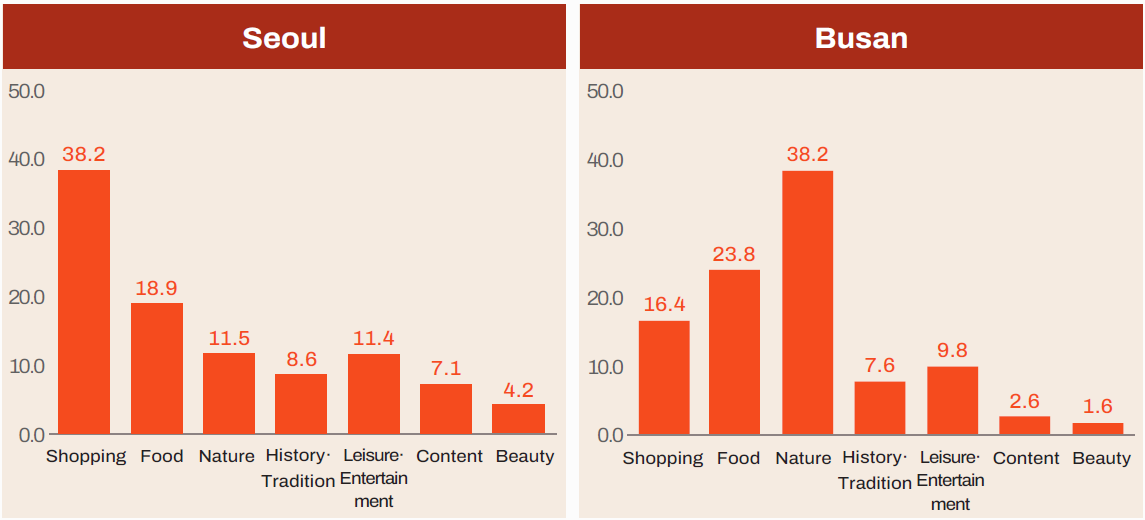
The analysis found that Seoul recorded an overwhelmingly high proportion of shopping-related mentions at 38.2%. Unlike Tokyo—where shopping experiences are centered around exploring commercial districts such as Shinjuku, Shibuya, and Ginza (43.0%)—Seoul demonstrated a “purpose-driven shopping structure” focused on price advantages and targeted purchases, including duty-free shopping, tax refunds, and value-for-money consumption.
The report also found that Seoul’s K-content tourism experiences remain heavily concentrated around “fandom-driven visitation” linked to specific entertainment agencies and concerts, including SM, HYBE, and YG. The findings suggest that Seoul needs strategies capable of transforming such fandom-centered visits into immersive experiential spaces and long-stay tourism content.
Regarding these findings, Yejin Ahn, Senior Researcher at Yanolja Research, stated, “As Chinese tourists increasingly shift toward experience-oriented consumption, Seoul’s shopping structure centered primarily on products and pricing faces the risk of becoming substitutable through digital commerce channels and cross-border online shopping.” She added, “K-beauty should evolve beyond simple cosmetics purchases into experiential wellness programs such as skin analysis, personal color consulting, and makeup classes. Likewise, fandom-based K-content should be transformed into permanent experiential spaces where visitors can directly experience and enjoy Korean content on-site, thereby enhancing overall travel satisfaction.”
Busan, by contrast, demonstrated a distinctly different experience structure from Seoul. Nature-related mentions accounted for the largest share at 38.2%, followed by food (23.8%) and shopping (16.4%). This indicates that Busan is perceived by Chinese tourists as a “multidimensional experiential destination” integrating marine scenery, relaxation, gastronomy, and leisure experiences. In particular, marine resources such as Haeundae, Gwangalli, Cheongsapo, and Songdo Beach were frequently mentioned alongside experiential elements including the Blue Line Beach Train, night views, seafood, and market food culture. The findings suggest that Busan’s natural environment is consumed not merely as scenery to observe, but as “participatory experiential content” involving riding, walking, dining, and photographing.
Share of Mentions Across the Seven Core Experience Dimensions in Seoul and Busan (Unit: %)
■ “Busan Ranked First in Overall Satisfaction”— A Successful Model of an Experiential Marine Tourism City
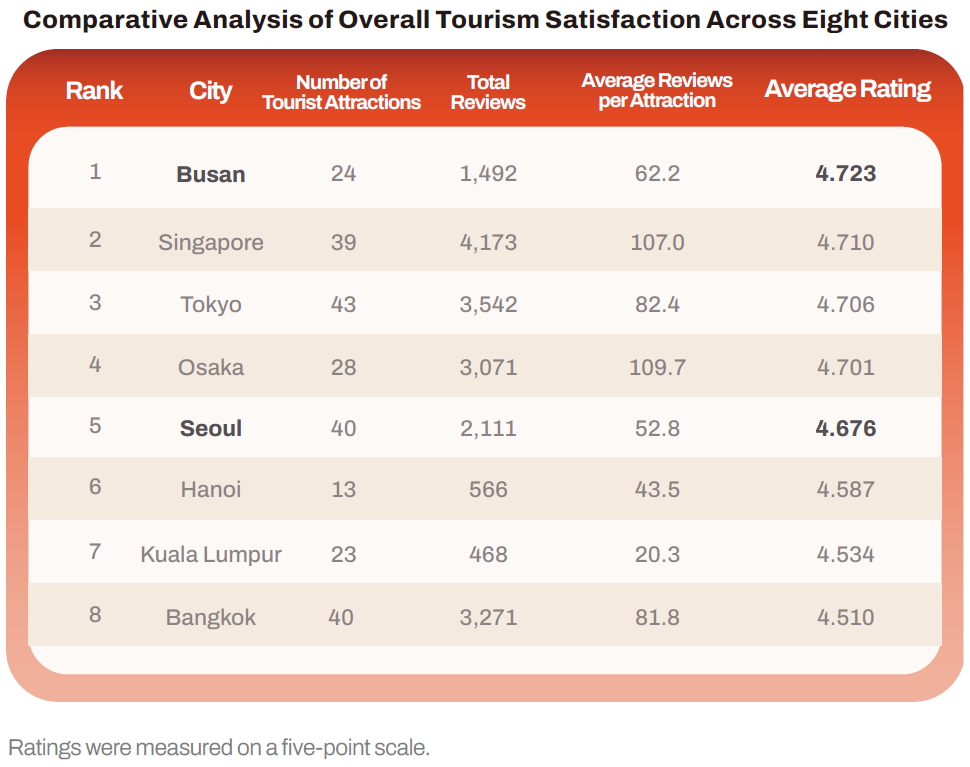
Busan’s competitiveness also stood out in the post-visit satisfaction analysis based on Chinese tourist reviews. In the comparative analysis of overall tourism satisfaction across the eight cities, Busan ranked first with an average score of 4.723 out of 5. Singapore (4.710), Tokyo (4.706), and Osaka (4.701) followed behind, while Seoul ranked fifth with a score of 4.676. Busan also ranked first in the entertainment category with a score of 4.743.
Kyuwan Choi, Professor at Kyung Hee University, commented, “Busan’s strength does not simply lie in possessing marine scenery. Its real competitiveness comes from successfully transforming its coastal resources into a complete experiential structure by organically integrating mobility, panoramic views, nightscapes, gastronomy, photography, and leisure activities.” He added, “Tourism competitiveness is determined not by the mere possession of resources, but by how effectively those resources are embedded into travelers’ memories. Busan represents a highly meaningful case of transforming marine resources into participatory experiential tourism content.”
■ Seoul’s Challenge: Enhancing Experiential Density & Busan’s Challenge: Evolving into a Regional Tourism Hub
The analysis also identified clear strategic challenges that both cities must address for long-term growth.
Although Seoul possesses strong initial visitation drivers through K-shopping, K-beauty, and K-content, it received relatively low evaluations in the categories of natural landscapes and historical-cultural tourism. In particular, Seoul ranked last among the eight cities in satisfaction for historical and cultural attractions, recording a score of 4.588. The report indicates that despite Seoul possessing abundant tourism assets such as Gyeongbokgung Palace, Deoksugung Palace, the Han River, Namsan, and hanok villages, these resources have yet to be sufficiently transformed into immersive experiential programs capable of encouraging longer stays and deeper engagement among Chinese tourists.
Busan, meanwhile, achieved the highest scores in both overall satisfaction and entertainment satisfaction. However, the report identified its relatively weak foundation in historical and cultural tourism resources as a potential long-term structural risk. The report explains that Busan must expand the experience-oriented planning capabilities proven successful in marine tourism into historical and cultural storytelling. It further recommends that Busan strengthen connections with nearby destinations rich in historical and natural resources—such as Gyeongju, Geoje, and Tongyeong—to evolve into a broader southeastern regional tourism hub capable of generating stronger repeat visitation demand.
■ Seoul and Busan as Structurally Complementary Axes of Korean Inbound Tourism
The report emphasizes that Seoul and Busan should not be viewed as competing cities, but rather as “structurally complementary” pillars of Korea’s inbound tourism industry. According to the report, Seoul functions as the “capital of attraction,” where tourists admire and consume Korea through K-shopping and K-content, while Busan serves as the “capital of experience,” where visitors physically experience and emotionally remember Korea through marine leisure and local gastronomy. The report argues that Korea’s identity as a multidimensional tourism nation can only be fully realized when the distinct experiential assets of the two cities are organically connected.
Soocheong Jang, Director of Yanolja Research and Professor at Purdue University, stated, “The paradigm of global tourism competition has already shifted rapidly from ‘what resources a destination possesses’ to ‘how experiences are designed and delivered to travelers.’” He added, “When the Seoul–Busan KTX corridor is strategically developed as a tourism route connecting Seoul’s K-culture and shopping experiences with Busan’s marine and leisure tourism, Korea will be able to position itself not merely as a single-city destination, but as Asia’s leading ‘multidimensional experiential tourism country.’”
The full report is available on the Yanolja Research website.
 Prev
Prev  Back
Back 