
[Press Release] Record High Inbound Tourists in 2026 Q1
- Reg Date
- 2026.05.15
Record High Inbound Tourists in Q1… March Tourism Balance Hits Surplus for the First Time in 11 Years and 4 Months
Structural Shift Underway with Surging Arrivals at Regional Airports and Growth in Medical Tourism
Yanolja Research (Director: SooCheong Jang), a travel and tourism industry research institute, released a report titled "Analysis of Korea’s Inbound and Outbound Tourism Performance for Q1 2026" on May 14.
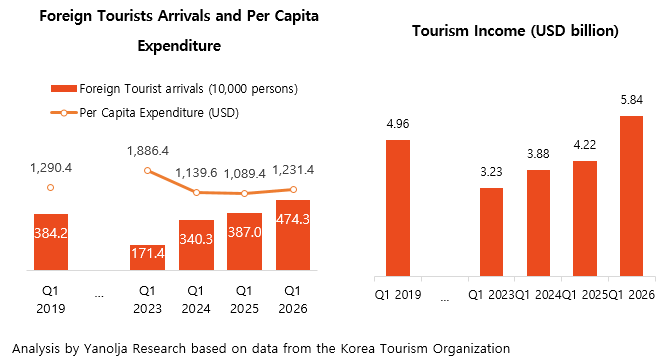
According to the report, the number of inbound foreign tourists reached 4.743 million in the first quarter of 2026, marking an all-time quarterly high. This represents an overwhelming growth rate of 22.6% year-on-year and a 23.4% increase compared to the same period in 2019. Furthermore, the report highlighted a significant turning point as the tourism balance in March recorded a $260 million surplus, marking the first shift into the black in 11 years and 4 months.
Inbound Tourism Accelerates Global Diversification: Surge in Local Airport Entries and 5.8-fold Jump in Medical Tourism
In the first quarter of 2026, the number of foreign tourists visiting Korea reached 4.743 million, breaking an all-time record. While the Asian market exceeded 2019 levels by 21.6%, long-haul markets such as the Americas (+55.1%), Europe (+30.7%), and Oceania (+67.1%) also showed explosive growth, accelerating the global diversification of the inbound market. By country, China solidified its position as the top market with 1.424 million visitors, surpassing 2019 performance by 6.8% for the first time since COVID-19. Japan (940,000, +18.3%) and Taiwan (543,000, +93.1%) also maintained high growth rates.
The diversification of entry routes was also notable. The number of visitors entering through local airports reached approximately 850,000, a 40.1% surge compared to 2019. This is more than double the growth rate of the Seoul metropolitan area (19.0%), confirming that inbound tourism is evolving into a regionally distributed demand. However, the report pointed out that the impact on Q2 inbound tourism demand must be monitored, as international flight cancellations have been occurring in April and May following the outbreak of the U.S.-Iran war in late February.
Qualitative Shift in Tourism Revenue: Medical and Wellness Tourism as a Breakthrough Amid Duty-Free Slump
Driven by the increase in foreign visitors, total tourism revenue reached $5.84 billion, a 17.8% increase from 2019. However, the expenditure per person was $1,231.4, falling short of the $1,290.4 recorded in 2019. The primary cause of the decline in average spending is the slump in duty-free shops. Compared to the same period in 2019, the number of duty-free customers plummeted from 4.47 million to 2.94 million, and the revenue per person dropped from $914.3 to $544.2. Consequently, total duty-free revenue shrank from $4.09 billion in 2019 to $1.6 billion in 2026. Additionally, the 10.9-fold increase in cruise passengers (167,000), who typically have shorter stay durations and lower spending, acted as downward pressure on average expenditure.
On the other hand, spending per person showed a recovery trend, increasing by 13% year-on-year. Notably, medical tourism spending recorded 491.1 billion KRW, a 5.8-fold increase from 84.15 billion KRW in Q1 2019. The report evaluated that high-value-added medical tourism demand is establishing itself as a breakthrough for improving profitability.
SooCheong Jang, Director of Yanolja Research, stated, "While the duty-free revenue model, which previously relied on mass shopping by group tourists, is facing its limits, local-centric experiential consumption—such as high-value medical and wellness tourism—is growing explosively." He diagnosed this as "a very positive signal showing that the Korean inbound market has entered a structural transition period toward improving profitability through qualitative transformation beyond mere quantitative expansion."
Outbound Tourism: Hits Record High, but Shifts to Decline in March Amid Concentration on Ultra-Short Haul
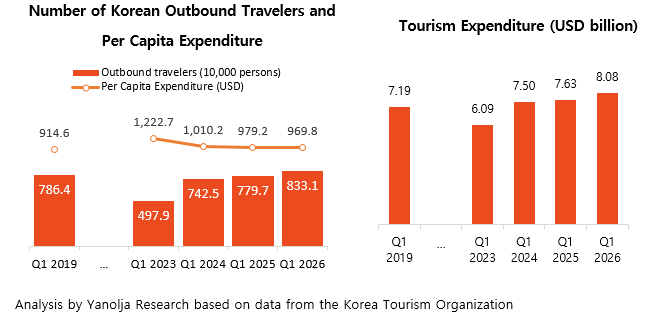
In the first quarter of 2026, the number of outbound Korean travelers reached 8.331 million, a 5.9% increase compared to 2019, marking a new all-time high. However, monthly trends showed a downward inflection point. Growth slowed from +12.2% in January to +5.8% in February, before turning negative at -1.7% in March. This is analyzed as a result of dampened overseas travel sentiment due to surging oil prices and airfares following the U.S.-Iran war, combined with a prolonged high exchange rate environment averaging 1,469 KRW/USD in the first quarter.
Under pressure from rising costs, destinations became heavily concentrated on "short-haul, budget-friendly" trips. While visitors to Japan skyrocketed to 3.058 million (+47% compared to 2019), other major destinations such as the U.S. (-30.2%), Thailand (-23.2%), the Philippines (-25.9%), Hong Kong (-31.7%), and Macau (-29.4%) remained sluggish, failing to recover to their 2019 levels.
In terms of tourism spending, the total consumption expanded as both the number of outbound travelers and the expenditure per person increased. The per capita expenditure rose from $914.6 in Q1 2019 to $969.8 in 2026. Due to the impact of the high exchange rate, per capita spending in KRW terms surged by approximately 38% compared to 2019. Consequently, total tourism expenditure in the first quarter of 2026 reached $8.08 billion.
Professor Kyuwan Choi of the College of Hotel and Tourism Management at Kyung Hee University analyzed, "The shift to a decline in outbound demand seen in March proves the direct impact that macroeconomic pressures—such as high exchange rates and rising airfares—have on travel sentiment." He added, "The polarization phenomenon, where consumers looking to travel abroad within a limited budget choose 'ultra-short-haul, budget-friendly trips' like Japan or Vietnam, is highly likely to establish itself as a mega-trend in the outbound market for the time being."
Q1 Tourism Balance Records $2.2 Billion Deficit, Shifts to Surplus in March for the First Time in 11 Years and 4 Months
The tourism balance for the first quarter of 2026 recorded a deficit of $2.24 billion. While the deficit margin is gradually improving from $3.62 billion in 2024 and $3.42 billion in 2025, it remains at a level similar to 2019 (-$2.23 billion). However, a turning point was reached in March as the tourism balance recorded a surplus of $260 million—the first in 11 years and 4 months—driven by a decline in outbound travel demand among Korean nationals while inbound foreign tourist numbers continued to rise.
Inbound Chinese Tourists Increase 26.9% Year-on-Year Amid China-Japan Tensions
Meanwhile, the report analyzed that the aftermath of the diplomatic conflict between China and Japan (hereinafter referred to as the "Korea-Japan Decree") that occurred in November 2025 continues to act as a major variable in the Korean tourism market. Due to China's travel restrictions to Japan, the number of Chinese visitors to Japan in the first quarter of 2026 plummeted by 54.6%, falling from 2.365 million in the same period last year to 1.074 million.
Conversely, the total volume of overseas travel by Chinese citizens maintained steady growth, increasing 9.5% from 25.619 million to 28.052 million.
During the same period, Chinese visitors to Korea reached 1.424 million, a 26.9% increase year-on-year, and South Korea's market share within the Chinese outbound market rose from 4.4% to 5.1%. Notably, Korea's growth rate for Chinese tourists (+26.9%) significantly outperformed major Asian competitors such as Hong Kong (+19.8%) and Macau (+16.4%).
Suckwon Hong, Senior Researcher at Yanolja Research, stated, "The growth rate of Chinese tourists to Korea has exceeded both the overall Chinese outbound growth rate and that of major Asian competitors." He added, "It appears that Korea is reaping a degree of reflective benefit from the China-Japan conflict. The large-scale Chinese tourism demand that was headed for Japan has been diverted to Korea as a nearby alternative, which is evaluated to have contributed to the tourism balance shifting to a surplus in March."
 Prev
Prev  Back
Back 