
[Press Release] Record-Breaking Foreign Tourists to Korea Last Year... Yet Tourism Deficit Hits $10.
- Reg Date
- 2026.02.26
Record-Breaking Foreign Tourists to Korea Last Year... Yet Tourism Deficit Hits $10.7 Billion
Will the "Anti-Japan Ban" from China be a Turning Point for Improving the Balance?
The tourism industry research institute Yanolja Research (Director Jang Soo-chung) released the "2025 Korea Inbound and Outbound Tourism Performance Analysis" report on February 24. According to the report, although the number of foreign tourists visiting Korea reached a record high of 18.93 million last year, the tourism balance recorded a deficit of $10.7 billion, marking the third consecutive year of deficits exceeding $10 billion. This indicates a persistent structural imbalance where quantitative growth in inbound tourism does not translate into increased profitability.
Inbound Tourism: "Record High" Reached... "Mass Shopping" Fades as "Medical & Experience" Rise
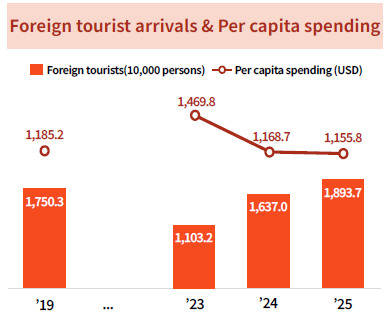
In 2025, the number of foreign visitors to Korea surpassed the 2019 level (17.5 million) by 8.2%, setting a new record. While the Asian market fully recovered beyond 2019 levels, long-haul markets such as the Americas (+45.8%) and Europe (+15.3%) saw explosive growth, signaling a turning point for the global diversification of the Korean inbound market.
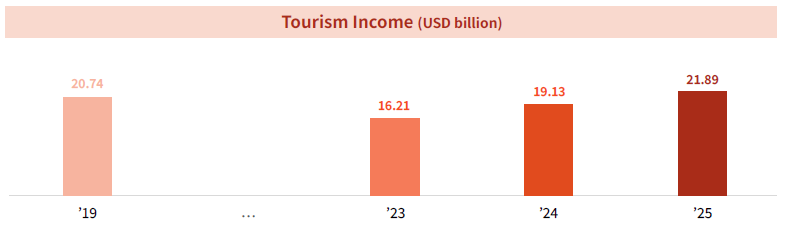
Driven by the surge in tourist numbers, total tourism revenue in 2025 reached $21.89 billion, a 5.5% increase from 2019. However, per capita expenditure was $1,155.8, falling short of the $1,185.2 recorded in 2019.
The report identified the slump in the duty-free shop business model—which previously relied on "mass shopping" by group tourists—as the primary cause for the decline in profitability. Total duty-free sales plummeted from $17.84 billion in 2019 to $6.56 billion in 2025. Additionally, the number of cruise tourists, who typically have short stays and low spending, increased more than fivefold compared to 2019, putting further downward pressure on average spending.
However, per capita spending showed signs of a rebound in the second half of the year. Notably, medical tourism spending skyrocketed 5.3 times compared to 2019, reaching approximately 2.08 trillion KRW. The report diagnosed that "locally-engaged high-end experience goods," such as medical tourism, are becoming a new core driver to offset the duty-free slump and boost per capita spending.
Outbound Tourism: Nearing 30 Million... "Ultra-Short Distance" Focus Amidst "Value Consumption"
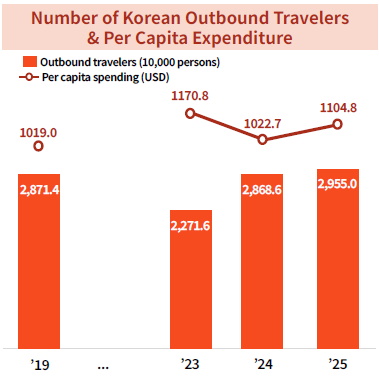
The number of Korean outbound travelers also hit a record high of 29.55 million in 2025, signaling that overseas travel has become a routine part of life. A trend of "practical travel"—choosing nearby countries to reduce airfare costs amid high inflation—was prominent. This led to an "ultra-short distance" concentration, with visitors to Japan surging 69.4% compared to 2019, reaching 9.46 million. In contrast, major destinations like the U.S. (-28.3%) and the Philippines (-32.3%) saw a significant decline, failing to close the gap with 2019 figures.
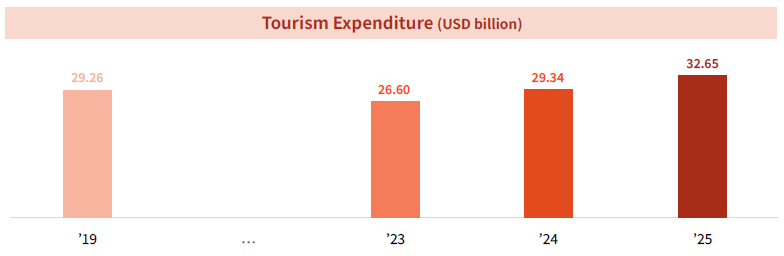
In terms of spending, total overseas consumption rose sharply due to the record number of departures combined with an increase in per capita spending. Per capita expenditure rose from $1,019.0 in 2019 to $1,104.8 in 2025. Due to the impact of high exchange rates, per capita spending in KRW jumped by more than 30% compared to 2019. This reflects a "value consumption" pattern where travelers invest the budget saved on transportation into local gourmet dining and shopping experiences. Consequently, total tourism expenditure reached $32.65 billion in 2025.
Three Consecutive Years of $10 Billion+ Deficits: Fears of Chronic Structural Imbalance
While both inbound and outbound tourist numbers reached record highs, the 2025 tourism balance recorded a $10.76 billion deficit. This is the result of a conflicting consumption structure: a decrease in inbound unit prices and an expansion in outbound spending. Concerns are growing that if a qualitative shift to increase the profitability of inbound tourism is not promptly accompanied by simple quantitative expansion, this chronic deficit and structural imbalance may become permanent.
Opportunity for Improvement via China’s "Anti-Japan" Sentiment
The report analyzed that the diplomatic conflict between China and Japan, which flared up in November 2025, has emerged as a strategic variable to improve the imbalance in Korea's tourism market. Following China's travel restrictions on Japan, the number of Chinese tourists to Japan in December plummeted by 45.3% year-on-year. While the diverted demand did not immediately shift elsewhere, the number of Chinese visitors to Korea exceeded those to Japan in December, suggesting that Korea is partially benefiting from the situation.
"Considering the time lag for switching destinations, the effect of demand shifting from Japan to Korea will become clearer in the first quarter of 2026, which includes the Lunar New Year holiday in February," said Hong Seok-won, Senior Researcher at Yanolja Research. He added, “If an influx of high-spending Chinese demand is confirmed, it will serve as a significant turning point for improving the tourism deficit by pulling up the currently lowered per capita expenditure.” The full report is available on the Yanolja Research website.
 Prev
Prev  Back
Back 