
Local airports stuck in a deficit quagmire must break out of their role as mere “outbound terminals
- Reg Date
- 2026.02.13
Local airports stuck in a deficit quagmire must break out of their role as mere “outbound terminals.”
Strategic opening of ‘Golden Slots’ to foreign carriers and developing airports as ‘Tourism Anchors’
As the concentration of foreign tourists in the Seoul metropolitan area intensifies, a new analysis suggests that South Korea’s chronically deficit-ridden regional airports must be redefined. They should shift from being simple transportation hubs to becoming "strategic anchors for regional tourism." In particular, the success of Japan’s national policy to revitalize regional airports indicates that results are only achieved when the central government’s "aviation support" is combined with local governments’ "tourism content."
On the 3rd, Yanolja Research (Director: SooCheong Jang) released a report titled "Opening the Gate to Regional Tourism: How Japan Turned Regional Airports into Inbound Engines" The report analyzes the Japanese government’s strategy and provides specific policy implications applicable to South Korea.
Japan’s “Inbound Tourism Support Airports” that revived regional hubs: airfare support is a means—within-region “connectivity” is the key
According to the report, Japan established the Tourism Vision to Support the Future of Japan in 2016 and set the dispersion of foreign tourists to regional areas as a national priority. Beginning in 2017, Japan designated 27 regional airports as “Inbound Tourism Support Airports” and rolled out support measures to attract foreign carriers, including: ▲discounting international landing fees by 50% or more ▲improving airport readiness (CIQ, ground handling, etc.) ▲joint support by relevant ministries and agencies.
What stands out is that Japan’s success did not end at simply “opening air routes.” The report identifies a shared trait among airports that received the top (S) grade in evaluations by Japan’s Ministry of Land, Infrastructure, Transport and Tourism: the “design of the post-arrival experience.” In other words, airports pursued foreign-carrier attraction while simultaneously focusing on “how tourists move and spend after landing.”
In Kyushu, Saga Airport significantly improved what many tourists cite as their biggest frustration—“transport inconvenience”—by launching a new express bus linking the airport and downtown and introducing a bold “1,000-yen rental car” program. As a result, the number of inbound foreign visitors doubled in just two years after implementation. In Shikoku, Matsuyama Airport saw the local government sign an agreement with an overseas LCC (low-cost carrier) to share load-factor risk, while a regional DMO led overseas marketing and product development in parallel—achieving roughly 200% growth in foreign guest nights in 2024 compared with pre-pandemic levels.
Figure. Tourism performance of major Japanese local governments
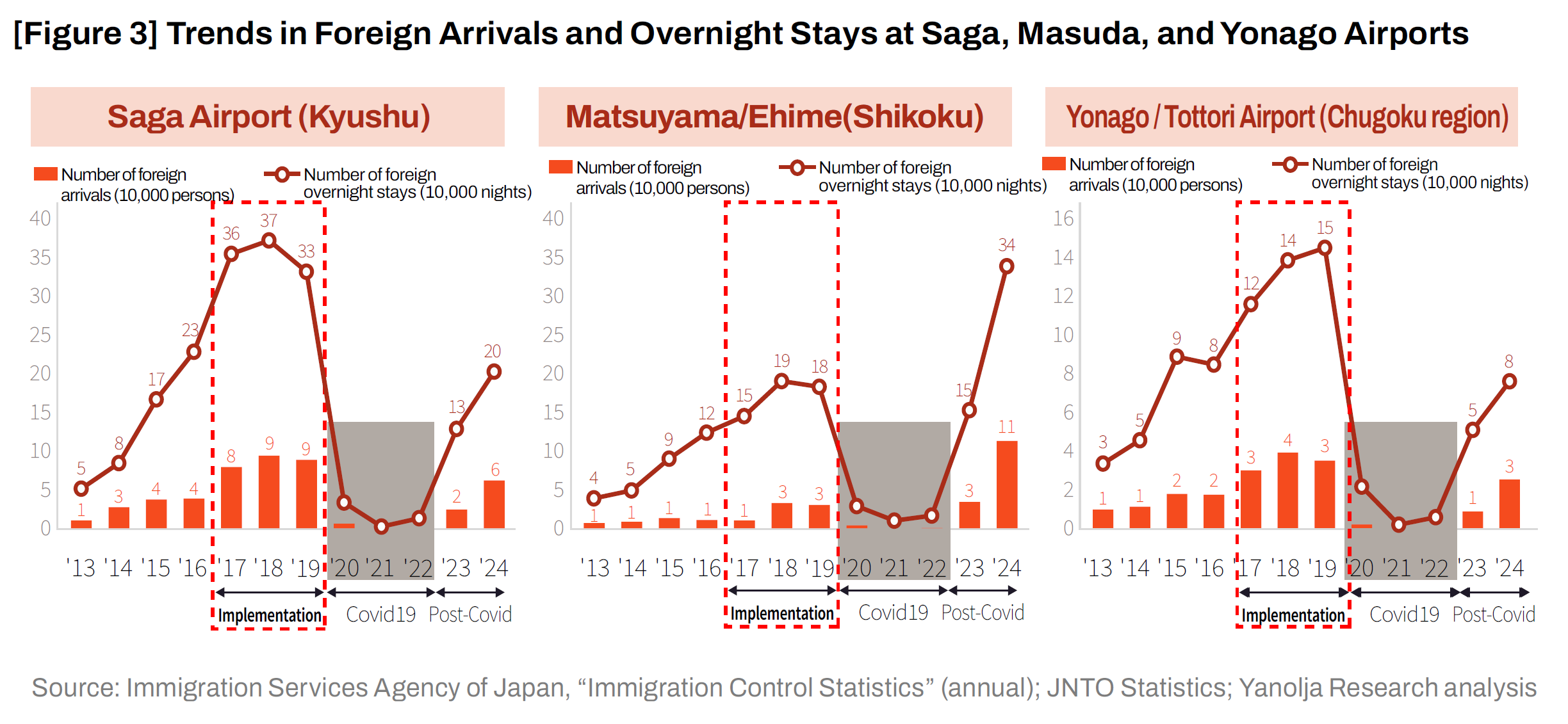
Senior Researcher Deachull Seo of Yanolja Research said, “Japan’s Inbound Tourism Support Airport program played a ‘pump-priming’ role by lowering the barriers to launching international routes through landing-fee reductions and facility support, but the real results were created in the phase that followed.” He added, “The core point is that successful airports leveraged national support and then, with local governments taking the lead, built a ‘complete travel experience after route launch’—including transport improvements and designing in-region travel flows for longer stays.”
Korean airports reduced to domestic “outbound terminals”… prime “golden slots” must be strategically allocated for foreign carriers
By contrast, the report argues that Korean airports remain preoccupied with handling outbound demand—Koreans traveling overseas. It points to a structural contradiction: even when foreign airlines seek to enter Korea’s regional airports, high-profit “golden time” slots are already occupied by national carriers targeting domestic outbound demand, creating a high barrier to entry.
The report recommends an urgent shift in regional airports’ “business constitution” toward becoming inbound gateways. As solutions, it proposes: ▲using available slots at regional airports—such as Daegu Airport—as a “strategic resource” to attract foreign carriers ▲establishing a shared accountability structure for policy goals through matching funds between local and central governments ▲building an integrated transfer network linking Incheon Airport (gateway) and regional airports (hubs).
Professor Kyuwan Choi of Kyung Hee University’s College of Hotel and Tourism Management said, “Korea’s aviation market is heavily skewed toward outbound demand led by national carriers, which creates strong structural constraints on attracting foreign carriers to expand inbound tourism.” He emphasized, “Beyond simple subsidies, bold policy incentives are needed—such as prioritizing the allocation of attractive slots to foreign carriers. At the same time, local governments must recognize airports as ‘economic anchors’ that can prevent regional decline, and work with DMOs to generate real demand.”
Through this report, Yanolja Research stressed that revitalizing regional airports is not merely an infrastructure issue, but a core strategy for addressing regional decline by connecting inbound tourists’ “movement–stay–spending.” The analysis concludes that only when airports are combined with distinctive local tourism content can they evolve into hubs that prevent regional extinction and invigorate domestic demand.
The full report can be found on the Yanolja Research website.
 Prev
Prev  Back
Back 