
[Press Release] Annual KRW 14 Trillion Tourism Deficit: An Urgent Need to Fix a “Leaking Bucket”
- Reg Date
- 2026.02.03
Annual KRW 14 Trillion Tourism Deficit: An Urgent Need to Fix a “Leaking Bucket”
Competing with “Irreplaceable Appeal,” Not Appeals to Patriotism
Foreign tourist arrivals to South Korea are projected to surpass 20 million for the first time in history in 2026. Yet the number of Koreans traveling abroad this year is expected to reach around 30 million, creating a gap of 10 million travelers. As a result, the tourism balance deficit—estimated at roughly USD 10 billion (KRW 14.5 trillion)—is likely to persist.
In a recent report titled “Measures to Address Korea’s Inbound–Outbound Tourism Imbalance: Turning the Tourism Deficit into Domestic Economic Vitality,” Yanolja Research (President: SooCheong Jang) likens this structural imbalance to a “leaking bucket,” noting that dollars earned through exports such as semiconductors and automobiles continue to flow overseas in the form of experience-driven consumption.
Deficits Persist Despite Rising Inbound Tourism: A Structural Gap of 10 Million Travelers
According to the report, since the endemic phase, outbound travel demand among Koreans has concentrated not domestically but in Japan and Southeast Asia. Even in 2019, outbound travel (28.71 million) far exceeded inbound travel (17.5 million), a pattern likely to repeat in 2026. Although foreign arrivals are increasing, Koreans’ overseas spending is growing faster, entrenching the tourism deficit.
Deachul Seo, Senior Researcher at Yanolja Research, commented: “This is not a problem that can be solved simply by strengthening inbound attraction policies. The fact that outbound growth is outpacing inbound recovery is a clear signal of declining competitiveness in domestic tourism products and services.”
“Even Half the Price Feels Expensive”: Consumers’ Cold-Blooded Valuation
Consumer perceptions revealed in the report are even more sobering. A Yanolja Research survey found that 54% of respondents said they would consider domestic travel but would only be willing to pay 30–50% of their overseas travel budget. Only 18% said they would willingly spend the same amount as they do on overseas travel—indicating that domestic travel is already perceived as worth less than half of overseas alternatives.
This perception is particularly pronounced among the MZ generation (Millennials and Gen Z). The report notes that for this cohort, overseas travel represents “dopamine-driven experiential consumption” that can be recorded and shared on social media, whereas domestic travel is viewed as familiar, predictable, and restorative. If this perception hardens, domestic tourism demand—currently supported by people in their 50s and 60s—could weaken sharply over the long term.
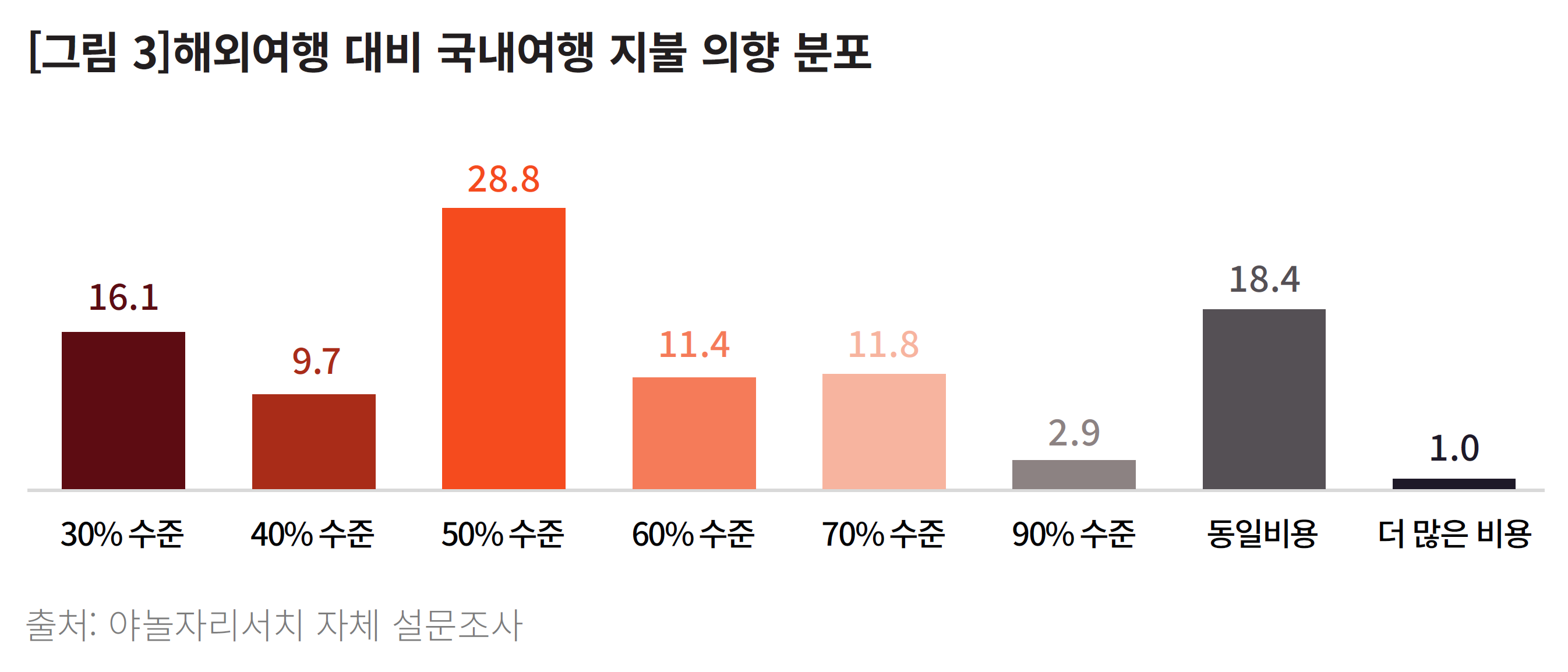
The Solution Lies in “Irreplaceable Experiences”
SooCheong Jang, President of Yanolja Research (and Professor at Purdue University), stated: “Today’s tourism deficit is not due to the business cycle or exchange rates. It is the cold result of consumers valuing domestic travel at less than half the worth of overseas travel.” He added, “In this situation, persuading people to choose domestic travel through patriotism or campaigns alone is an approach that ignores reality.”
Referring to Japan’s case, Jang emphasized: “Japan’s success did not come from lower prices, but from systematically designing experiences that are only possible there. For Korean tourism to be chosen again, it must compete through irreplaceable content that combines local stories, everyday life, food, and nature.” He further noted that “An annual tourism deficit of USD 10 billion may not be a crisis, but rather a signal of opportunity—showing that Koreans are ready to spend on better experiences.”
Three Strategic Pillars for Transformation
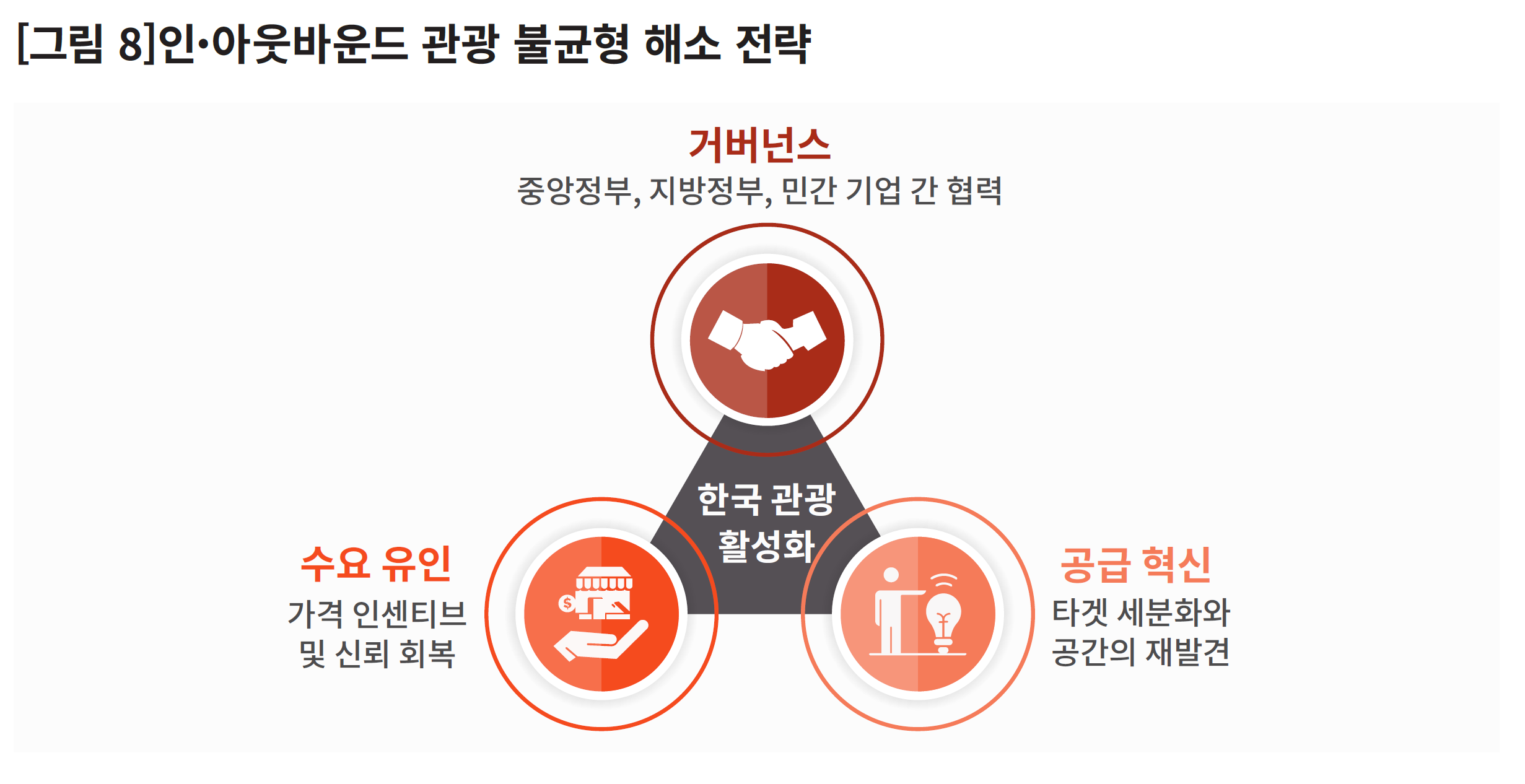
The report proposes three core strategies:
- Supply-side innovation centered on target-specific ‘killer content’
- Demand stimulation through price–quality certification and vacation dispersion
- Reestablishing governance led by the private sector and local regions
Under this framework, the central government should focus on deregulation, while the private sector and local communities take the lead in execution.
Source: Yanolja Research
Kyuwan Choi, Professor at Kyung Hee University’s College of Hotel & Tourism Management, stressed: “Administration centered on government offices alone cannot keep pace with rapidly changing market conditions. Korean tourism must move away from the ‘cosmetic makeup’ of flashy promotional videos and toward painful but necessary ‘structural reform,’ led by the private sector and local residents who understand the market best.” He added, “The government should concentrate on creating an enabling environment where private-sector creativity can translate into tangible results.”
Ultimately, the report concludes that the KRW 14 trillion-plus tourism deficit is more than a simple loss—it is an urgent signal demanding a full-scale industrial transformation of Korean tourism. If Korea succeeds in shifting from price competition to fundamental competition based on irreplaceable value, the tourism industry can be reborn not as a channel of national wealth outflow, but as a core growth engine driving domestic economic vitality and balanced regional development.
 Prev
Prev  Back
Back 