
K-Medical Tourism: Anchoring High-Value Travel
- Reg Date
- 2026.09.29


K-Medical Tourism: Anchoring High-Value Travel
Kwanyoung Lee, Associate Research Fellow, Yanolja Research / [email protected]
SooCheong Jang, Professor at Purdue University & Director at Yanolja Research / [email protected]
Kyuwan Choi, Professor at Kyung Hee University & Director at H&T Analytics Center / [email protected]
In quantitative terms, Korea's inbound tourism has already entered a new phase. Inbound visitors reached a record 18.94 million in 2025, and this year the country is looking to surpass 23 million. Yet the amount a single foreign tourist spends in Korea has actually declined, from $1,185 in 2019 to $1,156 in 2025. More visitors are coming, but the value each one leaves behind is shrinking. This is why the next task is to turn growth in visitor numbers into growth in tourism revenue—in other words, to raise the value added of inbound tourism.
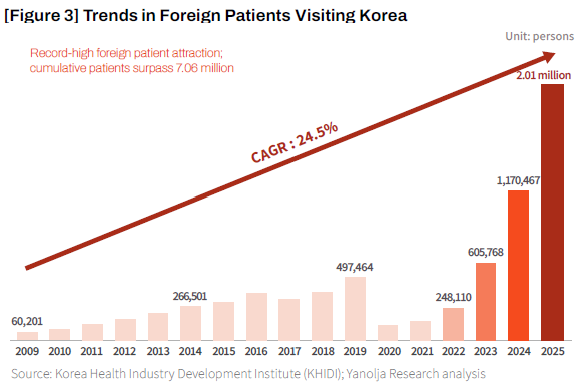
Medical and wellness tourism is one of the most promising strategic levers for this task. The number of foreign patients reached 2.01 million in 2025, more than tripling in two years, and their per-capita spending is about 2.5 times that of general tourists. Even more noteworthy is where the money is spent. Medical fees account for only about 40 percent of their spending, while the remaining 60 percent or so is spent at accommodations, stores, and restaurants. In effect, a single medical appointment brings with it several days of lodging, shopping, and dining. From this functional perspective, this Insight defines medical care as an "anchor" that captures the entire stay and the consumption that comes with it. The more beauty, wellness, and recovery programs are added, the broader that reach becomes.
However, this opportunity will not materialize on its own. Today's competition in medical tourism is not decided by the capabilities of hospitals alone. Prospective customers compare and select hospitals online months before departure, and choose destinations where everything from consultation and booking to accommodation and recovery is seamlessly connected. Competitor countries such as Singapore, Türkiye, Thailand, and Malaysia have set out in writing what may be advertised and to what extent, and are mobilizing insurance, visas, and even financial support to reduce friction along this process. Even Korea's assets—its level of medical care and K-culture—cannot deliver their full value if the pathways that lead to customers' choices are blocked.
There are three such pathways: the stage at which Korean medical care becomes known to overseas consumers (Awareness), the stage at which that interest is bundled into bookings and travel itineraries (Connection), and the stage at which first and repeat visits accumulate to broaden the base of the market (Base Expansion). As it happens, all three are caught up in institutional constraints: medical advertising standards that do not contemplate the online environment; a provision that excludes even travel platforms from patient attraction activities on the grounds that they handle travel insurance; and the value-added tax (VAT) refund special provision for cosmetic medical services, which expired at the end of 2025. Each may have a valid rationale, but because they were designed by different ministries at different times, they fall out of alignment at various points along what is, for the tourist, a single continuous journey. This misalignment goes beyond administrative inconvenience; it becomes a handicap that Korea imposes on itself in competition with other countries vying for the same customers.
The reason this issue must be addressed now is that the institutional framework has already begun to move. Since the start of 2026, a legal basis for telemedicine for foreign patients has been established, the Healing Tourism Industry Act has taken effect, plans for visa improvements have been announced, and amendment bills concerning the entities permitted to attract patients and the refund special provision have been introduced in succession. However, these changes are proceeding separately by ministry, and the standards governing the awareness stage have been left out. Whether these individual improvements end up scattered or mesh into a single journey that becomes a source of competitiveness depends on how they are designed now.
This Insight has two objectives. The first is to confirm, on the basis of spending structure and demand base, why medical and wellness tourism is a strategic pillar for raising the value added of inbound tourism. The second is to diagnose, through comparison with competitor countries, where and why the current institutional framework obstructs the market at the three points of awareness, connection, and base expansion, and to present feasible directions for institutional reform. What is needed is not a wholesale relaxation of regulations. It is to safeguard what must be protected, such as medical safety and consumer protection, while establishing standards that businesses and users can anticipate, and to reconnect institutions that each ministry has set up separately so that they fit the tourist's journey.
The Next Task for Inbound Tourism: Raising the Value Added of Tourism
The Upside for Growth Remains Open
The recovery of Korea's inbound tourism has exceeded expectations. Inbound visitors rose from 11.03 million in 2023 to 16.37 million in 2024 and 18.94 million in 2025, surpassing the pre-pandemic peak (17.50 million in 2019). Cumulative arrivals for January–July 2026 also reached 12.80 million, up 21.3 percent from the same period of the previous year, and July (2.093 million) set an all-time monthly record. At this pace, surpassing 23 million this year appears to be within reach, and the government's target of 30 million by 2028 also comes into range.
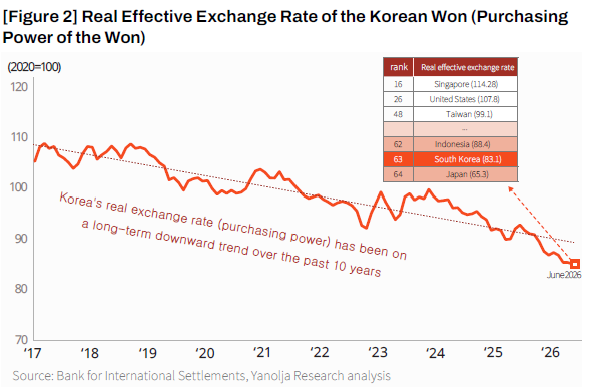
This growth is underpinned by the spread of K-content, the recovery of core markets and the diversification of source countries, as well as the weakness of the won. The won's real effective exchange rate has been declining for ten years, ranking 63rd out of 64 countries as of June 2026 according to Bank for International Settlements data. With these factors working together, the monthly tourism balance turned to a surplus in March 2026 for the first time in 11 years and 4 months (excluding the COVID-19 period) and remained in surplus for four consecutive months through June. Although it swung back to a slight deficit in July, when outbound travel demand peaks, the cumulative deficit for January–July narrowed by 78.4 percent to $1.3122 billion from the same period of the previous year ($6.0824 billion).
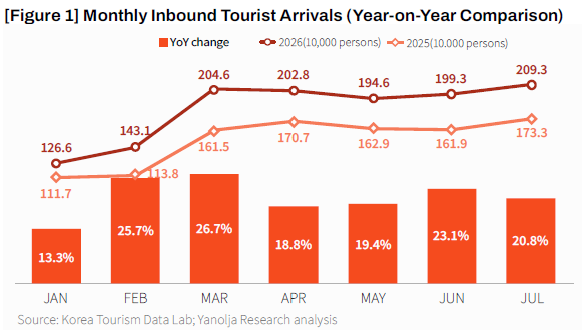
The problem is that spending has not grown in step with the increase in visitors. Per-capita spending by foreign tourists fell from $1,185 in 2019 to $1,156 in 2025, only 77 percent of Japan's level ($1,501) in the same year. The weak won is a double-edged sword: it lowers the threshold for deciding to visit Korea and thereby increases tourist numbers, but it also reduces the dollar value of the same won-denominated spending. Expanding arrivals on the back of price competitiveness alone cannot be expected to improve the quality of tourism revenue.
The Direction of Value-Added Growth and Medical Tourism
Medical tourism and MICE tourism can be cited as high-value-added tourism sectors, and the government, too, has high expectations for them. MICE tourism, such as hosting international conferences and exhibitions, plays an anchor role in enhancing national prestige and leadership, but it takes considerable time for its effects to become visible. By contrast, as its recent growth shows, medical tourism plays a key role in raising value added in both the short and the long term.
The direction of value-added growth is to extend stays, fill sightseeing-centered itineraries with experiential consumption, and develop premium products targeting consumer segments that can afford such spending. Medical tourism is one of the few areas that satisfies all of these goals at once. Visits for medical treatment presuppose a certain length of stay, and spending on accommodation, food and beverages, and shopping arises naturally during procedures and recovery. As of 2024, per-capita spending by foreign patients was KRW 3.99 million, 2.5 times that of general foreign tourists (KRW 1.60 million). It is a segment that can raise the average in a market where per-capita spending has stagnated.
In this report, the "high value added" of medical tourism is understood along two dimensions: total journey value, which includes medical expenses as well as spending on the stay, accommodation, food and beverages, shopping, transportation, and companions generated in a single visit; and customer lifetime value, which accumulates through repeat visits. Even low-priced cosmetic and dermatological procedures can constitute a high-value-added segment if their total journey value is high and their potential for repeat visits is large. However, current data only show a propensity for repeat visits; they are not rigorous estimates of customer lifetime value that track the cumulative spending of the same users.
Medical Care Is the Anchor: The Structure of Korean Medical Tourism
A Leap in Scale
A total of 2.01 million foreign patients visited Korea in 2025. Following 610,000 in 2023 and 1.17 million in 2024, this marks a third consecutive year of near-doubling growth and more than four times the pre-pandemic peak of 497,000 in 2019. The compound annual growth rate of 24.5 percent since institutionalization in 2009 far exceeds the 5.7 percent growth rate of overall inbound tourism over the same period.
The global medical tourism market is also projected to grow at an average annual rate of 12.3 percent, from $278.3 billion in 2025 to $996.9 billion in 2036, but Korea's growth outpaces this. Behind this lies a market structure that distinguishes Korea from other destination countries.
61.7 Percent of Spending Occurs Outside the Hospital
According to the Korea Health Industry Development Institute (KHIDI), total domestic spending by foreign patients and their companions in 2024 is estimated at KRW 7.5 trillion, with a production-inducing effect of KRW 13.8 trillion and a value-added-inducing effect of KRW 6.2 trillion. What stands out is the composition of that spending. In the same institute's credit card data analysis, of the KRW 3.99 million in card spending per foreign patient, spending in the medical sector amounted to KRW 1.53 million (38.3 percent), while the remaining 61.7 percent occurred outside the hospital—on accommodation, shopping, food and beverages, transportation, and the like.
This is what makes medical tourism an agenda for the tourism industry. If its value lay solely in medical fee revenue, it would remain an achievement of the health sector; but if about 62 percent of spending occurs outside the medical sector, the expansion of this market means an expansion of value added across inbound tourism as a whole. Medical care functions as an anchor, forming a medical-tourism value chain that extends to accommodation, shopping, food and beverages, transportation, and wellness.
Why Medical Care Becomes the Anchor in Korea
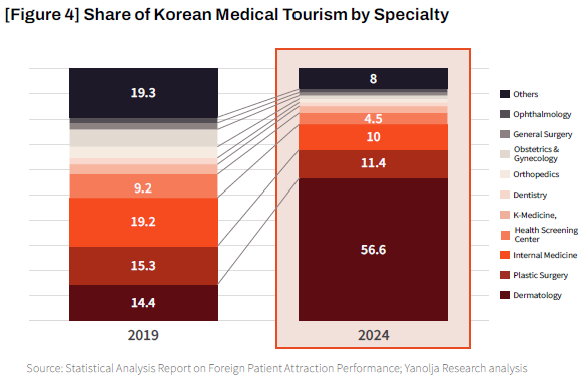
Not all medical tourism has this structure. In markets centered on treatments that involve long recovery periods and restricted mobility, such as major surgery, spending is concentrated on medical fees. The composition of the Korean market, however, is different. As of 2024, dermatology accounted for 56.6 percent and plastic surgery for 11.4 percent, with the two specialties together making up 68 percent of the total. In 2019, the distribution was more dispersed—integrated internal medicine at 19.2 percent, plastic surgery at 15.3 percent, and dermatology at 14.4 percent—but the composition shifted substantially as the number of dermatology patients increased 8.3-fold, from 85,000 to 705,000.
In dermatology and plastic surgery, outpatient procedures that do not require hospitalization account for a high share, so in many cases patients can continue their tourism itineraries after recovery, depending on the type of procedure and the judgment of the medical staff. This is an important factor explaining a structure in which spending outside the hospital exceeds medical expenses. Price conditions also come into play. The presence of domestic suppliers of botulinum toxin and fillers keeps material costs low, and a specialized division-of-labor operating system allows procedures to be offered at considerably lower prices than in major markets such as the United States. Low unit prices limit medical revenue per visit, but at the same time they lower the threshold for new demand and repeat visits.
The Demand Base Supporting the Anchor: New Inflows and Repeat-Visit Potential
This structure is sustained by two flows: new inflows and repeat visits. At the inflow stage, K-culture is an important demand base. An analysis of raw data from the 2024 International Visitor Survey found that, among respondents who visited Korea for medical purposes, Korean Wave content (16.5 percent) ranked second, after previous visit experience (17.7 percent), as the reason they became interested in traveling to Korea. In KHIDI's 2023 Survey on Foreign Patients' Experience and Satisfaction with Korean Medical Services, 41.3 percent of respondents also said that exposure to Korean culture had influenced their choice of Korean medical care, and Jung and Choi (2025) estimated that a 0.1-point increase in the Hallyu Index raises total demand for medical tourism to Korea by 5.02 percent. This suggests that K-culture may serve as an asset that partially lowers the cost of building initial awareness for medical tourism.
The propensity for repeat visits is also high. In the same raw data, the share of medical tourists who had visited Korea four or more times reached 38.6 percent. This is because cosmetic procedures have the character of ongoing, maintenance-type consumption, and the relatively low price burden leaves room for the next visit. According to KHIDI, Japan has one of the lowest total per-capita spending levels among major nationalities (KRW 2.02 million) but the largest number of patients (441,000), showing a high-frequency visit structure. This is why this market should be viewed not in terms of medical spending per single visit, but from the perspective of long-term customer value, including the potential for repeat visits.
In sum, Korean medical tourism is a market that creates greater value from the stays and consumption that medical care opens up than from medical care itself. The concentration in certain specialties is often pointed out as a weakness, and diversification is needed over the medium to long term, but from the tourism industry's perspective, the current structure offers ample room for combining medical care and tourism. This structure, however, does not sustain itself. It functions only when the three pathways identified in the introduction are open.
Three Conditions for the Anchor to Work and the Current Institutional Landscape
We now examine, in turn, those three pathways—that is, the conditions under which medical care can function as an anchor that opens up stays and consumption.
The first is awareness. Prospective consumers must know what kind of medical care they can receive in Korea and at what level. For interest in visiting Korea to translate into choices and judgments about specific procedures and medical institutions, information is needed to fill the gap in between.
The second is connection. The interest that has been formed must lead to bookings and visits, and accommodation, transportation, and tourism must be bundled into a single itinerary with medical care at its center. In a market where most spending occurs outside the hospital, the presence or absence of an entity responsible for this integration determines the magnitude of value added.
The third is base expansion. New users must keep flowing in, and those who have visited once must return. If new inflows decline, the pool on which repeat visits depend thins out; if repeat visits do not continue, the cost of acquiring users must be fully recovered in a single visit.
However, these three conditions can operate sustainably only on the common foundation of Trust & Safety. This includes accurate information about medical institutions, verification of medical staff information, informed consent based on sufficient explanation, quality of interpretation, management of complications and emergency response, cancellation and refund standards, clear allocation of responsibility in the event of medical accidents, post-return follow-up care, and the management of personal and medical information. If this foundation is weak, awareness, connection, and the expansion of the visit base will not last long. The more a discussion seeks to broaden online advertising and the range of entities permitted to attract patients, the more it must put trust and safety front and center to withstand policy objections.
Each of the three conditions is governed by institutions created at different times. Awareness is governed by the medical advertising standards set out in Article 56 of the Medical Service Act and Article 15 of the Act on Support for Overseas Expansion of Healthcare System and Attraction of International Patients (hereinafter the "Medical Overseas Expansion Act"); connection by Article 27(4) of the Medical Service Act, which enumerates entities with respect to patient attraction; and the visit base by the VAT refund special provision for cosmetic medical services, which expired at the end of 2025. Although their timing of introduction, purposes, and competent ministries all differ, they are bound together as a single problem in that they are points at which competitor countries have already prepared answers.
1. Awareness: Standards Are Needed for Online Medical Advertising Targeting Foreigners
It has been repeatedly noted in the industry that a significant share of foreign patients visiting Korea decide on medical institutions and procedures through online searches several months before entry. The stage at which interest shifts into decisions about specific procedures and institutions largely takes place online. The problem is that the domestic institutional framework lacks separate criteria for judging online advertising targeting foreigners.
Medical Advertising to Attract Foreign Patients Is Prohibited in Principle
Article 56(2)(12) of the Medical Service Act prohibits domestic advertising for the purpose of attracting foreign patients. This provision was introduced in 2009 together with the permission of patient attraction activities, as a complementary measure reflecting concerns about overheating of the domestic medical market and effects on Korean nationals.
The exception to this principle is the special provision in Article 15 of the Medical Overseas Expansion Act. Medical institutions registered to attract foreign patients may place medical advertisements written in foreign languages, but the scope of this permission is limited by location. The locations enumerated in the Enforcement Decree are foreigner-only stores, bonded stores, designated duty-free shops under the Jeju Special Act, airports with international air routes, trade ports, and special tourist zones designated by mayors or provincial governors in consultation with the Minister of Health and Welfare. Even in these locations, advertisements must undergo prior review; at airports and trade ports, advertisements skewed toward specific medical specialties are prohibited; and before-and-after photos and videos of procedures are not permitted in any location. In short, the exception is limited to enumerated physical locations, an approach premised on the distribution channels that existed when the system was designed in 2016.
The Permitted Scope of Online Medical Advertising Is Unclear, and the Use of Core Content Is Severely Restricted
All six items enumerated in the Enforcement Decree are physical spaces; online channels are not included. Accordingly, medical institution websites operated in foreign languages and social media accounts targeting overseas users are interpreted as being subject not to the special provision of Article 15 but to the general standards of Article 56 of the Medical Service Act.
This means a two-layered restriction. First, the very fact that an advertisement aims to attract foreign patients may fall under the prohibition in Article 56(2)(12) on "domestic advertising to attract foreign patients." In addition, the content standards commonly applied to all medical advertising—namely, the provisions on patient testimonials that risk misleading consumers about treatment effects (Subparagraph 2), exaggeration of objective facts (Subparagraph 8), and discounts or waivers of non-covered medical fees in a manner that misleads consumers (Subparagraph 13)—apply equally to advertising targeting foreigners. In effect, content standards designed to protect domestic consumers are applied as-is to overseas platform environments where reviews and before-and-after examples are commonplace.
Businesses find it difficult to control the reach of online advertising. Unlike billboards in airport duty-free areas, web pages written in foreign languages can also be viewed by domestic users. Article 56, however, regulates the act of advertising itself rather than its target audience. Even content produced exclusively for foreigners may be deemed domestic medical advertising as long as it is accessible in Korea, and if so, patient testimonials, before-and-after photos, and discount displays may fall under the prohibition. As a result, domestic medical institutions find it difficult to use core content such as reviews and before-and-after photos even on online channels targeting foreigners.
A more fundamental problem is that there is no settled answer for this situation. It is difficult to find in the current provisions any explicit standard on whether the applicable norms change if a separate foreigner-only site is set up or domestic access is technically blocked, or on how to treat cases where foreign-language pages are exposed to Korean nationals. When the standards for judgment are unclear in an area subject to criminal penalties and administrative sanctions, businesses have no choice but to respond conservatively, and the current passive practice can be seen as a result of this.
Competing Medical Tourism Countries Have Answers to This Problem
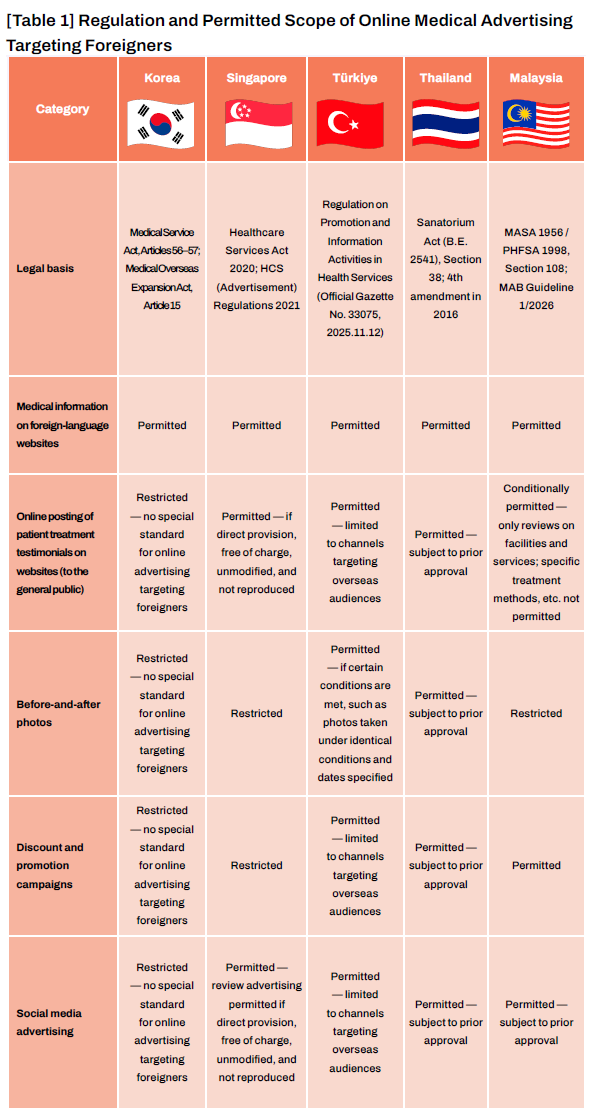
It is commonly assumed that competitor countries allow medical advertising freely, but that is not the case. Singapore completely prohibits before-and-after photos of procedures and does not permit inducements such as discounts or package price comparisons, while Thailand requires prior approval for all medical advertising except advertisements containing only the business name and address. Their regulations are by no means lax.
The difference lies in whether answers to the two questions identified earlier—what is permitted, and how domestic exposure is treated—exist in writing. The four countries have each prepared those answers in different ways.
Singapore: Regulation 14 of the Healthcare Services (Advertisement) Regulations 2021 prohibits reviews and testimonials in principle but permits them if four requirements are met: the patient must have provided them voluntarily and free of charge, reflecting their own experience; the content must not have been modified; the medical institution must not reproduce them; and the patient must have provided them directly to the medical institution. If these requirements are met, they may be posted on the premises, on websites, and on social media accounts.
There is also an answer to the question of domestic exposure. The Ministry of Health states that advertisements on a medical institution's website are subject to the regulations as long as they are accessible to persons located in Singapore, even if they target foreigners outside Singapore, and that sites accessible only by circumvention through VPNs or similar means may fall outside the scope of application. The boundary is made public through administrative guidelines.
Türkiye: The Regulation on Promotion and Information Activities in Health Services, which took effect in November 2025, prohibits, for domestic advertising, promotional posts featuring patients' expressions of satisfaction and the publication of price, discount, and campaign information, while Article 8 applies a separate international medical tourism track to medical institutions and intermediary agencies holding Ministry of Health authorization. The conditions are that they operate separate social media accounts or websites targeting overseas audiences, use languages other than Turkish, and not target residents of Türkiye, with domestic targeting and automatic targeting on social media turned off. If these requirements are met, treatment testimonials may be posted on condition that the patient's explicit consent is documented, and discounts and competitive price announcements are also permitted. A dual track, under which what is prohibited domestically is permitted on overseas channels, is thus guaranteed in the text of the regulation. At the same time, Article 8 requires the use of the HealthTürkiye logo on all media and the posting of the medical tourism authorization certificate on the relevant site, so that the permitted advertisement itself functions as a signal that the institution is state-certified.
Thailand: Section 38 of the Sanatorium Act requires prior approval for all advertising except advertisements containing only the business name and address, and detailed procedures are governed by notifications. Whether an advertisement targets foreigners does not determine whether it is permitted; the key is whether approval has been obtained. The notifications specify processing times and fees by approval category, and the Medical Facility Advertising Manual publicly distinguishes between permissible and impermissible expressions, allowing businesses to self-check before applying.
Malaysia: The Medicine Advertisements Board guidelines divide patient reviews by content. Reviews concerning facilities, such as cleanliness and staff responsiveness, are permitted, while reviews concerning treatment techniques and services or the competence of medical personnel are prohibited. Discounts and promotions are explicitly permitted, with specific examples, under Guideline 7.1.1. Domestic exposure is addressed in Guideline 9.1. Facilities advertising outside Malaysia must comply with the requirements of the relevant country, but if the advertisement is also available to the general public in Malaysia through the internet or other means, it must also comply with these guidelines. The provision makes clear that separating channels does not change the applicable norms.
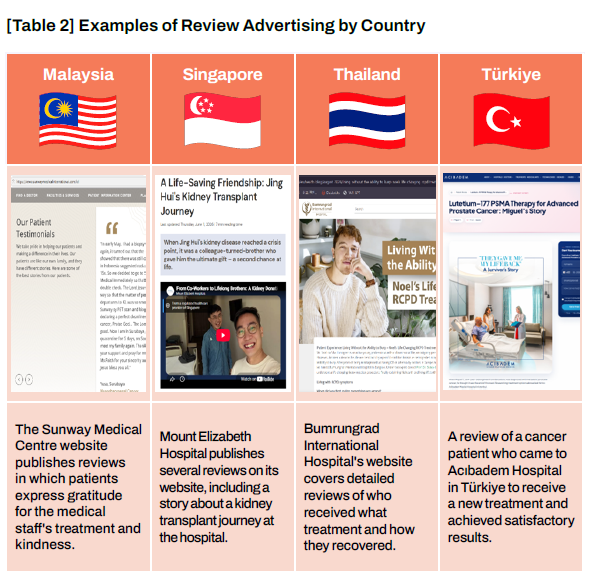
The existence of standards is also confirmed in actual practice. Singapore's Mount Elizabeth publishes, on a patient review page accessible without logging in, the case of a kidney transplant patient along with the patient's real name. Türkiye's Acıbadem Hospital, as required by Article 8, separates its domestic and international medical tourism domains and publishes patient reviews to the general public on its international site. Thailand's Bumrungrad International Hospital publishes detailed patient reviews covering symptoms, treatment processes, and outcomes. Malaysia's Sunway Medical Centre publishes, within the scope permitted by the guidelines, thank-you reviews that patients have left about the hospital and its medical staff.
What the Absence of Separate Standards for Online Advertising Targeting Foreigners Leaves Behind in Korea
In the meantime, a de facto review function has taken shape in the consumer market, centered on cosmetic medical platforms. This is because the same review is regulated differently depending on who posts it. Since the addressees of Article 56(2) of the Medical Service Act are medical personnel and the like, a review posted by a medical institution on its own channel is prohibited as medical advertising, whereas identical content voluntarily written by users and posted on a platform or map service is not directly subject to this provision. Content that is commissioned or produced in exchange for compensation may constitute medical advertising, but the boundary between such content and user posts is unclear in practice.
The constraint this structure leaves behind is not limited to the quality of information. When reviews and before-and-after photos are blocked on their own channels, the means by which medical institutions can communicate their clinical capabilities narrow to factual information such as certifications, medical staff's education and careers, and the equipment they hold. Foreign users unfamiliar with the Korean medical system have no standard for interpreting such differences. In particular, in specialties where before-and-after comparisons are not feasible, patients' accounts of their experience are practically the only means of building trust, yet that means is difficult to use on institutions' own channels.
As a result, medical institutions come to depend on third-party channels to distribute information about themselves, and it also becomes difficult for them to control the content and context of what is expressed. The fact that domestic cosmetic medical platforms derive their revenue from hospital advertising fees is one facet of this dependence. Institutions with established recognition can leverage their accumulated exposure, but the newer an institution is, the narrower its path to building trust through its own channels, making it difficult to find means of differentiation other than price. In this respect, even when domestic medical institutions seek to provide high-quality information of their own on treatment effects in order to reduce treatment-related information asymmetry, they are constrained by advertising regulations. The result is a situation in which they have no choice but to rely on costly external promotion channels.
As the path of information distribution shifts from search to generative search, the implications of this constraint grow even larger. To be presented in search results, reliable information managed by the institutions themselves must be accumulated online, yet the very parties who should be accumulating it are restricted in what they can say on their own channels.
Reasons for Caution in Expanding the Permitted Scope
Of course, there are reasons for caution in expanding the permitted scope of online advertising. The potential for misunderstanding treatment effects, excessive stimulation of demand for cosmetic medical services, and effects on domestic consumers are all substantive concerns, and they were also the rationale for introducing the domestic advertising prohibition in 2009. However, among the comparison countries reviewed in this report, no case was identified in which the standards for judgment themselves were left blank on account of such concerns. Rather, the greater the risk of misunderstanding associated with an item, the more specifically these countries defined the requirements, and they also set out how online exposure would be treated. What needs to be examined is not whether to relax regulations, but in what form standards applicable to the online channel should be established.
2. Connection: The Provision Defining the Entities That May Attract Foreign Patients
It Is Unclear Who Will Integrate the Non-Medical Spending Segment
For spending outside the hospital to translate into actual value added, an entity is needed to bundle medical care and tourism into a single itinerary. When the patient journey is divided into search and booking, entry and transportation, treatment, stay and accommodation, shopping and dining, and recovery and wellness, the distribution of responsible entities turns out to be uneven. At the search and booking stage there are facilitators and medical intermediary platforms, and the treatment stage is handled by medical institutions; but in the non-medical segments before and after treatment—stay, accommodation, shopping, dining, and so on—where a substantial part of spending occurs, there are virtually no businesses that plan and take responsibility for them. It is a structure in which users must find their own accommodations and plan their own routes.
Three Types of Entities Have Failed to Fill the Gap, Each for a Different Reason
Each type of entity has its own reasons for not filling this gap. Medical institutions have little incentive to manage services outside their core business. Because their revenue structure centers on medical fees, linking accommodation or wellness yields limited returns and only adds to their management burden.
Facilitators face a capacity problem. Registered facilitators numbered 2,713 as of July 2026, but most are small-scale, and within a structure centered on interpretation, pick-up, and booking services, it is difficult for them to secure the personnel and infrastructure needed to plan products spanning flights, accommodation, and tourism.
Online travel platform businesses that possess travel infrastructure are caught by institutional constraints. They already have accommodation and transportation inventory, multilingual customer support and overseas payment capabilities, and booking management systems, but because the insurance agency status they hold in order to sell travel insurance conflicts with Article 27(4) of the Medical Service Act, entry entails legal risk. If the first two are problems of business structure and capacity, the third is a problem of institutions.
The Result of Unrelated Institutional Changes Overlapping
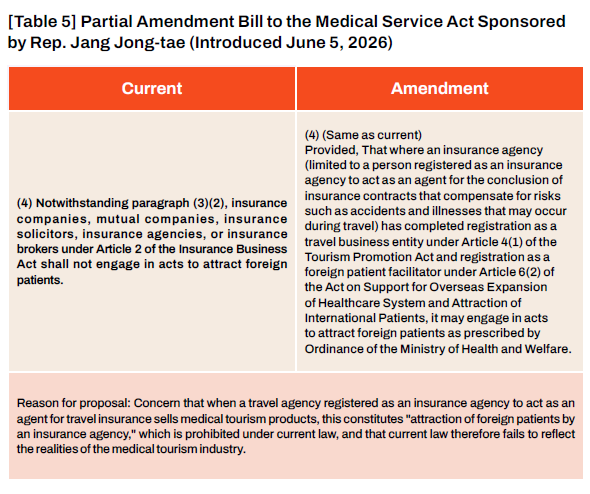
Article 27(4) of the Medical Service Act provides that insurance companies, mutual companies, insurance solicitors, insurance agencies, and insurance brokers under Article 2 of the Insurance Business Act shall not engage in acts to attract foreign patients. In light of the legislative materials from the time the provision was introduced in January 2009, the main target appears to have been private insurance companies. Article 27(3)(2), which permits the attraction of foreign patients, was introduced in the same amendment, and paragraph (4) was introduced as a further qualification attached to that exception. What it sought to curb appears to have been not patient attraction itself, but the insurance industry entering the medical market through the newly opened channel, against the backdrop of concerns over the commercialization of healthcare and the possibility of private insurers dominating medical institutions. These concerns themselves remain valid today.
The problem is that the provision did not separately define the nature of the entities it regulates, and instead imported wholesale the entities enumerated in Article 2 of the Insurance Business Act. Institutional changes with different purposes followed. In 2015, the financial authorities established the single-line non-life insurance agency system to allow businesses selling goods or services to handle non-life insurance related to their core business, and 21 industries, including travel businesses, became eligible for registration. However, the system presupposed businesses that directly sell or provide goods or services, and electronic financial business operators were also excluded, so online businesses that broker products and process payments on behalf of others remained outside its scope.
The turning point came in 2018. The amended Enforcement Decree, which took effect on June 5 of that year, made businesses brokering goods and services through online malls and electronic financial business operators under the Electronic Financial Transactions Act eligible for registration, and the name of the system was changed to the simplified non-life insurance agency. It was at this point that online travel platforms gained a practical path to registration. Starting with Hanatour in 2019, Yellow Balloon, MyRealTrip, Interpark, and others registered one after another in 2022, when overseas travel resumed.
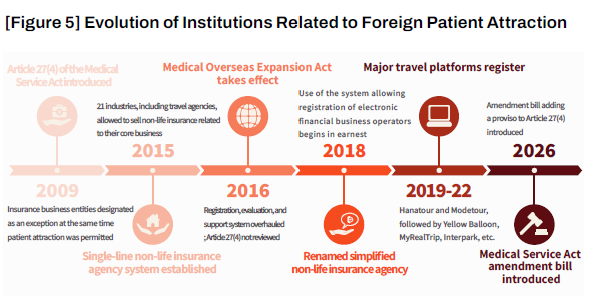
By registering under the agency system in order to sell travel insurance, these businesses came to qualify as insurance agencies under the Insurance Business Act and were thus automatically brought within the scope of the Medical Service Act's prohibition on foreign patient attraction. The legislative materials reviewed in this report did not reveal any intent to directly regulate travel platforms. It can be seen that unintended regulatory effects arose from the overlap of unrelated policy decisions.
Why the Issue Is Difficult to Resolve Through Interpretation
If the issue could be resolved through interpretation, there would be no need to go as far as legislation. This, however, is difficult for two reasons.
First, the provision explicitly specifies its scope of application. Article 27(4) enumerates insurance agencies under Article 2 of the Insurance Business Act, and simplified non-life insurance agencies fall within that definition; excluding only certain types of agencies through interpretation is therefore likely to go beyond the scope of the statutory text. Second, this provision is a criminal penalty provision. Violations are punishable by imprisonment of up to three years or a fine of up to KRW 30 million, and under the joint penalty provision, fines may also be imposed on corporations. Authoritative interpretations by the competent ministry do not bind investigative agencies or courts, so even if the ministry judges that a business is not subject to the provision, criminal liability is not thereby exempted.
Ultimately, businesses must bear the risk of punishment without any means of confirming legality in advance. Under these conditions, withholding participation is a rational decision.
Consequences That Have Emerged While the Provision Remained Unaddressed
The consequences of the regulation appear to diverge from its original purpose. To the extent confirmed by this report, it is difficult to find cases since 2009 in which attempts by insurance companies to attract patients were called into question on the grounds of this provision, whereas those actually brought within its scope were businesses that handle travel insurance as an ancillary business. The parties on whom the regulation has a substantive effect have come to differ from those targeted at the time of legislation.
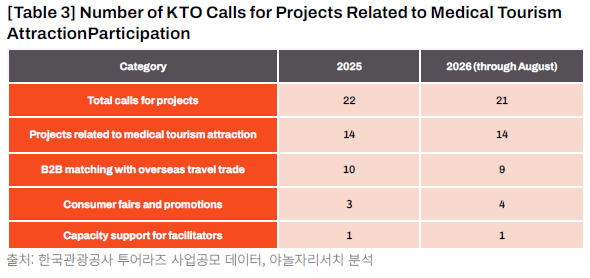
The impact is not limited to whether individual businesses participate. The first is exclusion from the public support system. Most of the Korea Tourism Organization's (KTO) support programs related to foreign patient attraction ([Table 3]) require registration as an attracting medical institution or a facilitator as an eligibility requirement. However, businesses subject to Article 27(4) cannot reliably meet this eligibility requirement, since the act of attraction itself could be subject to criminal penalties. The fact that the criterion for exclusion is not business capability but whether a business handles travel insurance reveals the nature of the problem.
The second is the difference in the conditions applied to domestic and overseas businesses. Article 27(4) applies to entities registered or licensed in Korea under the Insurance Business Act, so overseas platforms without domestic insurance registration are not directly subject to it. Of course, Article 6 of the Medical Overseas Expansion Act imposes a registration obligation on anyone seeking to attract foreign patients regardless of nationality, and since May 2026, sanctions for unregistered attraction have been strengthened to include public disclosure of names and the confiscation and collection of criminal proceeds, in addition to the existing imprisonment and fines. However, since the registration requirements presuppose a domestic office, capital, and guarantee insurance, they do not adequately contemplate businesses without a domestic base, and enforcement is also less effective when customer recruitment and brokering take place abroad.
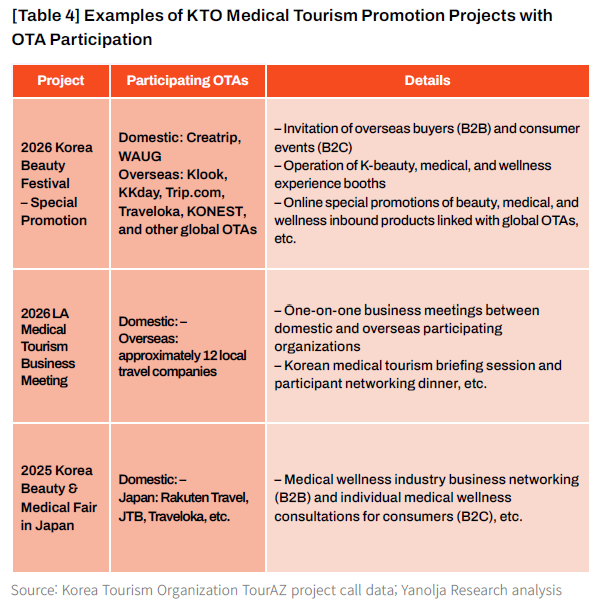
This structure is also confirmed in the participant lists of public projects. Global travel platforms such as Klook, KKday, Trip.com, and Traveloka participated in the 2026 Korea Beauty Festival special promotion, while Rakuten Travel, JTB, and others were listed at the Korea Beauty & Medical Fair held in Japan in 2025. Many of those on the participant lists are overseas platforms competing for the same inbound demand to Korea. The fact that the large platforms that handle travel insurance in Korea do not appear on these lists shows the substantive effect of the constraint identified above.
An Area Left to Business Judgment in Comparison Countries
Within the scope of the legislation of the major medical tourism countries reviewed in this report, no legislative precedent was identified that excludes specific businesses from foreign patient attraction on the grounds that they handle travel insurance. On the contrary, Türkiye's Regulation on International Health Tourism and Tourist Health, amended in 2025, allows authorized intermediary agencies to arrange complication insurance and travel insurance for patients, with the state covering a substantial portion of the premiums, and stipulates that accommodation, transportation, and transfer services be provided through authorized travel agencies. This is the point at which approaches diverge: whether insurance handling and travel business functions are viewed as a means of user protection or as grounds for blocking market entry.
Of course, it is also true that travel platforms in other countries do not actively deal in medical services. This, however, appears to stem from market structure rather than institutional prohibition. In markets where medical care is the sole purpose of the visit, there is little room for combining it with tourism, and the composition of the Korean market is distinct from this.
That said, permitting entry does not in itself guarantee an improvement in the market. Issues surrounding display ranking and fee structures have been raised across the platform industry, and their impact may be greater in the medical field. The operating standards that should accompany permission to enter are addressed in the recommendations below.
Meanwhile, calls for improvement on this issue led to legislative discussions following the parliamentary audit in October 2025, and a partial amendment bill to the Medical Service Act was introduced in June 2026.
3. Base Expansion: The VAT Refund Special Provision for Cosmetic Medical Services
In this market, where the share of repeat visitors to Korea is high, raising per-capita spending and increasing the total volume of visits must go hand in hand. Because spending outside the hospital occurs with every visit, the broader the visit base, the greater the spillover to the tourism sector, even at the same level of spending. Expanding the base by which any increase in per-capita spending is multiplied is what determines the performance of the market as a whole. This is why incentives supporting new inflows and repeat visits matter.
Introduction and Expiration of the Refund Special Provision
The special provision for VAT refunds on cosmetic and plastic surgery medical services for foreign tourists, introduced in 2016, refunded VAT only for procedures received at attracting medical institutions registered under the Medical Overseas Expansion Act. Patients had an economic incentive to use registered institutions, and businesses had a reason to maintain their registration. The special provision was extended six times before expiring on December 31, 2025.
Behind its discontinuation lies the judgment of the fiscal authorities: the sunset condition—abolition once the industry reaches a certain level—was deemed to have been met owing to rapid growth. In addition, concerns have been raised about equity, given the lack of grounds for providing a tax reduction only to foreigners; about the growing scale of refunds; and about the weak justification for supporting the cosmetic field amid shortages of personnel in essential and regional healthcare. These arguments all carry real weight.
Changes Observed Following the Expiration
The indicators observed in the first half-year after the expiration show two trends at once. However, the figures below were merely observed during the same period as the expiration; they have not been confirmed as effects of the expiration. According to KHIDI's analysis of payment data from overseas-issued Hana Card cards, total card spending in the first half of 2026 by foreigners confirmed to have used domestic medical services was KRW 3.0973 trillion, up 25.6 percent from the same period of the previous year. Of this, medical-sector spending increased 38.6 percent to KRW 1.4203 trillion, driving 62.7 percent of the total increase, and non-medical spending also rose 16.3 percent to KRW 1.677 trillion. Among the top 14 countries, average medical-sector spending per card rose 30.1 percent, from KRW 1.338 million to KRW 1.741 million. Looking only at medical spending per card, this is a movement consistent with value-added growth.
The same analysis also reveals a different trend. The number of cards used in the medical sector from the top 14 countries rose by only 1.0 percent, from 581,670 to 587,612. If the number of cards used is regarded as a proxy for the size of the user base, the increase in spending appears to have been driven more by higher spending per card than by an expansion of users. This combination departs from the trend to date. In a market where the number of foreign patients had nearly doubled for three consecutive years, 1.0 percent is close to stagnation. The declines in spending at duty-free shops (−1.4 percent) and airlines (−7.5 percent) over the same period point in broadly the same direction.
The fact that a substantial part of the growth is appearing in higher spending per card rather than in an expansion of the number of cards used is not in itself a negative outcome. However, given that spillover to the tourism sector is proportional to the number of visits, the stagnation in the number of cards used is a signal that warrants examination, even though causality has not yet been confirmed.
What Price Means from the Perspective of the Entry Gateway
It is difficult to link the expiration and the movement of the base directly as cause and effect. Multiple factors are at work together, including changes in relative prices due to the weak won, airfare levels, and the high base effect of the previous year, and cross-checking will be needed once the statistics on first-half attraction performance are published. Follow-up research should rigorously verify this causal relationship through difference-in-differences or interrupted time-series analysis and price elasticity analysis by nationality and procedure. Even without presupposing causality, however, the nature of the demand segment on which the refund benefit operated is worth examining.
The cosmetic procedures that were eligible for the refund constitute the entry gateway to this market. In the first half of 2026, card spending on dermatology rose 49.5 percent to KRW 768.5 billion, accounting for 54.1 percent of total medical-sector spending, and KHIDI stated that it regards dermatology procedures as a good stepping stone for foreign patients to experience Korean medical care for the first time, and that a model linking them with dentistry, ophthalmology, health screening, and other services is needed. This segment is not high-priced, but it is a channel for new inflows and a starting point for expanding consumption.
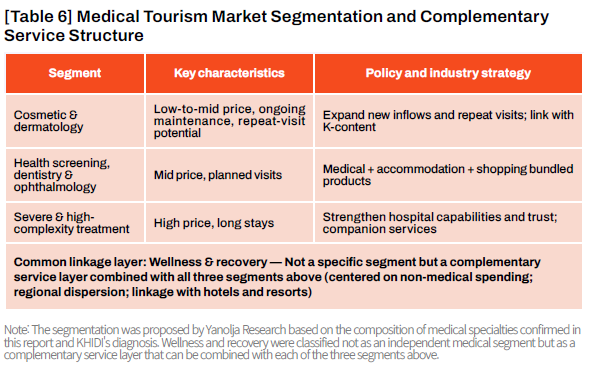
The three medical segments do not necessarily transition in a linear fashion. However, after cosmetic and dermatology services form the first experience of Korean medical care, the scope of consumption may expand to adjacent services such as health screening, dentistry, and ophthalmology, and wellness and recovery services can function as a complementary layer that is combined with each medical segment to raise the value of the overall journey. This expansion can be viewed as a "Medical-Tourism Value Expansion" portfolio. It is not a linear transition in which cosmetic customers are "upgraded" to severe-treatment customers, but a process in which a single user broadens consumption across multiple medical and wellness areas. The key is not attracting large numbers of low-priced cosmetic users per se, but creating a structure that broadens their scope of consumption into adjacent medical and wellness areas.
Moreover, the lower the price segment, the greater the effect of the same percentage price change on visit decisions. Ten percent means one thing for a procedure costing several million won and another for a highly price-sensitive consumer segment considering procedures of around one million won. The fact that the refund operated at the latter point should be considered not as evidence of causality, but as a hypothesis to be verified in follow-up studies.
Meanwhile, the VAT refund special provision for cosmetic medical services also helps bring medical transactions that might take place outside the formal system into the open, because hospital revenue is officially captured the moment it is reported for the purpose of the VAT refund. With the expiration of the special provision, concerns have been raised among front-line hospitals and facilitators that some medical transactions may go underground again. The VAT refund special provision for cosmetic medical services is a system that can contribute not merely to enhancing price competitiveness but also to increasing the transparency of medical transactions.
Major Destination Countries Invest Public Funds in Visit Incentives
Major destination countries are institutionalizing visit incentives in different ways. Thailand combined medical expense refunds with eased immigration procedures, while Türkiye mandates complication insurance for medical tourism with the government covering up to 70 percent of the premiums, refunds up to 70 percent of social media advertising costs targeting overseas audiences, and offers airfare discounts in partnership with the national flag carrier. Though their forms differ, they share the practice of investing public funds to lower the threshold for visits.
The counterarguments identified earlier remain valid, and arguments to revive the same scheme without verified effects will inevitably run into the same objections. For the review to make progress, the framework of discussion—what the scheme should be evaluated by—must change.
Thus, although the three institutions were formed against different backgrounds, from the perspective of the conditions under which the anchor works, they belong to a single line. At the awareness stage, criteria specific to online advertising targeting foreigners have not been adequately established; at the connection stage, the entities that would bundle medical care and tourism have not been adequately put in place; and for the visit base, the effects of, and alternatives to, the expired incentive remain unverified. Since competitor countries have already prepared answers at the same points, these gaps translate directly into differences in competitive conditions. However, this state of affairs is not fixed. Since the start of 2026, the related institutions have been moving in several directions at once.
Institutional Changes in 2026
This is why the introduction emphasized "now." Since the start of 2026, related institutions have moved in succession across different areas, and some have reached implementation while others remain at the stage of plans or bills.
April 15, Ministry of Justice launches visa system improvements: At a stakeholder meeting, the Ministry of Justice announced plans to improve the visa system in two directions. One is to ease the criteria for designating Excellent Attracting Institutions, introducing additional points for regional institutions while reasonably adjusting the standards for administrative sanctions. The other is to streamline screening requirements and procedures so that short-term (C-3) multiple-entry visas or long-term stay (G-1) visas are more easily issued to foreign patients who require repeated treatment or seek to enter for wellness tourism.
The fact that repeated treatment and wellness tourism were explicitly targeted shows that the visa system is being redesigned on the premise of repeat visits and stay-based consumption rather than one-time treatment visits.
April 21, Healing Tourism Industry Act takes effect: The legal and policy concept of healing tourism was established, and a basis was laid for the registration of healing tourism businesses and the certification of excellent facilities. Beauty, spa, rest, healing, food, meditation, and similar activities were incorporated into a legally defined industrial category. It is the first legislation to institutionally define the stay and recovery segment that follows procedures.
May 26, Amendment to the Medical Overseas Expansion Act: A legal basis was established for providing telemedicine to foreign patients using information and communications technology. Not only clinic-level but also hospital-level medical institutions can now provide continuous observation, consultation, diagnosis, and prescription, including for first-time patients. This change brought pre-visit consultation and post-return management into the institutional framework.
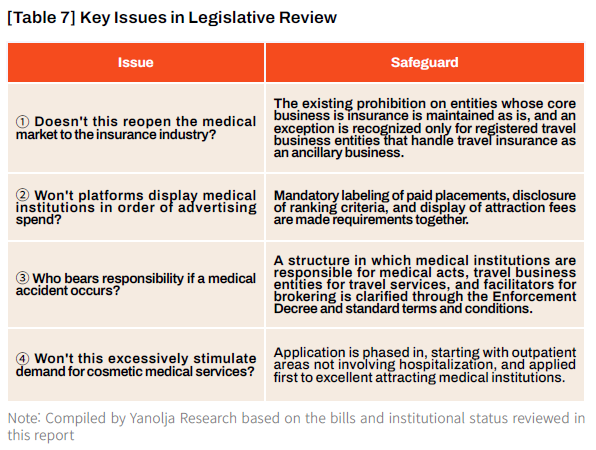
June 5, Partial amendment bill to the Medical Service Act introduced: The bill maintains the prohibition in Article 27(4) but adds a proviso recognizing an exception only for persons registered as insurance agencies to act as agents for travel insurance contracts ([Table 5]). The exception applies only where the business has completed both registration as a travel business entity under the Tourism Promotion Act and registration as a foreign patient facilitator under the Medical Overseas Expansion Act, and the specific methods of attraction are to be prescribed by Ordinance of the Ministry of Health and Welfare. It is an approach that keeps the restriction on entities whose core business is insurance, while carving out an exception only for businesses that handle insurance as an ancillary business.
August, Amendment bill to the Restriction of Special Taxation Act introduced: An amendment bill was introduced to reinstate the special provision for VAT refunds on cosmetic and plastic surgery medical services for foreign tourists, which expired at the end of 2025, by extending its application period to "December 31, 2029." The rationale for the bill stated that medical tourism is a high-value-added industry whose benefits do not end with medical revenue but extend to accommodation, tourism, and retail.
Status of the Two Amendment Bills
The two amendment bills at the introduction stage must go through deliberation in the National Assembly. The Medical Service Act amendment is structured to take effect six months after promulgation, so its actual effective date will depend on when it passes. Because it takes the form of adding a proviso while maintaining the existing prohibition, the scope of contention is relatively narrow.
The Restriction of Special Taxation Act amendment is different in nature. Although it takes the simple form of changing only the application period, extending a tax reduction depends on the judgment of the fiscal authorities, and the counterarguments identified in the previous section remain valid. This time, however, the bill presented changes in the composition of refund performance as grounds. The number and amount of refunds increased from 33,659 cases and KRW 7.9 billion in 2016 to 1,721,095 cases and KRW 196.4 billion in 2025. Yet the average refund per case, after KRW 230,000 in 2016, peaked at KRW 270,000 in 2021 and then fell to KRW 90,000 in 2024, remaining around KRW 110,000 in 2025. This means that usage shifted from being centered on high-priced plastic surgery to highly accessible dermatological and cosmetic procedures. Over the same period, the number of medical institutions to which the special provision applied also roughly tripled, from 538 to 1,665.
The fact that the number of cases increased more than 50-fold while the refund per case declined shows that the scheme operated more broadly for a large number of users of low-cost procedures than for a small number of high-cost procedures. Herein lie the grounds for evaluating the scheme from the perspective of the visit base.
Institutions Scattered Across a Single Journey
The changes above were each carried out by different ministries according to their respective needs. Visas fall under the Ministry of Justice, healing tourism under the Ministry of Culture, Sports and Tourism, telemedicine and patient-attraction entities under the Ministry of Health and Welfare, and the tax special provision under the Ministry of Economy and Finance.
Yet when these changes are arranged along the foreign patient's journey, a different picture emerges. Pre-visit consultation connects to the legal basis for telemedicine; inflows and bookings to the overhaul of the provision on patient-attraction entities; visit decisions and repeat visits to the refund special provision and improvements to multiple-entry visas; entry to simplified visa procedures; post-procedure stays and recovery to the Healing Tourism Industry Act; and post-return management back again to telemedicine. In effect, legal foundations that can bind the entire journey, from search to follow-up care, into one are being put in place step by step. Of the three conditions, institutions have actually begun to move with respect to connection and the visit base.
What Remains and What Must Be Connected
However, institutions concerning awareness were not the subject of these changes. The advertising special provision in Article 15 of the Medical Overseas Expansion Act remains as it was. Pre-visit consultation through telemedicine has become possible, but the standards for online information provision that would allow prospective consumers to become aware of and assess Korean medical institutions before reaching that consultation have still not been settled. The door to consultation has opened, but the standards for the stage that brings people to that door remain unresolved.
It should also be considered that the two amendment bills are still at the stage of National Assembly deliberation. The longer implementation is delayed, the longer the asymmetry in conditions persists, and the market continues to move in the meantime.
In sum, the institutional changes of 2026 are improving the three conditions from multiple directions, but each was designed independently. For individual reforms to translate into journey-level competitiveness rather than ending up scattered, the remaining conditions must be addressed together, and the scattered qualifications and standards must be designed to mesh with one another.
Recommendations: Align Institutions Around the Journey
The preceding discussion converges on a single point. Korean medical tourism has established a structure in which medical care works as an anchor that opens up stays and consumption, and the remaining task is to align institutions so that this structure can operate on a broader base.
The following recommendations are not a call for deregulation. Under all three conditions, the problem was not the intensity of regulation, but either the absence of standards or the failure of institutions created at different times to mesh with one another. What is needed is to set standards that businesses and users can anticipate and to align scattered institutions and qualifications so that they operate along a single journey, with trust and safety as the prerequisite.
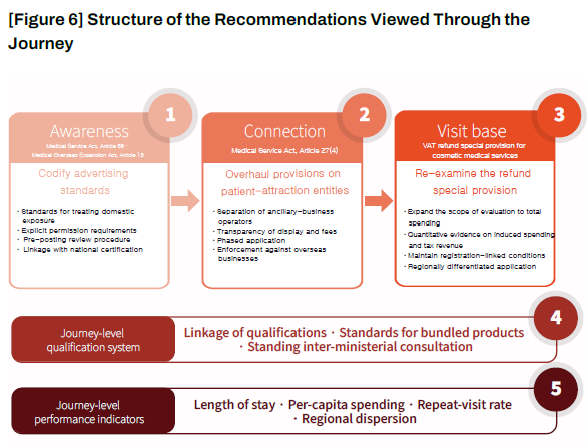
Recommendation 1: [Awareness] Codify the Standards for Judging Online Medical Advertising Targeting Foreigners
In the area of awareness, the most urgent task is to establish standards applicable to the online channel. The special provision in Article 15 of the Medical Overseas Expansion Act enumerates physical locations and therefore does not extend online, and no separate standards for judging online advertising targeting foreigners have been established. The following four items are points for review to fill this gap.
First, set standards for treating domestic exposure. Given that the reach of online channels is difficult to control, this is the item that most urgently needs an answer. Singapore uses accessibility by persons located in the country as the criterion and Malaysia uses availability to the general public in the country, while Türkiye has made the operation of separate channels and the blocking of domestic targeting requirements. Whichever direction is chosen, there must be an answer as to whether the applicable norms change when channels are separated, so that businesses can make decisions and invest accordingly.
Second, specify permission requirements in statutes or guidelines. This approach stipulates the conditions under which patient testimonials, before-and-after photos, and price displays, respectively, are permissible. Singapore's four requirements for reviews and Malaysia's content-based distinctions serve as references. The purpose is not to expand or narrow the scope of prohibition, but to ensure the predictability of judgments.
Third, provide a procedure for obtaining confirmation before posting. Even with standards in place, the judgment of whether individual expressions meet them remains. Thailand specified processing times and fees for each approval category of its prior-approval procedure in notifications, allowing businesses to prepare advertisements with predictable lead times. Since Korea already has a prior review system for medical advertising, no new body is needed. Including online advertising targeting foreigners within the scope of review, setting processing times, and publishing review cases by type would also make the standards more concrete.
Fourth, consider linking permission requirements with national certification. Türkiye, while permitting advertising targeting overseas audiences, also made the use of the HealthTürkiye logo and the posting of authorization certificates mandatory, so that permitted advertising itself serves as a signal of a verified institution. Korea also has a system for designating excellent attracting medical institutions, which provides a basis for such linkage. This shows that improving advertising standards can lead directly to building national brand infrastructure.
In the short term, administrative guidelines can reduce uncertainty under current law, including on domestic exposure, the criteria for overseas-only channels, and review procedures. However, if the aim is to expand the permitted scope of expressions currently prohibited by law, the need to amend the Medical Service Act or the Medical Overseas Expansion Act and their subordinate regulations must be reviewed separately.
Recommendation 2: [Connection] Overhaul the Provisions on Patient-Attraction Entities and Design Operating Standards Alongside
A. What the National Assembly Should Do: Amend Article 27(4) of the Medical Service Act
Overhauling Article 27(4) of the Medical Service Act is not a matter of lifting regulation but of bringing the regulated parties back in line with the legislative intent. What this provision targeted in 2009 was the entry of the insurance industry into the medical market, and that concern remains valid today. However, the fact that businesses handling travel insurance as an ancillary business are equally captured by the text of the provision can hardly be regarded as an outcome anticipated by the legislation. The bill that has been introduced keeps the restriction on entities whose core business is insurance and separates out only businesses that handle travel insurance as an ancillary business, and therefore does not undermine the values the 2009 legislation sought to protect.
B. What the Government Should Do: Design Post-Entry Operating Standards
The effectiveness of the overhaul, however, depends on operating standards after entry. Three things need to be considered together.
First, transparency of display criteria and fee structures. If advertising expenditure determines display order, users' choices may be distorted. Since a notice setting caps on attraction fees and an obligation to report business performance already exist, requirements for disclosing display criteria and displaying fee structures can be established within this framework. The fact that the bill delegates the specific methods of attraction to an Ordinance of the Ministry of Health and Welfare also leaves room for such design.
Second, phased setting of the scope of application. Since the dermatology and plastic surgery fields that make up the majority of the Korean market center on procedures that do not require hospitalization, a realistic approach is to apply the change first to these outpatient areas and then adjust the scope after confirming the state of user protection.
Third, enforcement against cross-border businesses. Because the registration requirements are designed on the premise of a domestic office and capital, the problem of enforcement against businesses without a domestic base remains even if the system is overhauled. Securing the effectiveness of attraction rules regardless of nationality is a separate task.
Recommendation 3: [Visit Base] Re-examine the VAT Refund Special Provision from the Perspective of Visit Incentives
The crux of the debate over reinstating the refund special provision is whether to view it as a tax reduction for cosmetic medical services or as a cost of attracting a consuming population to Korea. The scope of the calculation differs accordingly.
First, broaden the scope of evaluation to total spending. Of foreign patients' spending, 61.7 percent occurs outside the hospital. If there are visits induced by the refund, failing to also account for the accommodation, shopping, and dining spending those visits generate, and the tax revenue arising from it, would miss a substantial part of the scheme's economic effect. The changes in the composition of refund performance identified in the previous chapter point in the same direction.
This, however, must be supported by data, not assertion. At present, quantitative evidence on induced spending and tax revenue relative to refund amounts is insufficient, and persuading the fiscal authorities requires calculations in monetary terms rather than national-interest arguments. Securing this data is a prerequisite.
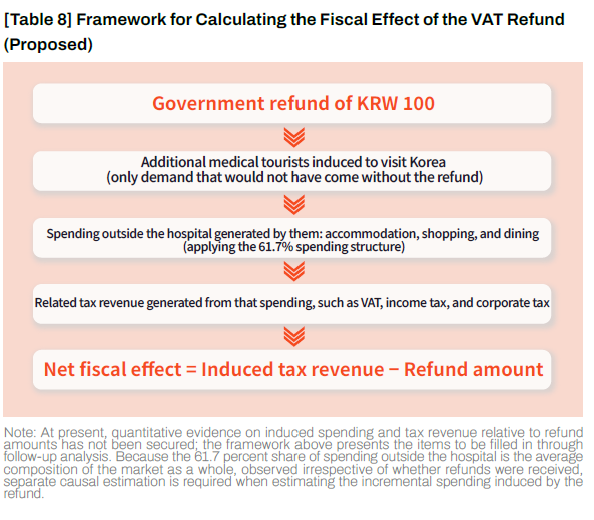
Second, reflect in the design the fact that the special provision was more than tax support. The previous special provision applied only to procedures received at attracting medical institutions registered under the Medical Overseas Expansion Act, so medical institutions first had to complete the registration process for patients to receive refunds. The roughly threefold increase in the number of medical institutions to which the special provision applied suggests that the tax benefit may have partly served to draw institutions into the formal system. This condition should be maintained upon reinstatement, and registration requirements and ex-post management should be reviewed together so that registration does not remain a mere formality.
Third, incorporate the perspective of regional diffusion. As of August 2026, 2,655 attracting medical institutions and 1,682 facilitators were located in Seoul, meaning more than half of the total are concentrated there. Beyond simply extending the application period, differentiated application for institutions located in the regions or preferential treatment for products linked to regional wellness resources could be considered. This also aligns with the Ministry of Justice's consideration of introducing additional points for regional institutions in the criteria for Excellent Attracting Institutions.
Recommendation 4: [Integration] Consider a Journey-Level Qualification System
If the preceding three recommendations each respond to a particular condition, this recommendation addresses the problem of connecting the three conditions.
Arranging the institutional changes of 2026 along the journey produces a single flow, but this is not a designed outcome. At present, for a single business to package everything from pre-visit consultation to booking and entry, procedures and stay, and recovery and follow-up care into one product, it must separately pass through two qualification systems—travel business registration and foreign patient facilitator registration—and telemedicine requires a separate cooperative arrangement with medical institutions. Medical tourism visas are issued on the premise of an invitation from a registered attracting institution, and only invitations from Excellent Attracting Institutions designated by the Ministry of Justice are processed quickly via electronic visa. While visas fall under the Ministry of Justice, the qualifications on which they are premised derive from registration under the Ministry of Health and Welfare. Combining recovery-period programs adds registration as a healing tourism business under the Act on Fostering the Healing Tourism Industry. Registration offices are also divided—basic local governments for travel businesses and healing tourism businesses, and metropolitan and provincial governments for foreign patient facilitators—and the competent ministries are likewise split among the Ministry of Culture, Sports and Tourism, the Ministry of Health and Welfare, and the Ministry of Justice.
First, streamline the linkage paths between qualifications. Mutual recognition of overlapping registration requirements or simplified procedures for businesses holding multiple qualifications could be considered. Rather than creating new qualifications, a realistic approach is to streamline the connections between existing ones.
Second, establish standards for journey-level product composition. This concerns defining the scope of responsibility of each party and the handling path in the event of an incident for products combining medical care, accommodation, transportation, and wellness. Korea already has a protection system spanning medical malpractice liability insurance, facilitator guarantee insurance, and mediation and advance payment of compensation by the Korea Medical Dispute Mediation and Arbitration Agency. Clarifying how this system applies to bundled products would secure predictability for businesses and trust for users.
Third, institutionalize inter-ministerial consultation on a standing basis. For individual institutional reforms to translate into journey-level effectiveness, the competent ministries must be aware of, and able to coordinate, one another's changes. Rather than creating a new body, a realistic starting point is for existing pan-ministerial consultative bodies to regularly take up agenda items addressing medical tourism at the journey level.
Recommendation 5: [Foundation] Extend Performance Indicators to the Journey Level
Finally, there remains the problem of measurement. At present, medical tourism performance is managed mainly around the number of foreign patients and medical fees. However, much of this market's spending occurs outside the hospital, and the results of raising the value added of inbound tourism also appear in that area. Treatment-centered indicators alone make it difficult to measure policy effects.
Length of stay, total per-capita spending, repeat-visit rate, and regional dispersion must be managed together. In particular, indicators on the visit base currently rely on proxies. As KHIDI itself acknowledges, the number of cards used does not match the actual number of patients. Linking attraction performance statistics, card spending data, and immigration statistics to identify visit frequency and repeat-visit cycles on an actual-patient basis would also provide grounds for judging the three preceding recommendations.
In particular, for schemes that involve fiscal expenditure, such as the VAT refund special provision, discussion can hardly advance without quantitative proof of their effects. Improving the indicator system is the foundation on which the other recommendations can be reviewed.
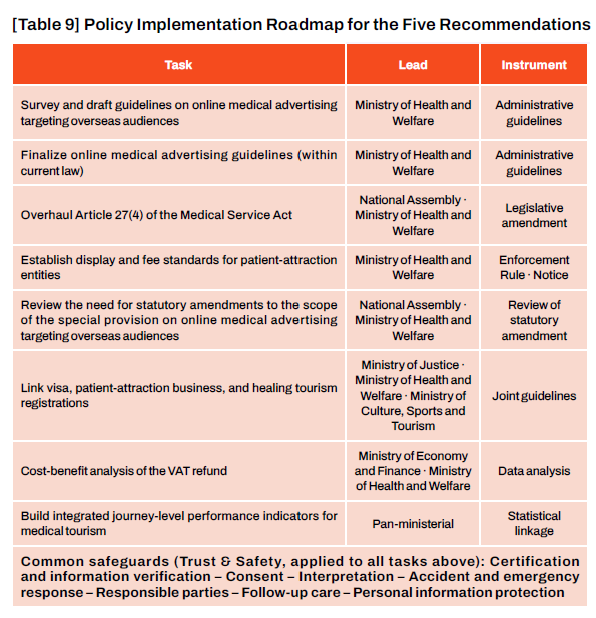
The five recommendations are not parallel. If only connecting entities are secured while the means of making things known remain restricted, there will be no suitable way to promote products even once they are put together. Even if connection becomes possible, the total volume of value added will not grow unless the visit base broadens; and even if the base broadens, spending will stay inside the hospital unless there are entities to take charge of the stay segment. None of these effects will feed into the next policy decision unless they are measured. And the common safeguards at the bottom of [Table 9] are the prerequisite for all five recommendations. The more a reform broadens online advertising and the range of patient-attraction entities, the more certification and information verification, consent, interpretation, accident response, responsibility, follow-up care, and personal information protection must be designed as requirements alongside it.
Realistically, processing the two amendment bills under deliberation is the most immediate task, while improving advertising standards requires a separate review period. Whichever is addressed first, however, the effectiveness of individual reforms will be limited to the extent that the rest are not addressed together.
Conclusion: Beyond Deregulation, Institutional Alignment Is Competitiveness
Korea's inbound tourism has surpassed its pre-pandemic peak in visitor numbers and is growing rapidly. Per-capita spending, however, has actually declined and remains at 77 percent of Japan's level. The task now is not only to attract more tourists, but to ensure that each visit generates greater consumption and value added.
Medical and wellness tourism is a representative area that can respond directly to this task. The fact that 61.7 percent of foreign patient spending occurs outside the hospital shows that medical care is an "anchor" of inbound tourism that extends consumption beyond treatment itself to accommodation, shopping, dining, and transportation. Korea possesses medical and cosmetic infrastructure, price competitiveness, and the recognition built by K-content. But for these strengths to translate into actual competitiveness, Korean medical care must become known overseas, interest must connect to visits and consumption, and the base of the market must continue to broaden.
The problem this report focuses on is that institutions created in the past for different purposes sit at each of these three processes and have not been sufficiently aligned with changes in the market. Medical advertising, the entities permitted to attract foreign patients, and the tax special provision each originated from legitimate policy objectives, but the market has already moved toward the convergence of online platforms with travel and wellness. If institutions of the past unnecessarily sever today's tourist journey, the issue becomes not merely one of regulation but one of competitiveness.
Since the start of 2026, alongside the legal basis for telemedicine, the Healing Tourism Industry Act, and discussions on visa improvements, amendments concerning patient-attraction entities and taxation are also being pursued. What matters is not to let these changes end as improvements to individual institutions, but to connect them along a single tourist journey that runs through search, booking, visit, treatment, recovery, and repeat visits.
The solution, therefore, does not lie in lifting regulations across the board. While maintaining the principles of medical safety and consumer protection, it is necessary to clarify what is permitted and what is restricted, and to overhaul institutions that conflict with one another or unnecessarily disrupt the tourist's journey. The key is not "deregulation" but "clarification of standards and alignment of institutions."
Medical and wellness tourism is an important opportunity for Korean tourism to convert growth in visitor numbers into growth in consumption and value added. When institutions connect, rather than obstruct, the competitive advantages the market has created, the anchor of medical care can extend beyond the hospital into value for the tourism industry and regional economies as a whole.
---
Acknowledgements
This Insight was prepared with reference to the discussions and recommendations of the 1st Forum (June 10, 2026) and the 2nd Forum (August 13, 2026) of Yanolja Research's "YARI Medical & Wellness Tourism Forum." We thank the forum members who participated and shared diverse opinions and expert recommendations. The contents and views of this Insight, however, are based on the authors' analysis and judgment and do not represent the official views of individual forum members or of the forum as a whole.
References
Academic Papers
Jung, K. & Choi, Y. (2025). An Analysis of the Effect of the Korean Wave on Inbound Medical Tourism Demand. Asia Yeongu (Asian Studies), 28(3), 45–64. (in Korean)
Domestic Statistics and Reports
Ministry of Culture, Sports and Tourism & Korea Tourism Organization (2025). 2024 International Visitor Survey and raw data.
Korea Tourism Organization, Korea Tourism Data Lab. Inbound visitor statistics and tourism balance and per-capita spending statistics (2019–July 2026).
Korea Tourism Organization, TourAZ. Project call data related to medical tourism attraction (2025–August 2026).
Korea Health Industry Development Institute (2024). 2023 Survey on Foreign Patients' Experience and Satisfaction with Korean Medical Services.
Korea Health Industry Development Institute (2025). 2024 Statistical Analysis Report on Foreign Patient Attraction Performance.
Korea Health Industry Development Institute (2025). Analysis of 2024 domestic spending by foreign patients (credit card data) and economic ripple effects.
Korea Health Industry Development Institute (2026). Analysis of card spending by foreign patients in the first half of 2026 (payment data from overseas-issued Hana Card cards).
Ministry of Health and Welfare & Korea Health Industry Development Institute (2026). 2025 foreign patient attraction performance announcement materials; Registration status of foreign patient attracting medical institutions and facilitators (as of July–August 2026).
Ministry of Justice (April 15, 2026). Presentation materials from the stakeholder meeting on visa system improvements related to foreign patient attraction.
Domestic Legislation and Legislative Materials
Medical Service Act, Article 27(3)–(4), Article 56, Article 57, and the Enforcement Decree of the same Act.
Act on Support for Overseas Expansion of Healthcare System and Attraction of International Patients, Articles 6 and 15, and the Enforcement Decree of the same Act (including the amendment of May 26, 2026).
Insurance Business Act, Article 2, and the Enforcement Decree of the same Act (establishment of single-line non-life insurance agencies in 2015; amendment to simplified non-life insurance agencies effective June 5, 2018).
Restriction of Special Taxation Act, Article 107-3 (special provision for VAT refunds on cosmetic and plastic surgery medical services for foreign tourists; expired December 31, 2025).
Act on Fostering the Healing Tourism Industry (effective April 21, 2026); Tourism Promotion Act, Article 4; Electronic Financial Transactions Act.
Rep. Jang Jong-tae (sponsor) (June 5, 2026). Partial Amendment Bill to the Medical Service Act.
Partial Amendment Bill to the Restriction of Special Taxation Act (introduced August 2026; changes the application period of the VAT refund special provision to December 31, 2029).
Foreign Legislation and Guidelines
Singapore. Healthcare Services Act 2020; Healthcare Services (Advertisement) Regulations 2021, reg. 14; Ministry of Health, administrative guidance on the scope of application of the advertising regulations.
Türkiye. Sağlık Hizmetlerinde Tanıtım ve Bilgilendirme Faaliyetleri Hakkında Yönetmelik (Regulation on Promotion and Information Activities in Health Services), Resmî Gazete No. 33075, 2025. 11. 12.
Türkiye. Uluslararası Sağlık Turizmi ve Turistin Sağlığı Hakkında Yönetmelik.
Thailand. Sanatorium Act B.E. 2541 (1998), s. 38 (B.E. 2559).
Malaysia. Medicines (Advertisement and Sale) Act 1956; Private Healthcare Facilities and Services Act 1998; Medicine Advertisements Board (MAB) Guideline 1/2026, paras. 7.1.1, 9.1.
International Statistics, Market Data, and Other Sources
Bank for International Settlements (2026). Effective exchange rate indices (Real, Broad).
Fact.MR (2026). Medical Tourism Market Size, Share & Forecast to 2036.
Mount Elizabeth Hospitals (Singapore), Acıbadem Healthcare Group (Türkiye), Bumrungrad International Hospital (Thailand), Sunway Medical Centre.
 Prev
Prev  Back
Back 