
Vol.46 NOL Korean Festival Index: Measuring the Appeal of Korea’s Festivals with Data
- Reg Date
- 2026.08.27


NOL Korean Festival Index:
Measuring the Appeal of Korea’s Festivals with Data
SooCheong Jang, Professor at Purdue University & Director at Yanolja Research / [email protected]
Kyuwan Choi, Professor at Kyung Hee University & Director at H&T Analytics Center / [email protected]
The competitive principle of the tourism market is changing. For decades, the competitiveness of nations and tourism cities was determined largely by how many visitors they could accommodate. It was a competition centered on physical infrastructure—expanding airports, adding hotel rooms, and building out transportation networks and tourist facilities. Today, however, tourism competitiveness hinges less on sheer carrying capacity and more on the ability to offer visitors distinctive, memorable experiences.
Today’s tourists are no longer passive observers who tour famous landmarks and take photographs. They immerse themselves in a destination’s unique culture and stories, connect with local communities, and seek out moments they can experience only there. The value of tourism is shifting from “what did I see?” to “what did I feel and remember?” This shift means that competition in the tourism industry is likewise moving from an infrastructure competition centered on facilities and scale to an experience competition centered on emotion, memory, participation, and sharing.
At the heart of this experience economy stands the festival. A festival compresses a region’s history, culture, food, art, natural environment, and communal identity into a defined time and space. At the same time, it is a quintessential experiential tourism product—one that makes visitors participate, feel, consume, and share with others rather than simply look on. A successful festival goes beyond a single event to shape the image of a city or region, generate motivation to visit, and stimulate spending across related industries such as lodging, food, shopping, and transportation. In this way it functions as a core platform of the tourism ecosystem.
Globally, the economic impact of festivals and events has already grown to an enormous industrial scale. According to the Events Industry Council’s 2026 Global Economic Significance of Business Events, festival and event participation worldwide reached roughly 1.65 billion people in 2025, generating an estimated USD 1.3 trillion in direct spending and roughly USD 1.8 trillion in GDP contribution. World-class festivals such as Munich’s Oktoberfest, the Edinburgh Festival Fringe, and Brazil’s Rio Carnival began as local events but have become powerful tourism brands that now represent the identity of their cities and nations and draw visitors from around the world. In short, festival competitiveness is one of the important forms of Experience Capital that today’s tourism cities must accumulate.
In Korea, too, festivals have expanded rapidly as a core policy instrument for revitalizing regional tourism and local economies. The number of local festivals nationwide rose from 885 in 2019 to 1,214 in 2025—a 37.2% increase in just six years—while total festival-related budgets over the same period grew about 1.8-fold, from KRW 344.8 billion to KRW 619.5 billion. The fact that this growth has been especially pronounced in non-metropolitan regions facing population decline and the risk of regional extinction shows that many local governments now regard festivals not as mere cultural events but as strategic instruments for attracting visitors, expanding local consumption, and building regional brands.
Yet an important gap exists between this quantitative growth and actual performance. Although the number of festivals and their budgets keep rising, residents’ festival participation rates and citizens’ festival-experience rates have not grown proportionally, and per-capita tourism spending has not expanded as much as hoped. The national festival-experience rate fell from 39.1% in 2019 to 27.5% in 2023, and remained at just 29.3% in 2024 (Narasallim Briefing, 2024). A 2024 analysis of major culture-and-tourism festivals likewise found that a considerable share failed to generate visitor spending commensurate with their invested budgets.
Festivals are proliferating and budgets are growing—so why aren’t tourist participation and spending rising in step? This is the central question that Korea’s festival policy and industry must now answer. One source of the problem lies in the way we have measured festival performance. Conventional festival evaluation has relied mainly on supplier-centered quantitative metrics such as visitor counts, tourism revenue, economic ripple effects, media exposure, and invested budgets. These indicators are necessary for grasping a festival’s scale and operational performance, and they matter for assessing policy and administrative outcomes. But they alone cannot fully explain a festival’s competitiveness.
Without understanding what visitors were satisfied or disappointed with, what they remember as special, and whether they would revisit or recommend it to others, it is difficult to grasp a festival’s essential competitiveness. A festival with many visitors is not necessarily an attractive one, and a festival with a large budget does not necessarily deliver a good experience.
A restaurant analogy makes this clearer. It is like evaluating a good restaurant by surveying only the number of seats, daily footfall, revenue, and the size of the kitchen—while ignoring customers’ assessments of the taste of the food and the quality of service. Festivals are no different. Only when we measure how many people visited together with what they felt and how they evaluated it can we truly understand a festival’s competitiveness.
Moreover, the spread of the digital environment has opened new possibilities for measuring these demand-side evaluations far more precisely than before. After experiencing a festival, tourists voluntarily record their experiences on diverse social platforms—YouTube, Instagram, blogs, X, Facebook, and online communities. This unstructured data captures qualitative information about the visitor experience that administrative statistics or visitor counts alone cannot reveal: not merely whether someone attended, but their delight and emotion, crowding and inconvenience, assessments of food and programming, perceptions of price, and intentions to revisit and recommend.
From this problem awareness, Yanolja Research—together with the CHRIBA institute at Purdue University (USA) and the Center for H&T Analytics at Kyung Hee University—developed the NOL Korean Festival Index (official name: Korea Festival Attractiveness Index, KFAI). Drawing on the vast body of social big data generated about festivals nationwide, KFAI jointly measures Awareness—how well a festival is known—and Attractiveness—tourists’ positive and negative evaluations of the festival experience—so as to diagnose the competitiveness of Korean festivals from the demand side.
The purpose of KFAI is not simply to rank festivals. Its more important aim is to use data to explain “which festivals are competitive, and why,” and to help each festival diagnose its own strengths and weaknesses so it can design better tourism experiences. A festival with low awareness but high experiential satisfaction may need more aggressive branding and marketing; a festival with high awareness but low attractiveness should prioritize improving its content and operational quality. KFAI therefore has greater value as a diagnostic tool that uncovers each festival’s distinct problem and prescribes a tailored strategy, rather than as a uniform ranking exercise.
From this perspective, this Insight examines why festivals are important Experience Capital in the tourism industry from a theoretical and industry standpoint; diagnoses the structural gap between the quantitative growth and the performance of Korea’s festival industry; and explains the development logic and measurement framework of KFAI, which draws on social big data and AI-based sentiment analysis. It then analyzes the structure of awareness and attractiveness among Korean festivals through the 2026 nationwide evaluation and its competitive landscape, and finally shows how governments, local authorities, festival organizers, and the tourism industry can use this data for festival development, targeting, branding, marketing, operations, and performance management.
Ultimately, the question this study poses is simple. It is not “how many festivals should we create?” but “how do we create festivals that tourists want to return to?” Herein lies the reason Korea’s festival policy must now shift from quantitative expansion to qualitative competitiveness, and from supplier-centered performance management to value creation centered on the visitor experience.
Theoretical Background: What Is a Festival, and Why Measure “Appeal”?
What Is a Festival: A Special Time and Space Beyond the Everyday
To properly measure a festival’s competitiveness, we must first return to the most fundamental questions: What counts as a festival, and why do people leave their daily lives to take part in one? In Korean, the word chukje (祝祭) has traditionally been linked to rites that pray to the gods and offer sacrifices for the community’s prosperity and well-being. The English word festival likewise traces back to the Latin festivus, meaning joyful, and festus, meaning a religious holy day. In both East and West, then, the origins of the festival combine sacred ritual with secular enjoyment, and the liberation of both community and individual.
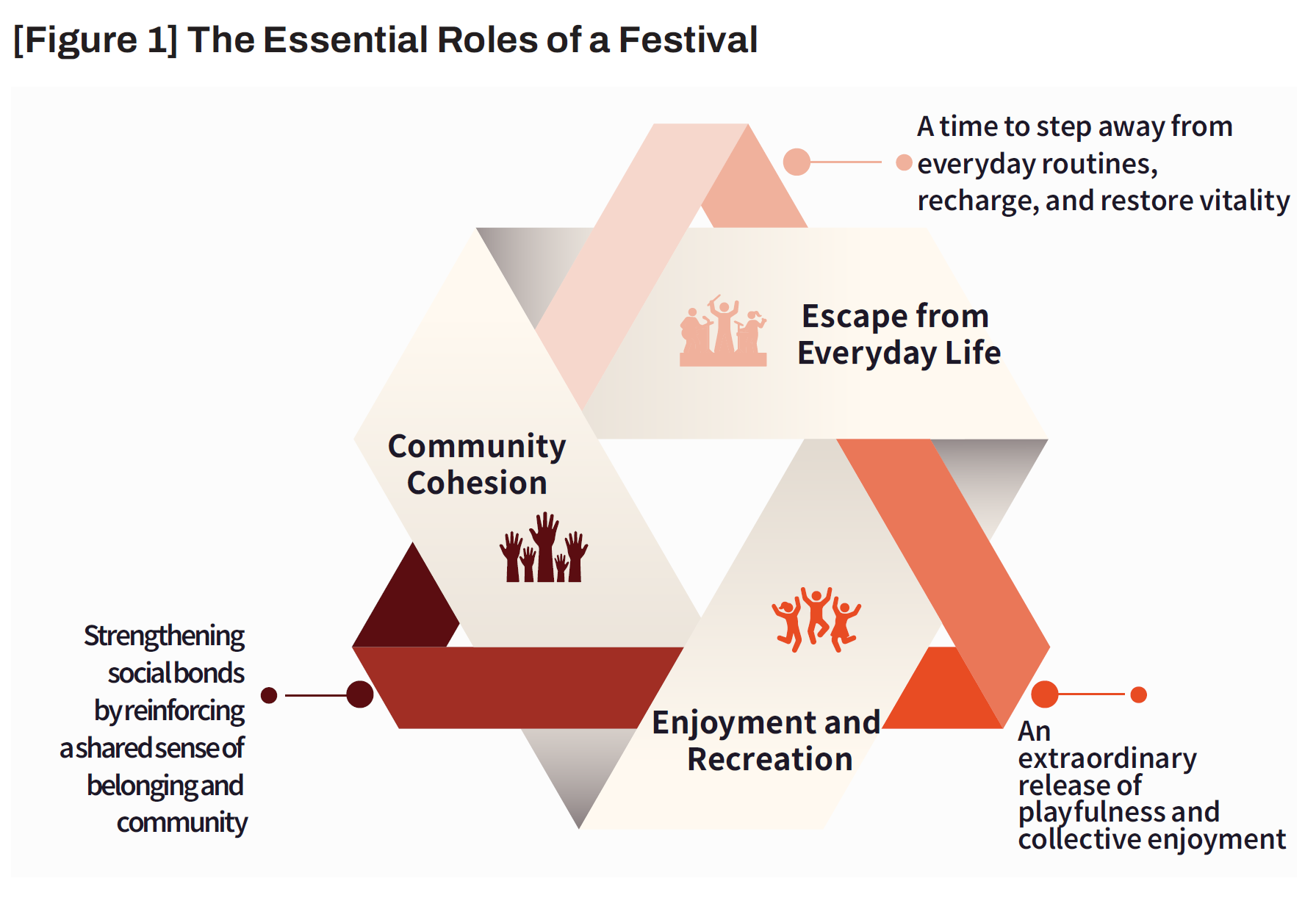
As eras changed, so did the role of festivals. In ancient times they were strongly ritual in character, praying to heaven and the gods for abundance and safety. In the medieval period they became spaces of liberation and transgression—a brief escape from rigid social order and class. In the modern era they expanded into arenas of identity that reaffirmed the historical and cultural identity of nations and regions. And in the contemporary period they have evolved into complex play-and-business assets, combining individual enjoyment and the appreciation of culture and the arts with the attraction of tourists and the revitalization of local economies. Through it all, the essence of the festival remains clear: it is an experience of briefly stepping outside the structures of daily life, sharing intense communal emotion with others, and enjoying pleasure together.
This essence is explained clearly by three scholarly concepts.
- Liminality: The anthropologist Victor Turner (1969) saw the festival as a “threshold time” in which everyday social structure is temporarily suspended. In this special time and space, the boundaries of occupation, status, and class weaken, and participants form communitas—a powerful person-to-person bond. A representative example is the Boryeong Mud Festival, where complete strangers cover themselves in mud and romp together.
- Collective Effervescence: Émile Durkheim (1912) explained that when people gather in one space and share the same emotions and symbols, a collective energy arises that is hard to experience in everyday life. The sense of unity that emerges when tens of thousands cheer in unison at a single performance shows why festivals create social solidarity that goes beyond mere entertainment.
- Play & Enjoyment: The mimicry and ilinx (vertigo) emphasized by Roger Caillois (1958) appear especially strongly in festivals. The very experience of dressing differently, dancing, eating and drinking, and departing from everyday norms breathes vitality into life.
A good festival, therefore, is not simply an event that draws a crowd. It is a festival where people have an experience unlike their ordinary days, share that experience with others, and leave with joy and emotional energy etched into memory.
Figure 1. The Essential Roles of a Festival
Common Roots and Divergent Paths of East and West
Western carnival and Korea’s traditional heaven-worship rites developed in different cultural spheres, yet they interestingly share a common root in the living order of agrarian society. Western carnival is linked to the Roman Saturnalia, which honored Saturn, the god of agriculture; in Korea, heaven-worship rites such as Buyeo’s Yeonggo, Goguryeo’s Dongmaeng, and Dongye’s Mucheon were held in step with the agricultural cycles of sowing and harvest. Both traditions share the aim of praying for abundance and well-being and of strengthening communal solidarity through drink, song, and dance.
Their paths of development, however, differed. Where Western carnival strengthened a character of transgression, subversion, and chaos—briefly overturning taboos and the established order—Korean festivals developed the character of a daedong (grand unity) and harmony in which all residents mingle amid folk performance, drink, song, and dance. This difference offers an important implication for Korean festival development today. A globally competitive Korean festival need not be designed like famous overseas festivals. On the contrary, reinterpreting the cultural DNA of Korean festivals—togetherness, grand unity, participation, and communal emotion—as a contemporary experience can become a source of differentiated competitiveness.
The Multifaceted Roles of Festivals: Cultural, Social, Psychological, Economic, Tourism, and Brand
The contemporary festival has become a multifaceted cultural form that performs several layers of roles at once rather than serving a single purpose. A festival simultaneously carries a cultural role of transmitting tradition and identity; a social role of fostering communal harmony and integration; a psychological role of providing escape from the everyday and playful satisfaction; an economic role of revitalizing the local economy; a tourism role of forming attraction and inbound channels; and a brand role of branding a region or nation. In Korea especially, amid the crisis of population decline and regional extinction, the festival is being re-examined as a powerful cultural-tourism asset that regions can leverage and as a strategy for regional survival.
Why Festivals Move Tourists: Push–Pull Tourism Motivation
If the sociological and anthropological essence of festivals explains why people love festivals, tourism-motivation theory explains why they choose a particular festival among many. According to the Push–Pull framework developed from the classic tourism-motivation studies of Dann (1977) and Crompton (1979), tourism behavior arises from the combination of motivations generated within the individual and external inducements offered by the destination.
Push factors concern “why do I want to travel?” They include escape from a dull routine, stress relief, the desire for new experiences, strengthening bonds with family and friends, and social interaction. Pull factors, by contrast, concern “why here, of all the many options?” A festival’s distinctive content and programming, food, atmosphere, cultural symbolism, scenery, and participatory activities draw tourists to a particular place. The accompanying research likewise defines a festival’s appeal as the function of Pull factors that convert Push desires into an actual choice to visit.
From this perspective, this study defines Festival Attractiveness as “tourists’ cognitive and affective evaluations formed with respect to a festival’s unique Pull factors that influence the decision to visit.” Here a crucial distinction arises. “Do people know about the festival?” and “Do those who know or have experienced it like it?” are two different questions.
However excellent a festival may be, if people do not even know it exists, it cannot enter the evoked set of potential tourists. Conversely, even a festival with high awareness and much buzz will struggle to translate into long-term revisits and recommendations if the actual experience falls short of expectations. Festival competitiveness, then, should be viewed not as a single number but along two axes at once: cognitive evaluation and affective evaluation. In the research model, the former is measured through social buzz volume as Awareness, and the latter through sentiment analysis as Attractiveness.
Put simply, if a film’s awareness is its box-office draw and buzz, its attractiveness is closer to actual audience evaluation and satisfaction. A box-office hit is not necessarily well reviewed, and an excellent work does not necessarily succeed at the box office. Just as one must look at both indicators to see where a work stands in the market, a festival, too, must be viewed along both awareness and attractiveness for an accurate diagnosis of competitiveness.
The Current State of Korean Festivals: From Quantitative Expansion to a Question of Competitiveness
The Surge of Local Festivals After Decentralization
Korea’s traditional festivals were originally closer to a living culture in which residents prepared and participated together in step with agricultural cycles. For each seasonal marker—Jeongwol Daeboreum, Dano, Baekjung, Chuseok—village organizations prepared festivals, and rather than separating stage from audience, they had a strongly communal, daedong character in which the entire community took part.
The decisive turning point at which modern local festivals began to surge was the full implementation of local autonomy in 1995. As local governments came to design their own tourism and cultural policies, festivals began to be actively used as policy instruments to promote regional specialty products, attract tourists, improve regional image, and revitalize the economy. The 1996 introduction of the Culture & Tourism Festival system likewise accelerated this trend. The accompanying research data confirm that from the 1990s onward, new local festivals increased sharply while the festival’s center of gravity shifted from the transmission of tradition and history toward tourism products leveraging agricultural specialties and natural resources.
As a result, the number of domestic local festivals more than doubled, from 555 in 2014 to 1,214 in 2025. In particular, between 2019 and 2025, festivals in the Seoul Capital Area rose 10.4% (from 230 to 254), while those outside it rose 46.8% (from 654 to 960). This shows that regions facing relatively greater risk of population decline and regional extinction have more actively used festivals as a survival strategy to draw in external demand.
Figure 2. Trend in the Number of Planned Local Festivals Nationwide (2014–2025)
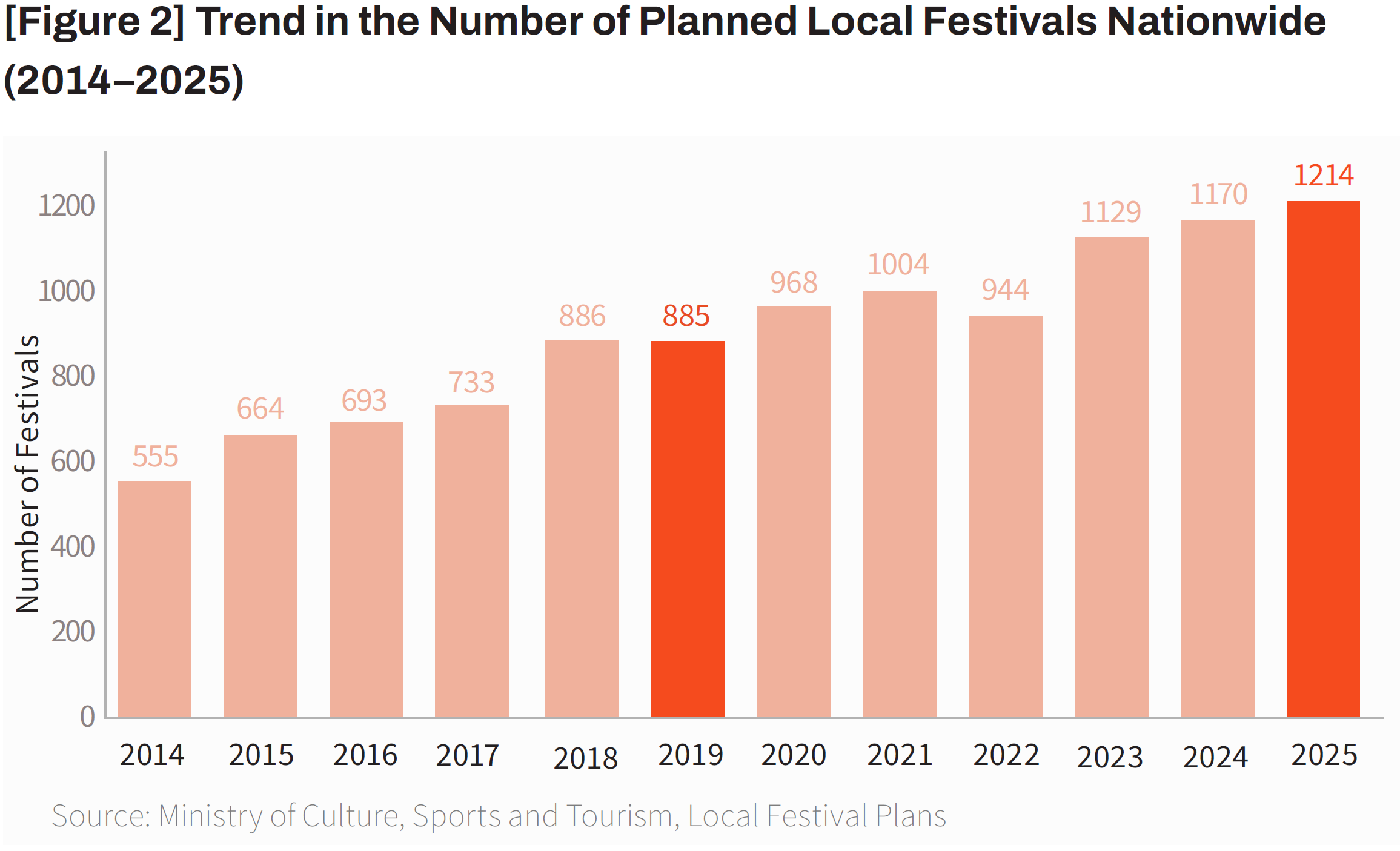
Source: Ministry of Culture, Sports and Tourism, Local Festival Hosting Plans
The expansion of festivals is not, in itself, a bad thing. Even in regions where manufacturing or large-scale facility investment is difficult, a region’s food, history, nature, people, culture, and stories can be converted into tourism products in a relatively short time. The problem is that the pace at which the number of festivals increases does not match the pace at which their market competitiveness rises.
Quantity Grew—But Did Quality Follow?
Between 2019 and 2025, nationwide festival budgets expanded significantly. On the basis of the accompanying data, total festival budgets rose from about KRW 342.4 billion to KRW 619.5 billion, and the average budget per festival rose from about KRW 400 million to around KRW 520 million. At the same time, however, 741 festivals—61% of all festivals in 2025—were small-scale events with budgets under KRW 300 million; 381 had budgets under KRW 100 million, and 182 ultra-small festivals had budgets under KRW 50 million.
On the operator side, about 70.7% of all festivals in 2025 fell within the public sphere—governments, local authorities, committees, and public foundations. Notably, among festivals less than five years old, the share directly hosted by governments or local authorities was 40.5%, whereas among festivals 50 years or older it fell to just 8.3%. The longer a festival has endured, the more the private sector and local community tend to play the larger role.
Figure 3. Trend in Total Festival Budget and Average Budget per Festival
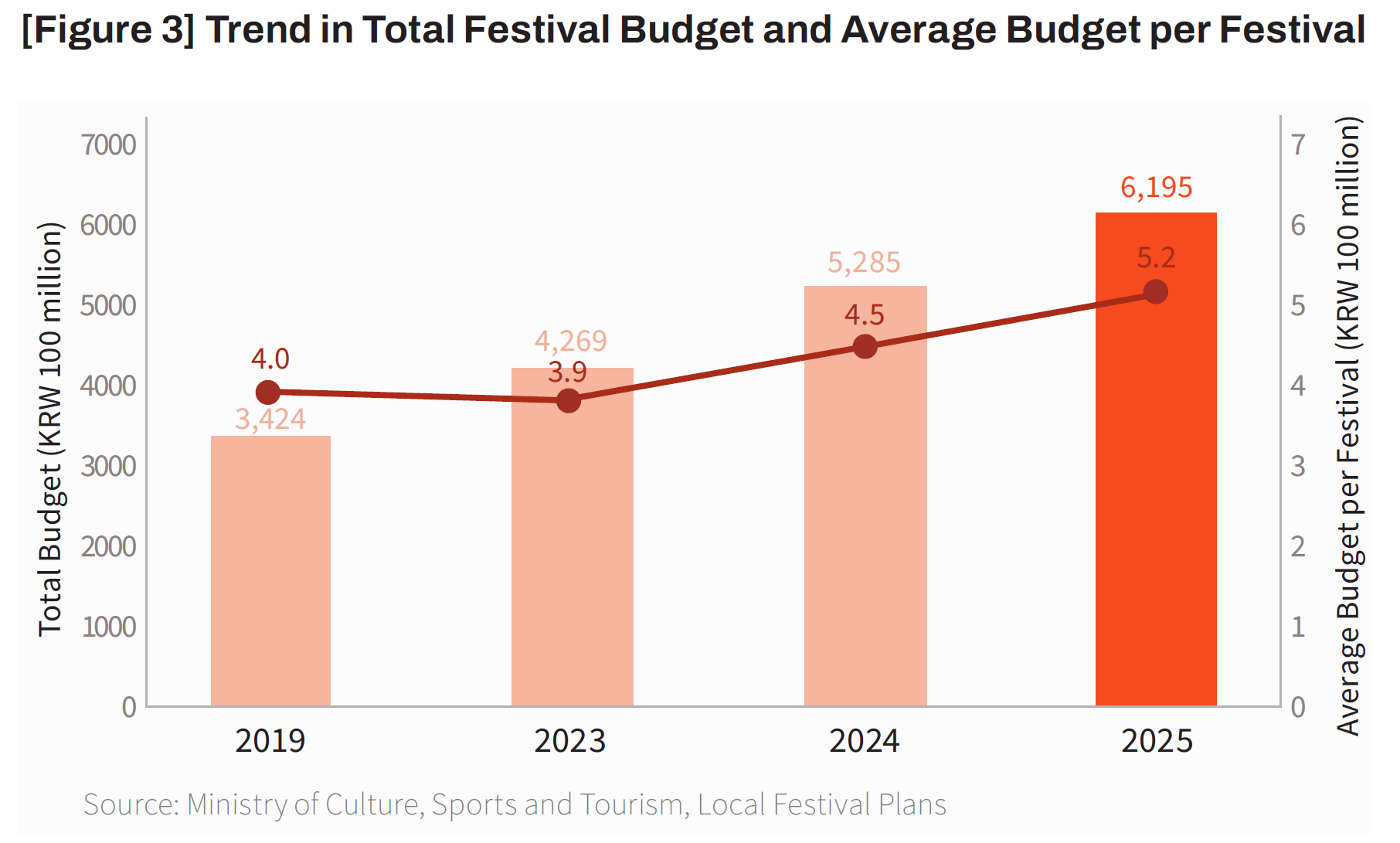
Source: Ministry of Culture, Sports and Tourism, Local Festival Hosting Plans
Content overlap is also conspicuous. Looking at 2025 festivals by theme, there were 210 festivals related to specialty and local foods, 185 flower-related festivals, and 120 night-themed festivals; the single keyword “cherry blossom” appeared in 53 festivals alone.
Of course, the fact that cherry blossoms or local food serve as festival themes is not itself a problem. The problem is that there are too many festivals that are mutually substitutable in the eyes of tourists. If the structure is one of seeing similar flowers in the same season, buying similar specialty products under similar tents, and watching similar stage programs, tourists find little reason to travel far to a distant region.
Thinking of Korea’s festival market as a single commercial district makes this easier to understand. An increasing number of shops can signal a vibrant district. But if the number of shops grows faster than the number of customers, if most shops sell the same menu, and if poorly performing shops keep operating anyway, then the number of shops is no longer a source of competitiveness—it becomes a problem of oversupply and a lack of differentiation. The question Korea’s festival policy must ask, therefore, is not “how many festivals should we cut?” The more important question is, “What unique value does each festival provide, and for whom, and how do we build a portfolio of festivals with distinct roles?”
Warning Signals from Participation and Spending
Quantitative expansion does not necessarily lead to expanded tourist participation. As noted above, residents’ participation in local festivals fell nationwide in 2024 compared with 2019, with an average decline of about 8.6 percentage points. This is especially important. If a local festival is not merely a one-off event for tourists, then residents accepting the festival as part of their own culture and life, and participating in it, is a crucial foundation for the festival’s sustainability. If residents drift away from planning and participating, leaving only an event for outside visitors, the festival may actually weaken the region’s own identity.
Ultimately, the problem Korea’s festivals face is not simply that “there are too many festivals.” The more fundamental issue is that differentiated identity, consumer experience, and systems of continuous performance evaluation and learning have not kept pace with the quantitative growth.
The Root Cause: A Structure Dominated by Supplier Logic
These problems stem not from the chance failure of individual festivals but from structure. The root cause is a structure dominated by supplier (local-government) logic, which produces four problems at once.
- Easy to launch, hard to review. Festivals under KRW 300 million are exempt from prior investment review and integrated disclosure (Article 3 of the Local Finance Investment Project Review Rules; Article 60 of the Local Finance Act), so they are launched easily without external verification and are hard to compare and verify nationwide. The budget for new festivals rose from KRW 48.5 billion (14%) in 2019 to KRW 113.5 billion (19%) in 2025—about one-fifth of the total budget now goes to festivals launched within the past five years.
- Severe similarity and duplication. With 53 cherry-blossom-themed festivals and 185 flower-themed festivals in total (15% of all festivals), festivals on the same theme are held repeatedly in the same period, erasing differentiation.
- Identity lost to vanity projects. When showcasing an official’s achievements within their term takes precedence over a festival’s own content, no identity forms. In practice, surges of new festivals recur after new local officials take office.
- Entrenched polarization and a proliferation of ultra-small festivals. A structure is taking hold in which a few large festivals and ultra-small festivals with budgets under KRW 50 million (182 of them) increase simultaneously.
What Successful Festivals Share: Irreplaceability
Conversely, festivals that sustain their competitiveness over the long term all have a clear answer to the question, “Why must one go there, of all places?” Korea, too, has cases where identity beat budget. Gangwon’s Hwacheon Sancheoneo (Ice Fishing) Festival, without a large budget or a Seoul-area location, began in 2003 with 220,000 visitors and has drawn more than one million for 18 consecutive years; in 2026 it welcomed 1.68 million visitors over 23 days. It recorded average per-capita spending of KRW 80,930, a direct economic effect of KRW 101.8 billion, and KRW 138.97 billion including ripple effects—and, selected by CNN as one of the “7 Wonders of Winter,” it secured global awareness without any separate marketing. Irreplaceable content—“an experience possible only in that region” (ice fishing)—overcame disadvantages of budget scale and location.
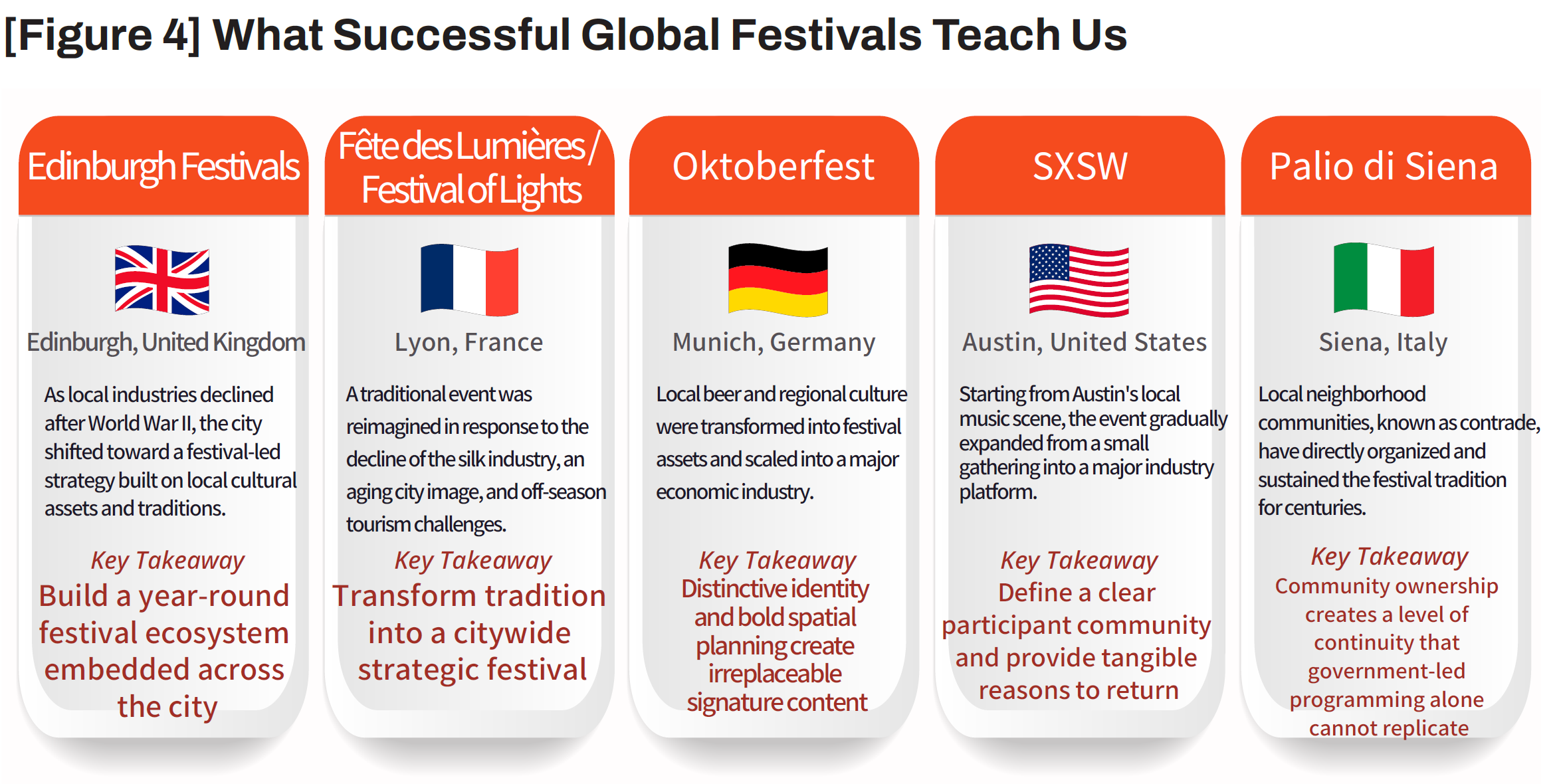
World-class festivals, too, grew around not scale or budget but “an experience possible only there”—that is, a firm identity. Edinburgh turned the entire city into a festival stage and built a year-round festival ecosystem; Lyon reinterpreted its traditional light culture as a strategic city festival. Oktoberfest expanded Munich’s unique assets of beer and local culture to industrial scale; SXSW began in Austin’s music scene and gave a clearly defined group of participants a reason to return again and again. Siena’s Palio draws its competitiveness from the very tradition of a local community that has prepared the festival itself for more than a thousand years. The common thread is not scale or budget but a clear target, a reason to revisit, and irreplaceable killer content.
Figure 4. What Successful Global Festivals Teach Us
Four Paradigm Shifts for Korean Festivals
Strengthening the competitiveness of Korean festivals requires more than improving individual programs; it requires changing the very principles by which festivals are planned, operated, and evaluated. The direction is a shift from supplier-centered to demand-centered, from quantitative expansion to qualitative deepening, from administrative logic to market logic, and from domestic-oriented to global-oriented. These four are not separate tasks but a single process of transforming the festival from “an event supplied by administration” into “an experience product that tourists choose and evaluate.”
① Supplier-centered → Demand-centered: Change the criteria of evaluation.
The shift to demand-centered means judging festival performance by what visitors experienced, not by what organizers provided. Visitor counts and event scale are still necessary, but they alone cannot explain a festival’s competitiveness. Going forward, we need a structure that continuously measures tourists’ responses—awareness, positive and negative evaluations of the actual experience, and the likelihood of revisiting and recommending—and links these to the next year’s planning and budget.
The key is not merely collecting data but using it in real decisions. For example, if awareness is high but attractiveness is low, one should improve content and operations rather than promote more; if attractiveness is high but awareness is low, one should strengthen product distribution and marketing. In other words, we must move from applying the same prescription to every festival to prescribing differently according to each festival’s problem.
② Quantitative expansion → Qualitative deepening: Make not “one more” but “the one that cannot be replaced.”
The core of qualitative deepening is not enlarging a festival’s scale but raising its non-substitutability. A festival must be able to answer the question, “Similar festivals exist in other regions, so why must I come to this one?”
Rather than continually creating new festivals, we should sharply define the core assets of existing festivals and reinforce them intensively. From a region’s history, food, nature, industry, and living culture, we should craft one “killer experience” that other regions cannot easily replicate, and consistently organize programming, space, food, products, and night-time content around it.
World-class festivals are strong not because they have many programs but because, at the mere mention of the festival’s name, an experience immediately comes to mind. Korean festivals, too, must shift toward being “the festival you go to because of this one thing,” rather than “the festival that has a bit of everything.”
③ Administrative logic → Market logic: Apply principles of growth, transition, and sunset to festivals.
Introducing market logic does not mean evaluating festivals solely by profitability. The key is to connect a festival’s purpose to its performance and to differentiate the mode of support according to the result.
Because each festival plays a different role, there is no need to apply the same yardstick. A tourist-attraction festival can be evaluated primarily by visits, spending, lodging, awareness, and attractiveness; a resident-harmony festival by resident participation and community effects; and a global-oriented festival by foreign visitors and overseas awareness.
Based on the results, portfolio management is needed that sorts festivals into ① intensive cultivation, ② maintenance and improvement, ③ consolidation and redesign, and ④ sunset. Festivals with high performance and potential should receive multi-year budgets and professional organizations, while similar or overlapping festivals, or those with persistently low performance, should be consolidated or have their very purpose redesigned. The essence of market logic is to change “a festival that continues once created” into “a festival that grows or transforms according to performance.”
④ Domestic-oriented → Global-oriented: Not a festival exported abroad, but one the world comes to.
Globalization does not simply mean increasing foreign visitors or expanding English-language signage. It means making the festival itself a destination-type product that international tourists choose as the main purpose of their trip.
What Oktoberfest, the Edinburgh Fringe, and Coachella have in common is that they are world-famous yet strongly bound to a specific place. As a festival recurs at the same time and place each year (“spatiotemporal fixity”), experiences and memories accumulate in that place, until the festival name and the city name fuse into a single brand.
Accordingly, the “Korean Coachella” plan the government recently announced should also clearly distinguish its pros and cons on the basis of the fundamental festival condition of “spatiotemporal fixity.” A touring overseas event can be effective for spreading K-content, but in terms of inbound tourism, the local economy, and city-brand formation, its effects are hard to accumulate in a specific domestic region. To become a global festival that represents Korea, one must set a firm home base in a Korean region and, while promoting content and brand abroad, design the core experience to be completed only in Korea. Only when people around the world buy plane tickets, stay overnight, and travel the region to see a festival does the festival’s global competitiveness convert into the competitiveness of Korean tourism—and, as a result, the festival’s economic fruits continue to accrue to Korea.
Table 1. Four Paradigm Shifts for Korean Festivals
| From | → | To | Key content |
|---|---|---|---|
| Supplier-centered | → | Demand-centered | From visitor counts to experience quality; a new experience-quality management system is required. |
| Quantitative expansion | → | Qualitative deepening | Not more festivals or bigger budgets, but greater completeness and differentiation of each festival. |
| Administrative logic | → | Market logic | Festivals endure or adjust according to demand and performance—not an official’s term or administrative convenience. |
| Domestic-oriented | → | Global-oriented | Raise domestic satisfaction in the short term; design for a global audience in the long term. |
From Declaration to Execution: Five Axes of Innovation
The four paradigm shifts above cannot be achieved by declaration alone. To translate them into actual policy, innovation is needed simultaneously along five axes: evaluation → restructuring → operating body → institutions → globalization. These five axes concretize the four shifts into the execution question, “what should change, and how?”
Table 2. Five Axes of Innovation Korea’s Festivals Need
| Category | Axis of innovation | Key content |
|---|---|---|
| ① Evaluation | Establish demand-side, experience-centered evaluation | Adopt an evaluation system based on tourists’ voluntary response data—like the NOL Korean Festival Index—as a common national standard. |
| ② Restructuring | Consolidate and adjust festivals | Sunset persistently low-performing “zombie festivals,” and coordinate similar or overlapping festivals at the metropolitan/provincial level rather than by individual municipality. |
| ③ Operating body | Autonomous, permanent private-led organizations | Move beyond annually reconstituted temporary bodies to permanent organizations with multi-year budgets and specialists, so planning capacity accumulates. |
| ④ Institutions | Close the review/disclosure blind spot | Reform the structure in which festivals under KRW 300M escape investment review and integrated disclosure—which induces “festival splitting”—to enable nationwide comparison and verification. |
| ⑤ Globalization | Pursue global branding | Rather than distributing budgets evenly across all festivals, select and concentrate support on a few flagship festivals and pursue global branding with multi-year budgets. |
These five axes are not sequential steps but a single system that works together, and its starting point is the first axis: establishing demand-side, experience-centered evaluation. To judge what to consolidate (②), which organization should run operations (③), which institutional blind spots to close (④), and which festivals to grow into global brands (⑤), one must first be able to measure “which festivals are competitive, and why” by the same standard across all festivals. Without the common language of measurement, decisions on the other four axes inevitably revert to administrative convenience and qualitative judgment.
It is precisely here that the need for the NOL Korea Festival Index begins. Measuring—by a single standard—which festivals tourists actually know, which they like, and why they evaluate them positively or negatively: KFAI is the core infrastructure for establishing ① demand-side, experience-centered evaluation among these five axes of innovation, and the foundation that supports the other four with data.
NOL Korean Festival Index (KFAI): What Was Measured, and How
First, Defining “What Is a Festival”
To compare festivals nationwide by the same standard, the first step is to clearly delimit the boundary of what is studied. If everything under the name “event”—sports matches, concerts, expos, conferences, local festivals—were included, essentially different objects with different visit motivations and experience structures would be placed in the same ranking.
Building on the prior work of Getz (2008) and van Vliet (2019), this study operationally defined three conditions a festival must meet.
Table 3. Three Necessary Conditions of a Festival
| Requirement | Meaning | Excluded |
|---|---|---|
| Planning | Intentionally planned and organized, with operations, safety, crowd flow, and communication structured in advance. | Spontaneous crowds and voluntary assemblies; everyday permanent attractions. |
| Spatiotemporal Fixity | Held at a specific place for a defined period, with clear start and end points. | Events whose dates or venues shift each time; irregular or ad hoc events. |
| Purposefulness | Participants share a common purpose—cultural enjoyment, community participation, tourism experience. | Pure sales-promotion events; private events such as weddings, reunions, and workshops. |
First is planning. A festival must be intentionally planned and organized, with its structure—operations, safety, crowd flow, communication—designed in advance. Accidentally formed crowds, voluntary assemblies, and everyday permanent attractions are therefore excluded.
Second is spatiotemporal fixity. A festival must be held at a specific place for a defined period, with clear start and end points. This is the criterion that distinguishes it from events whose schedule and venue keep changing or that occur irregularly.
Third is purposefulness. Participants must share a common purpose—cultural enjoyment, community participation, tourism experience. Pure sales-promotion events and private events such as weddings, reunions, and workshops fall outside this scope.
Even when the three conditions were met, cases whose participation motivation and experience structure differ essentially from a festival were excluded. A sports match centers on the game itself and its win or loss; a solo concert by a particular artist centers on consuming one performer’s content as the visit motivation; conferences and expos are often chiefly for information exchange and business transactions. On the other hand, music festivals such as Coachella or Glastonbury—where many artists, food, space, participatory programs, and community experience combine—were included as a single complex festival experience. This operational definition means more than mere academic classification: only by comparing comparable objects do the index’s rankings and scores acquire strategic meaning.
Methodology: Building a Single Sampling Frame of 1,452 Festivals Nationwide
The research team built a candidate pool of events promoted or referred to as festivals across Korea’s 255 basic-level local governments. By integrating the Ministry of Culture, Sports and Tourism’s 2025 and 2026 local-festival hosting plans, Korea tourism–related databases, and festival information from the KOPIS performing-arts integrated computing network, it set a sampling frame of 1,452 festivals.
Table 4. Summary of the Research Methodology
| Item | Details |
|---|---|
| Objective | Develop a social-big-data-based index of the attractiveness of domestic festivals. |
| Sample frame | 1,452 festivals nationwide (all events promoted or referred to as “festivals” across Korea’s 255 administrative districts). |
| Collection method | Collect social data by evaluation element using keyword sets tailored to the research objective. |
| Data channels | Channels selected after excluding news (dominated by promotional material and incident/issue articles): YouTube, Instagram, Blogs, Facebook, X (Twitter), Community (Café). |
| Study period | Most recent 12 months: July 2025 – June 2026 (data aggregation). |
| Data & analysis | Buzz volume and sentiment analysis of social data by element (Korean-language data). |
| Data partner | VAIV Company. |
The survey proceeded broadly in three stages: target selection → social-data collection → indicator computation. To capture each festival precisely, the team designed not only festival names and related keywords but also exclusion terms to remove homonyms and low-relevance documents, and inclusion terms to capture actual festival experiences. Throughout collection, an iterative refinement process was applied to retain only documents consistent with a tourism purpose.
The analysis period is the most recent year, from July 2025 to June 2026. Data channels included YouTube, Instagram, blogs, Facebook, X (formerly Twitter), and online communities and cafés. News, by contrast, was excluded from analysis: it is likely to contain a large volume of promotional coverage by local governments or organizations and articles tied to specific incidents or issues, which the team judged to diverge from the research objective of measuring tourists’ voluntary experiences.
Collection and analysis of Korean-language social data were carried out in collaboration with VAIV Company. In this process, by removing duplicate and near-duplicate documents, spam, and text unrelated to the study objects, the focus was on accurately capturing consumers’ voices about actual festivals rather than simply amassing a large volume of data.
This approach differs in character from a traditional survey. If an on-site survey captures visitors’ responses to questions the researcher set in advance, social data observes what consumers themselves said was important before the researcher asked. It therefore holds especially high diagnostic value when there is a gap between the elements festival operators consider important and the elements tourists actually talk about.
How AI Reads Tourists’ “Raw Voices”
The collected unstructured text was classified as Positive, Neutral, or Negative using a Transformer-based AI language model. Unlike traditional dictionary methods that merely count the frequency of specific positive or negative words, this model processes—within context—not only words, phrases, and sentence structure but also diverse linguistic signals such as typos, negation, punctuation, emojis, emoticons, and compound hashtags. In the final attractiveness computation, the accompanying research used positive and negative responses with a clear emotional direction and excluded neutral responses.
For example, the Korean expression “saram michyeotda” (literally, “people are crazy”) may, depending on context, be a complaint about extreme crowding or a strong positive expression that a performance was amazing. This is why sentiment must be interpreted together with the surrounding context rather than judged from a single word.
Importantly, AI sentiment-analysis results should not be interpreted as the absolute satisfaction of all visitors. Those who post on social media are not a random sample of all visitors, and user characteristics differ by platform. What KFAI captures is therefore, more precisely, “the collective market signal of tourists formed in open digital spaces.” When this characteristic is clearly understood, social data becomes not a substitute for surveys but a powerful complement that provides broad, continuous consumer responses hard to obtain through conventional research.
Two Independent Engines: Awareness and Attractiveness
The most important design principle of the NOL Korean Festival Index (KFAI) is to measure awareness and appeal separately.
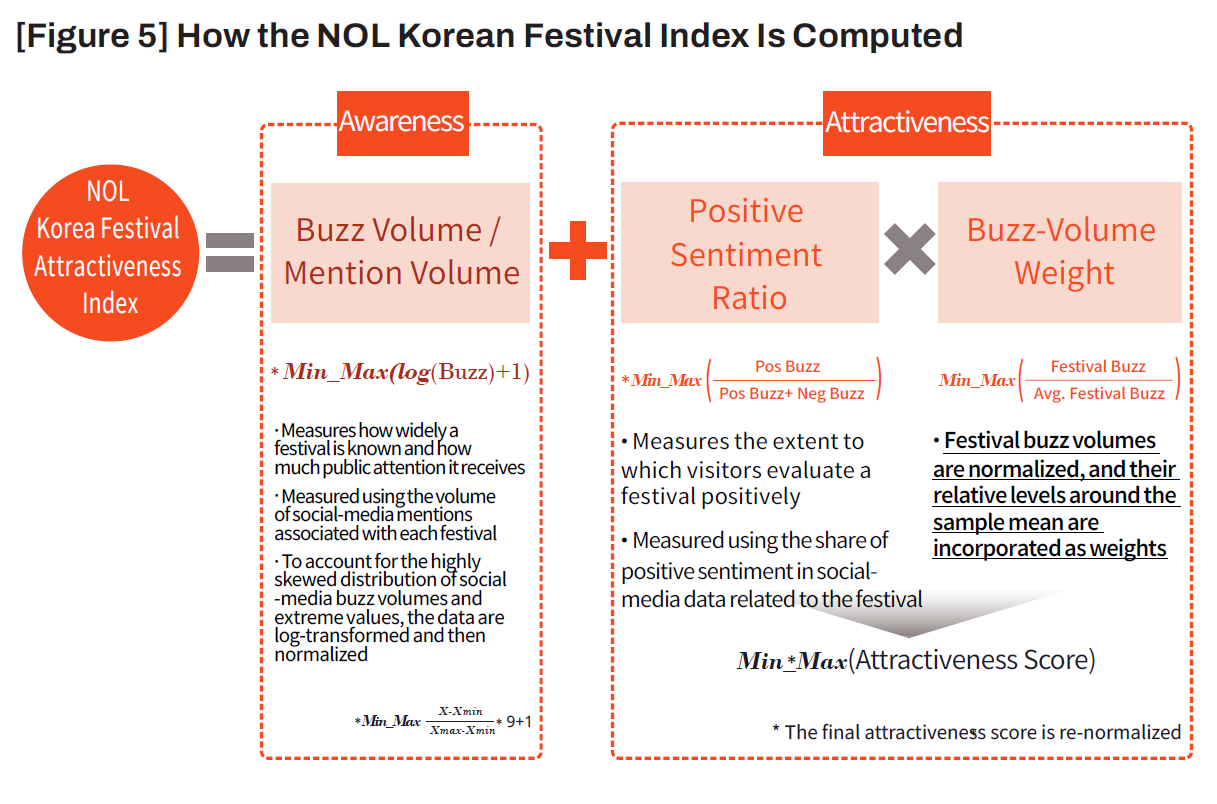
Awareness: “Do people know this festival?” Awareness indicates how much a given festival is mentioned and noticed in social spaces. The base data is buzz volume. By measuring how many festival-related documents are generated, it indirectly gauges how strongly the festival exists in tourists’ awareness.
However, comparing the raw data of a festival with very high mention volume—such as the Seoul International Fireworks Festival—directly against that of a small local festival can let a few extreme values distort the overall distribution. The study therefore applies a log transformation to buzz volume and then normalizes it, easing the overwhelming scale effect of large festivals. Finally, the awareness indicator is converted to a common 1–10 scale for easy comparison. Awareness means more than mere fame: however excellent a festival is, if potential tourists do not even know it exists, it cannot enter their consideration set. Awareness is thus a kind of entry condition for competing in the tourism market.
Attractiveness: “How highly do people rate this festival?” Attractiveness looks not at quantity but at the direction of evaluation. After classifying positive and negative sentiment in festival-related e-WOM, it computes the share of positive responses. In other words, it measures not simply “how much is being said” but “how positive what is said is.”
That said, treating a small festival with 100% positive evaluation from only a handful of mentions with exactly the same reliability as a festival that recorded a high positive share amid tens of thousands of mentions can create problems. To address this, the team normalizes each festival’s buzz volume and reflects the festival’s buzz share relative to the average as a weight, then re-normalizes attractiveness. That is, it considers not only the positivity of the evaluation but also the degree of market signal on which that evaluation rests. Attractiveness, too, is finally converted to a 1–10 scale.
Figure 5. How the NOL Korean Festival Index Is Computed
Computing the Index: Combining “Known” and “Liked” at 50:50
Finally, the NOL Korean Festival Index (KFAI) combines the two axes with equal weight.
KFAI = Awareness × 50% + Attractiveness × 50%
The final index, too, is expressed on a 1–10 scale. The 50:50 structure carries a clear strategic meaning: a festival’s long-term market competitiveness comes not from a “festival that is merely famous” nor a “good festival that no one knows,” but from a festival that combines awareness with experience quality. Interpreting this as a 2×2 strategic positioning makes it even more useful.
- High-awareness, high-attractiveness festivals are market-leading flagship festivals; they can consider brand reinforcement and global expansion.
- High-awareness, low-attractiveness festivals are the type that many people know and visit but whose actual experience reveals problems; improving experience quality—programming, crowding, service, price, crowd flow—comes first.
- Low-awareness, high-attractiveness festivals are “hidden champions” with high experiential satisfaction that are not yet sufficiently known in the market; branding, promotion, and expanded distribution are effective prescriptions.
- Low-awareness, low-attractiveness festivals need a re-examination of their content identity and product structure itself, rather than simply more marketing.
Figure 6. The Awareness–Attractiveness 2×2 Strategy Matrix and Prescriptions by Type
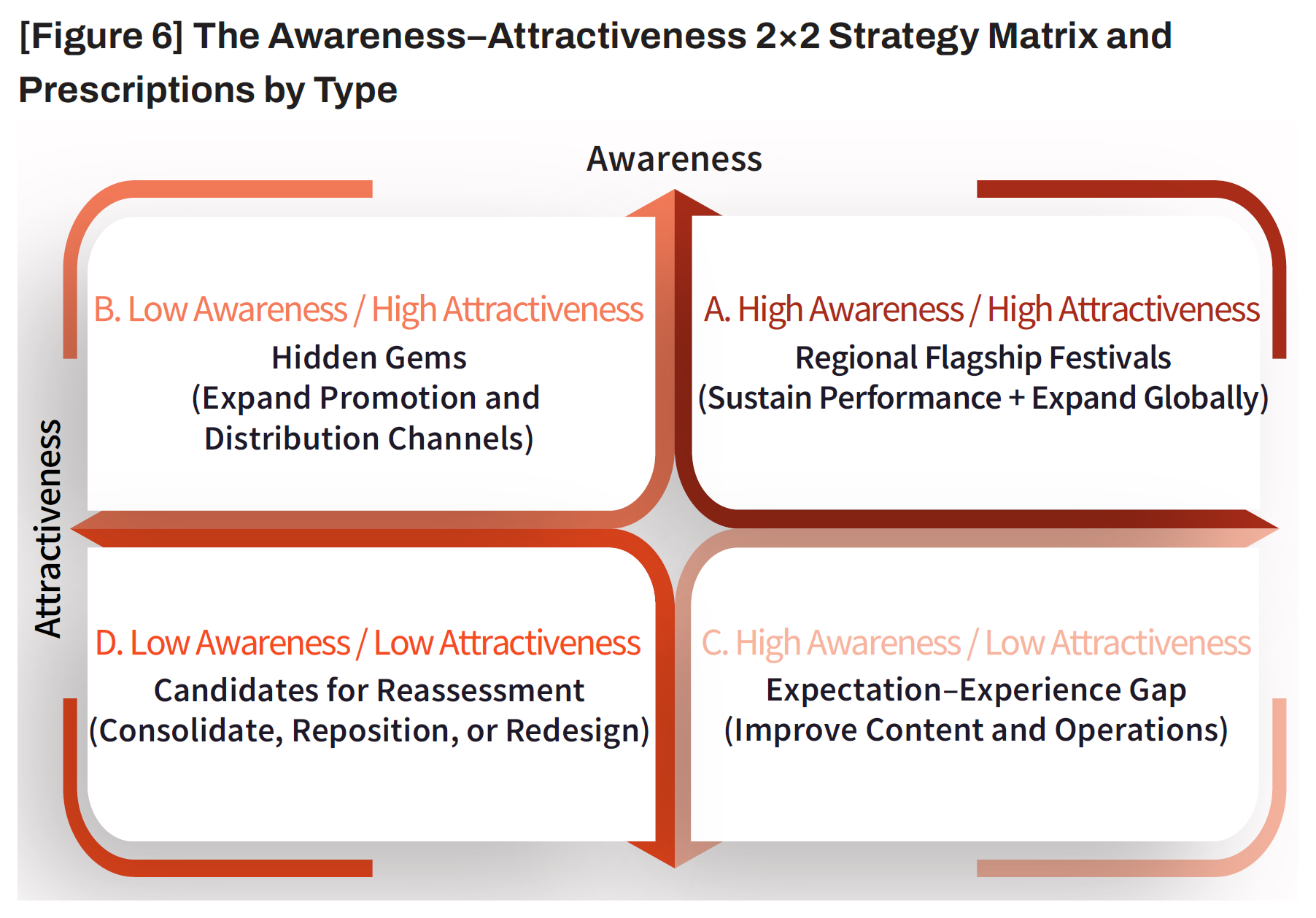
The core purpose of KFAI, therefore, is not to line festivals up from first to last. Its greater value is as a market-diagnosis tool that identifies why a festival’s competitiveness is high or low and thereby makes different prescriptions possible.
One point must be clearly distinguished when interpreting KFAI. The values converted to a 1–10 scale are normalized comparative indices, not absolute satisfaction rates from a survey. An attractiveness score of 8.0 must not be read as “80% of tourists were satisfied.” It is a scale for conveniently expressing a festival’s relative competitiveness against other festivals within the same analysis set and computation standard. At the same time, the index becomes far more valuable when measured by the same method every year: rather than merely comparing this year’s 1st place with its 50th, one can track whether each festival’s awareness and attractiveness are improving relative to its own past. The accompanying model is designed so that, if published annually, it can serve as a time-series management tool that tracks year-on-year change by dimension, not just ranking.
More Important Than Rank: “Position” and “Direction”
The study sorts festivals by overall rank into Tier 1 (ranks 1–50), Tier 2 (ranks 51–100), and Tier 3 (ranks 101–150), and manages the festivals ranked 151–200 among the 200 announced as a candidate group. It presents not only the overall ranking but also awareness rankings, attractiveness rankings, and rankings by region, season, and type.
Figure 7. Announcement Criteria for the NOL Korean Festival Index Rankings
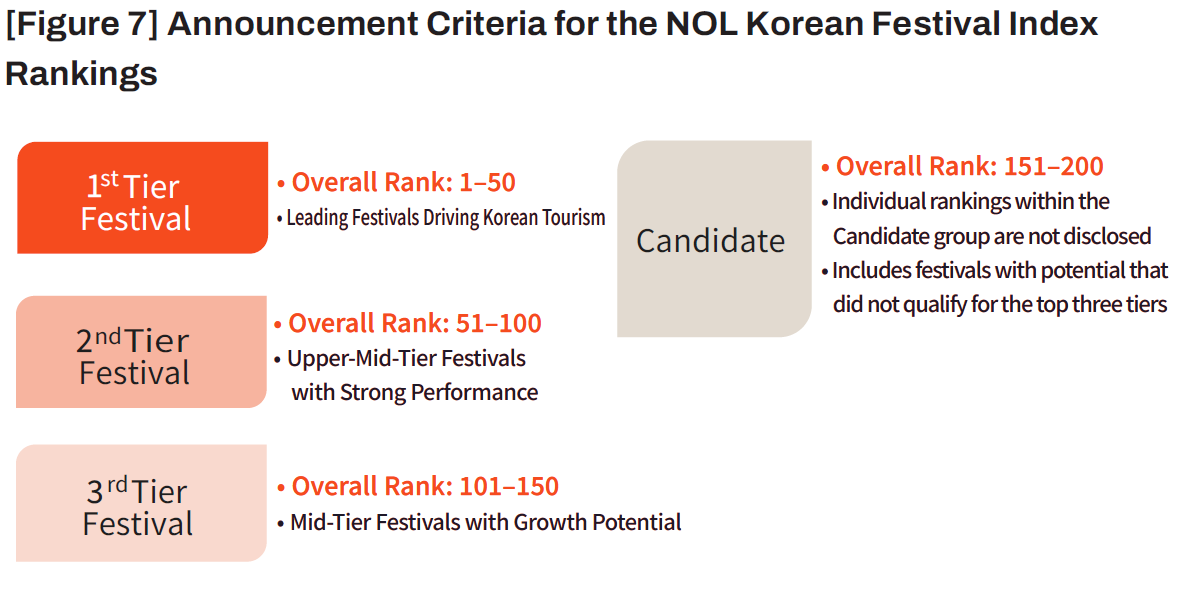
These multi-layered results matter because even festivals with the same overall score may have entirely different underlying problems. The same policy must not be applied to a festival with low awareness and one with low attractiveness: the former needs marketing and distribution, the latter needs improvement of its experience product. KFAI is therefore closer to a strategic map than a ranking table.
2026 Korea Festival Attractiveness Evaluation Results
As explained above, the 2026 Korea Festival Attractiveness Index (NOL Korean Festival Index, KFAI) sorted 200 festivals by overall rank into Tier 1 (1–50), Tier 2 (51–100), Tier 3 (101–150), and Candidate Cities (151–200). Rankings up to 150 within each tier group are included in the appendix of this report, and the full published results can be viewed on the Yanolja Research website below.
https://www.yanolja-research.com/festival/score?lang=en
Among all 1,452 evaluated festivals, first place overall went to the “Seoul International Fireworks Festival with Hanwha.” Held on just a single day in September or October each year in Seoul, it is hosted by the private company Hanwha. Rather than resting on regional uniqueness, it is an event powered by immense private capital—a scenery-type festival that combines fireworks shows by domestic production teams and invited overseas teams against the backdrop of the Han River waterfront and the city skyline.
Overall Top 20: The Strength of Nature/Ecology Festivals and Seoul’s Edge
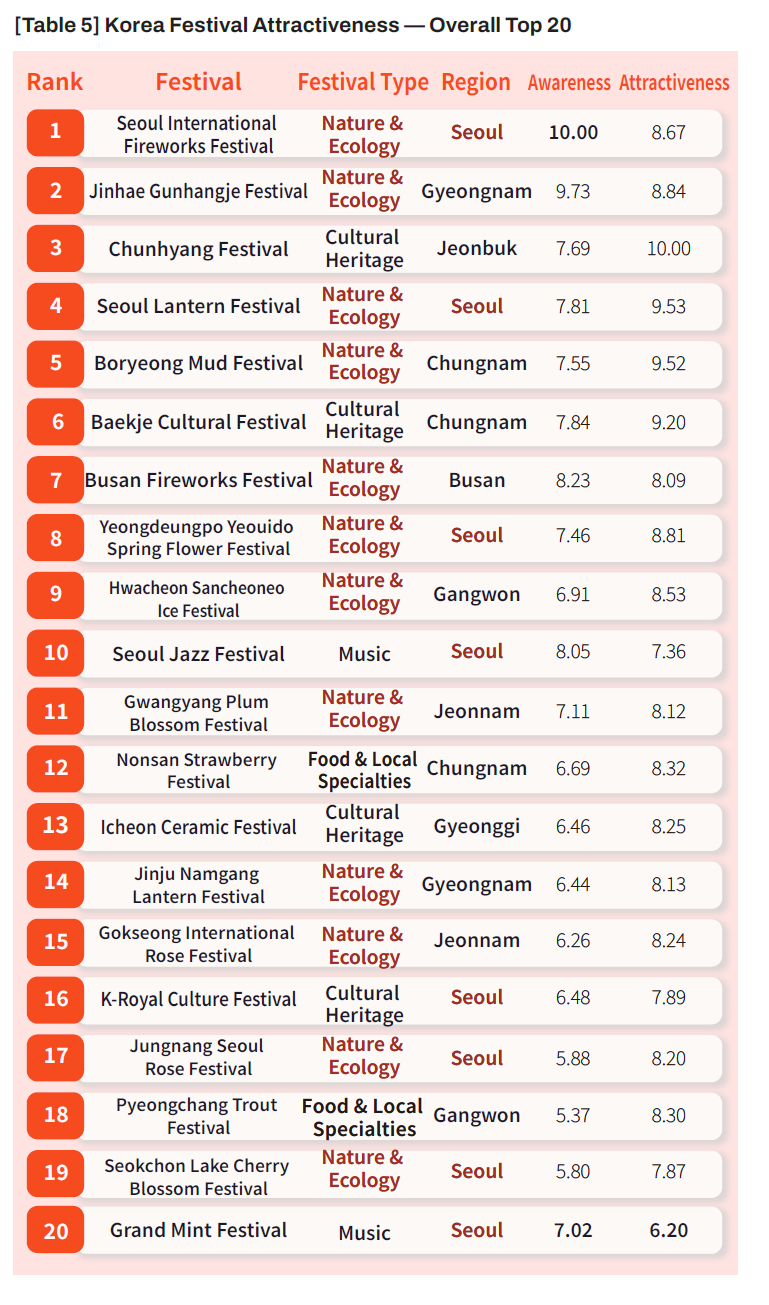
The Top 20 analysis shows that Korea’s festival market is led by nature/ecology festivals, and that Seoul festivals entered the very top ranks most often. Nature/ecology festivals, themed on natural scenery and seasonality, have a low barrier to entry and function as flagship content that relatively easily draws family visitors and local tourism demand.
As Table 5 shows, 12 of the Top 20 festivals (60%) were nature/ecology festivals. By region, Seoul showed an overwhelming edge over other regions in the diversity of festival types, with 8 of the Top 20 held in Seoul. Notably, the Seoul International Fireworks Festival, Seoul Jazz Festival, and Royal Culture Festival performed well on both awareness and attractiveness. This suggests that Seoul’s festivals are not concentrated in a single type but meet broad visitor demand with diverse content—evidence of Seoul’s competitiveness as a host city. Outside Seoul, local festivals with historicity and unique themes ranked at the very top on awareness and attractiveness: 2nd-place Jinhae Gunhangje, 3rd-place Chunhyangje, and 5th-place Boryeong Mud Festival. What these three share is a clear “reason it must be that place”—cherry blossoms (Jinhae’s naval port), the Chunhyang narrative (Namwon’s Gwanghallu), and the mud experience (Boryeong)—supporting this evaluation’s central finding that regional uniqueness raises attractiveness.
Table 5. Korea Festival Attractiveness — Overall Top 20
Top 20 Positioning: What Is Awareness, and What Is Attractiveness
Positioning the Top 20 by awareness (horizontal axis) and attractiveness (vertical axis) yields four groups. First, festivals high on both awareness and attractiveness include the Seoul International Fireworks Festival, Jinhae Gunhangje, Chunhyangje, Boryeong Mud Festival, Seoul Lantern Festival, Baekje Cultural Festival, and the Yeongdeungpo Yeouido Spring Flower Festival—the “flagship group” that forms the overall top ranks. Second, festivals relatively ahead on awareness include the well-known Seoul Jazz Festival and Busan Fireworks Festival; these draw much buzz but with experiential satisfaction that does not quite match, making content and operational improvement the task. Third, festivals relatively ahead on attractiveness are typified by the Hwacheon Sancheoneo Ice Festival—a “hidden champion” whose experience quality is already proven but which is not yet well known, for which promotion and awareness expansion are effective prescriptions. Within the Top 20, the lowest-awareness festival was the Pyeongchang Trout Festival (5.37), and the lowest-attractiveness festival was the Grand Mint Festival (6.20).
Figure 8. Korea Festival Attractiveness — Overall Top 20 Matrix
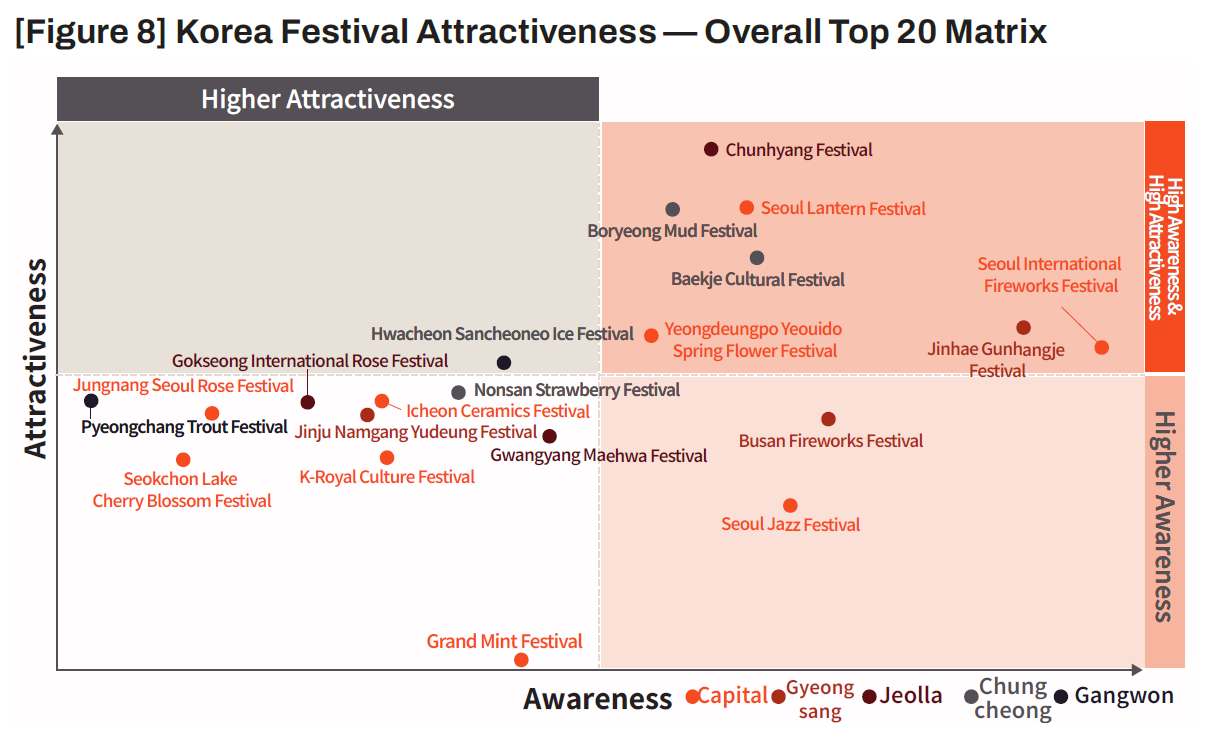
Expanding the positioning to the top 100 makes the structure by type even clearer. Music festivals showed a “high-awareness, low-attractiveness” structure, while flower and local-specialty festivals showed a “low-awareness, high-attractiveness” structure; fireworks and lantern festivals scored high on both. By region, non-metropolitan areas showed a “low-awareness, high-attractiveness” structure relative to the Capital Area—suggesting not that the experience quality of non-metropolitan festivals is low, but that a structural disadvantage in awareness formation constrains their overall ranking.
Korea Festival Awareness / Attractiveness Rankings
We now examine the rankings by dividing the index into awareness and attractiveness. Separating the two indicators is meaningful because it reveals in which dimension—“being known” (awareness) or “being liked” (attractiveness)—each festival is competitive, and thus what prescription it needs.
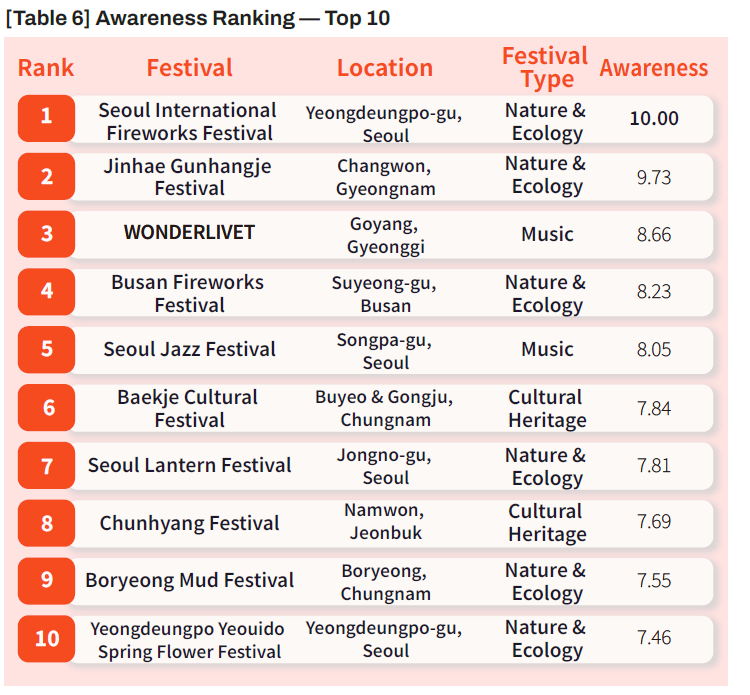
On awareness, the Seoul International Fireworks Festival ranked 1st, with Jinhae Gunhangje and Wonderlivet 2nd and 3rd. Among the top 50, nature/ecology types numbered 18 (36%), rising to 12 (48%) within the top 25, and 11 Seoul-based festivals sat in the upper awareness ranks. This is interpreted as a consequence of the relatively high population density of Seoul and large cities: because awareness rests on online mention volume (buzz), regions with larger populations and better access naturally generate more buzz.
Table 6. Awareness Ranking — Top 10
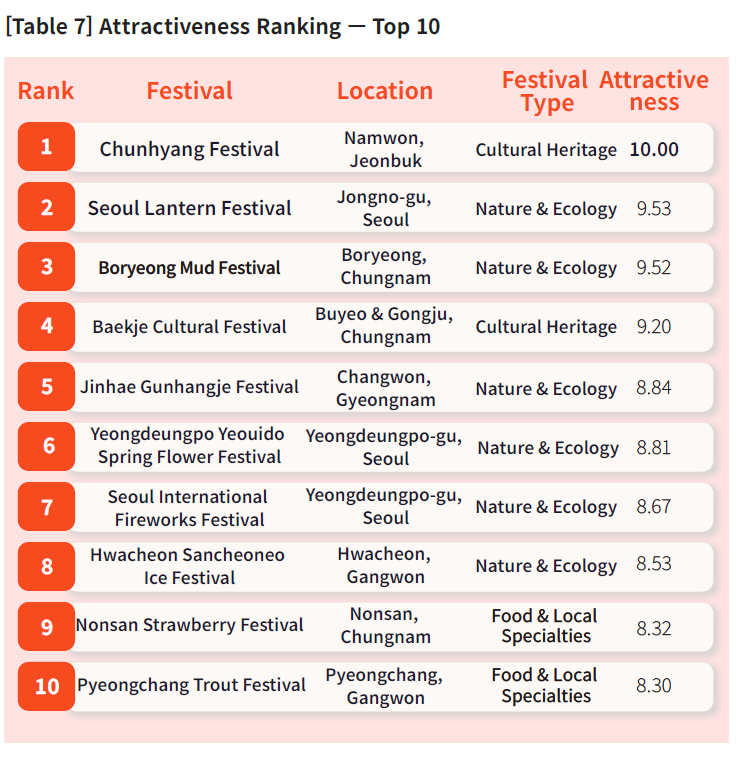
On attractiveness, Chunhyangje ranked 1st, with the Seoul Lantern Festival and Boryeong Mud Festival 2nd and 3rd. Among the top 50, nature/ecology types numbered 22 (44%), rising to 14 (56%) within the top 25—so the strength of nature/ecology types stood out even more on attractiveness than on awareness. Chunhyangje’s 1st place on attractiveness shows the underlying strength of a local festival. One of Korea’s longest-running local festivals, held in and around Gwanghallu Garden in Namwon, it makes the narrative and characters of the Chunhyang tale the organizing axis of the entire festival—a cultural-heritage festival. It radiates appeal through diverse content: ancestral rites and performances, folk games and gugak (traditional music) competitions, a Chunhyang selection contest, and parades. Because it rests on a local narrative, it forms a differentiation that cannot be reproduced elsewhere. That such cultural-heritage festivals score high on attractiveness in Korea’s festival market is an important finding of this study.
Here it becomes clear that awareness and attractiveness operate independently. Wonderlivet, 3rd on awareness, fell sharply on attractiveness and out of the Top 10, whereas the 8th, 9th, and 10th on attractiveness—the Hwacheon Sancheoneo Ice Festival, Nonsan Strawberry Festival, and Pyeongchang Trout Festival—did not make the awareness ranking. A “well-known festival” and a “festival people liked” do not necessarily coincide, showing that the two indicators must be managed as separate objects.
Table 7. Attractiveness Ranking — Top 10
Rankings by Festival Type
In this evaluation, Korean festivals were classified by their signature content into five types: cultural heritage, music, arts, food/local products, and nature/ecology. Evaluating by type—rather than lining up festivals of disparate scale and region in a single row—allows comparison among festivals of the same character, clarifying where each festival stands among its peers and what it should benchmark. This is an important task for the development of Korean festivals. For reference, average composite indices by type (Top 200) were highest for nature/ecology (64 festivals · 4.94), followed by food/local products (49 · 4.55), cultural heritage (44 · 4.44), music (23 · 4.40), and arts (20 · 4.00). Figure 9 shows the rankings by type.
Figure 9. Korea Festival Attractiveness — Rankings by Type
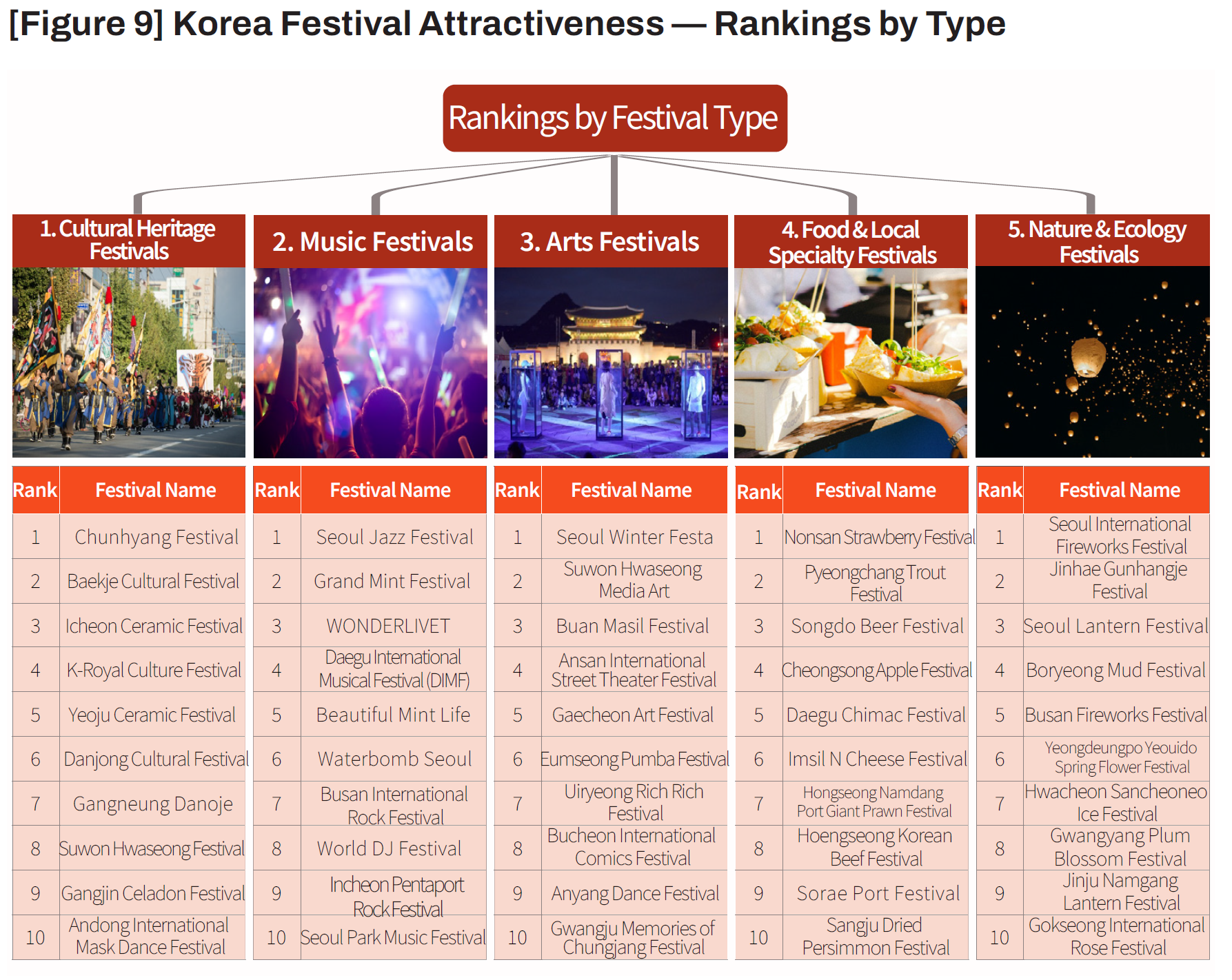
Cultural-heritage festivals experience tradition, history, ritual, and communal identity. The highest composite scores went to 1st Chunhyangje, 2nd Baekje Cultural Festival, and 3rd Icheon Ceramics Festival. Most are non-metropolitan local festivals that draw on their region’s unique content: indeed, 13 of the cultural-heritage Top 20 were festivals grounded in traditional culture such as ceramics, mask dance, and boat play. Festivals that did well in this type possess both historicity and uniqueness, indirectly suggesting that a festival cannot win visitor support in a short time. The key is how much unique narrative it shows while becoming steadily known to potential visitors. The fact that this type’s average attractiveness rank (102.0) is ahead of its average awareness rank (110.7) fits the same logic: becoming widely known takes time, but the satisfaction of visitors who have experienced it is high.
Music festivals are participatory festivals centered on performances, artists, and on-site atmosphere. The highest scores went to 1st Seoul Jazz Festival, 2nd Grand Mint Festival, and 3rd Wonderlivet. Of the top 15 music festivals, 13 were in the Capital Area—reflecting the residential density of the core pop-music audience and the region’s excellent transportation access. For such festivals, genre identity, large-scale staging, audience participation, and on-site energy are the core appeals, and creating a sense of collective immersion for visitors is the key to success. That said, music festivals show the sharpest imbalance among the five types. Their average awareness rank of 81.6 is first among all types, but their average attractiveness rank of 153.0 is last—a gap of −71.5. A buzzy lineup strongly drives inflow, but on-site crowding, value-for-money satisfaction, and operations erode the experience evaluation—so this is the “most known but least satisfying” type, which warrants caution.
Arts festivals center on creative content such as fine art, performing arts, and design. The highest scores went to 1st Seoul Winter Festa, 2nd Suwon Hwaseong Media Art, and 3rd Buan Masil Festival. Beyond appreciating works, artistic expression, and stage and exhibition production, exchange between creators and audiences is a core appeal. Arts festivals are evenly represented in the upper ranks across diverse regions, so they are worth planning even at the local level. However, their average composite index (4.00) is the lowest of the five types: without a clear differentiator such as strong local color or media art—like the top festivals—performance variance widens greatly.
Food/local-product festivals are themed on food, drink, and regional products. The highest scores went to 1st Nonsan Strawberry Festival, 2nd Pyeongchang Trout Festival, and 3rd Songdo Beer Festival. Appeal forms as visitors directly consume a region’s flavors and produce; gastronomic experience and securing the uniqueness of local-specialty brands are success factors. This type is stronger outside the Capital Area than within it: 13 of the Top 20 were themed on regional specialties, and a notable feature is their even nationwide distribution rather than concentration in the Capital Area. Here, too, attractiveness (87.8, 2nd among types) is ahead of awareness (103.8)—interpreted as “consumption participation” (directly eating and buying) translating immediately into satisfaction.
Finally, nature/ecology festivals center on visual materials and performances such as the natural environment, seasonal scenery, and flora and fauna. The highest scores went to 1st Seoul International Fireworks Festival, 2nd Jinhae Gunhangje, and 3rd Seoul Lantern Festival. They draw on natural-ecological resources—mountains, seas, flowers, animals, seasons, cityscapes—and sometimes stage performances that harmonize with natural scenery using artificial elements such as fireworks, lanterns, and hot-air balloons. It is an interesting result that 11 of the nature/ecology Top 20 were flower-themed. This type has the highest average composite index (4.94) of the five, with awareness (2nd) and attractiveness (1st) side by side at the top—showing it is flagship content that, with a low barrier to entry, simultaneously draws family visitors and local tourism demand.
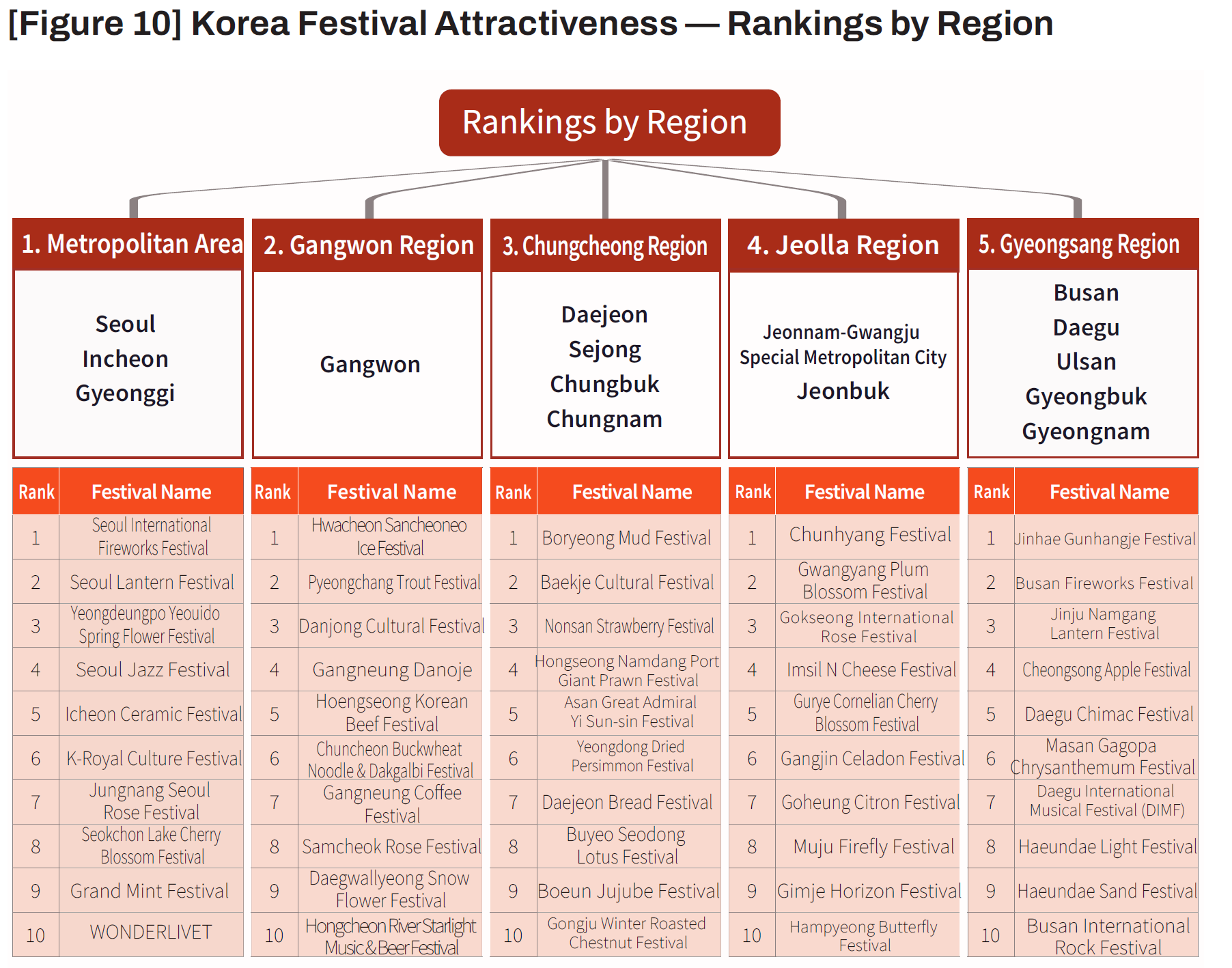
Rankings by Region
Dividing the Top 200 festivals into six broad regions, the Capital Area (61) and the Gyeongsang region (53) held large shares, while Jeolla (34), Chungcheong (30), Gangwon (19), and Jeju (3) were relatively lower. The densely populated Capital Area and Gyeongsang region showed strength, confirming a high correlation between accessibility and festival performance.
Table 8. Composition and Characteristics of the Top 200 by Region
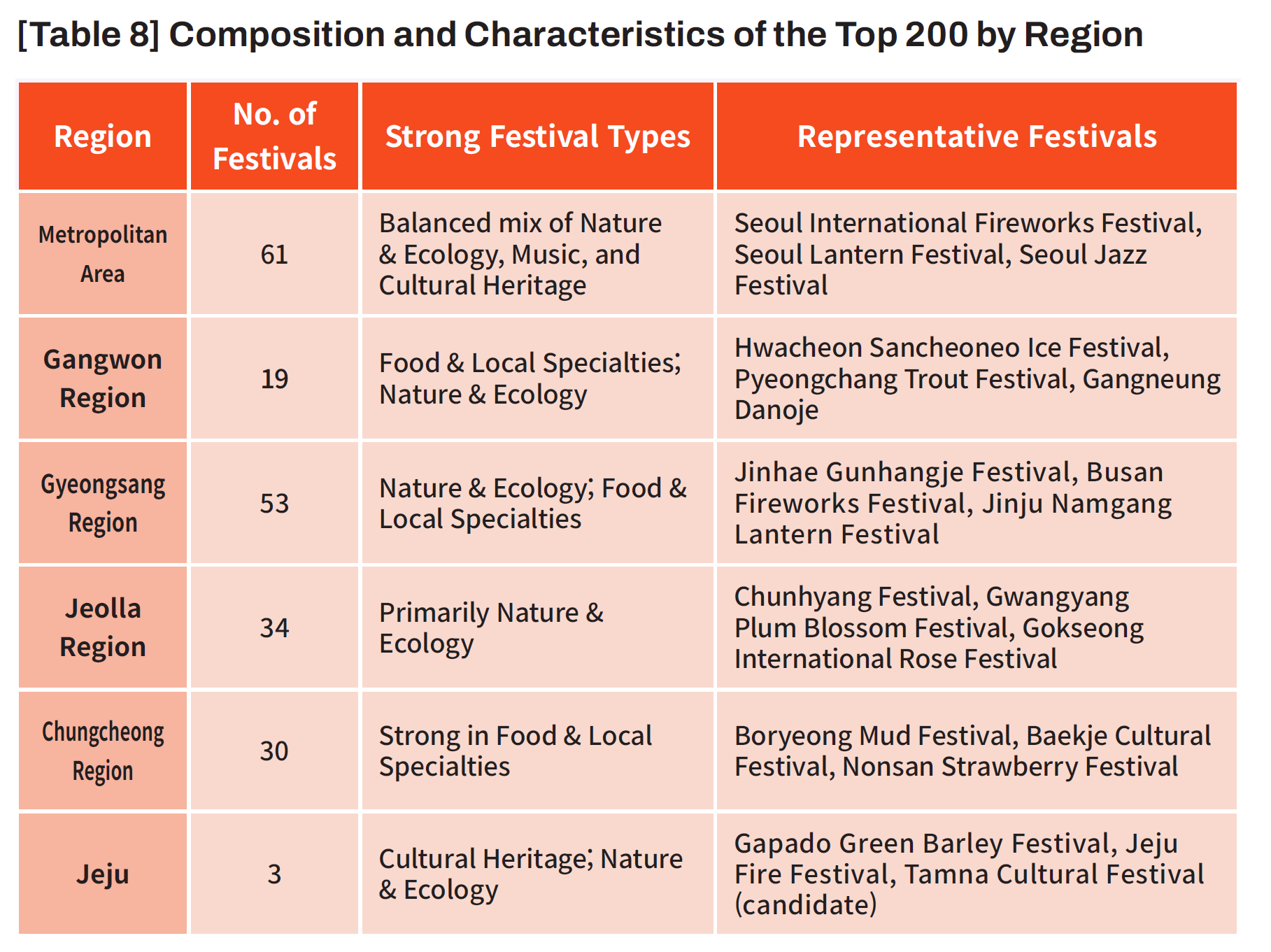
Each region’s representative festival was analyzed as follows: the Seoul International Fireworks Festival (Capital Area), Hwacheon Sancheoneo Ice Festival (Gangwon), Boryeong Mud Festival (Chungcheong), Chunhyangje (Jeolla), and Jinhae Gunhangje (Gyeongsang). Regional character is also distinct. The Capital Area has the greatest type diversity, with nature/ecology, music, and cultural heritage evenly distributed; Chungcheong is a “gastronomy region,” where food and specialty types reach about half (≈50%); and Jeolla is a “nature region,” with nature/ecology highest at about 41%. Jeju, with a sample of only three, is better interpreted around candidate festivals than by ranking.
Figure 10. Korea Festival Attractiveness — Rankings by Region
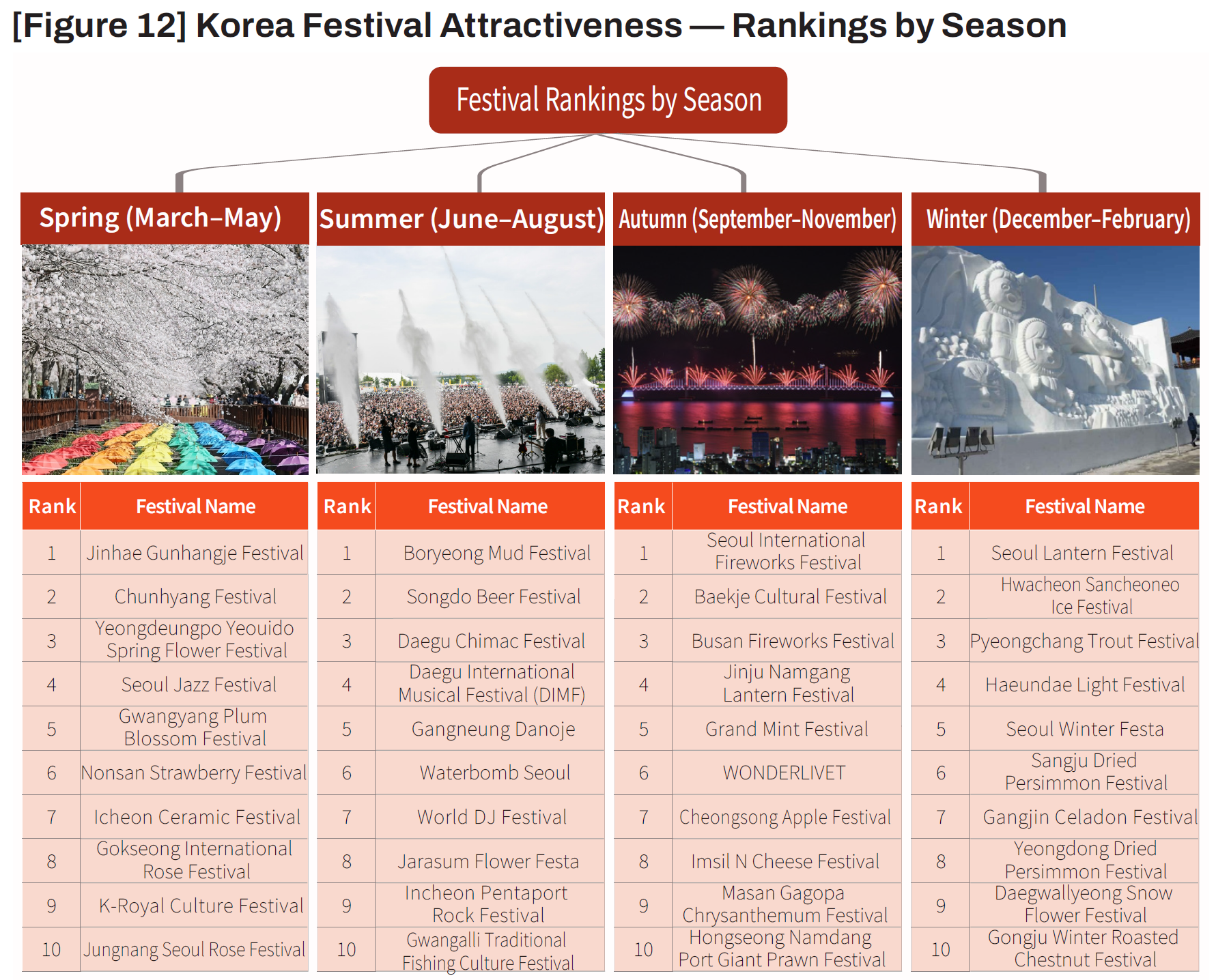
Rankings by Season
With Korea’s four distinct seasons, festivals differ in character and regional distribution by season. Looking at the Top 200, autumn festivals were overwhelmingly the most numerous at 90, followed by spring (60), summer (34), and winter (17).
Yet the core of this analysis is that the season with the most festivals is not the season of best performance. On the contrary, the average composite index by season ran Winter (5.06) > Spring (4.88) > Autumn (4.41) > Summer (4.26): winter, with the fewest festivals, recorded the highest performance. This is interpreted as follows: the more festivals cluster in a particular period (autumn), the more similar festivals cannibalize one another for visitors and buzz, whereas off-season festivals, with less competitive pressure, are relatively advantaged.
Dominant types also split by season. Spring and winter favor nature/ecology festivals (flowers, snow, light); summer favors music festivals; and autumn favors food/local-product festivals. Each season’s representative festival was Jinhae Gunhangje (spring), Boryeong Mud Festival (summer), Seoul International Fireworks Festival (autumn), and Seoul Lantern Festival (winter).
Figure 11. Seasonal Composition of Korea’s Top 200 Festivals and Average Composite Index
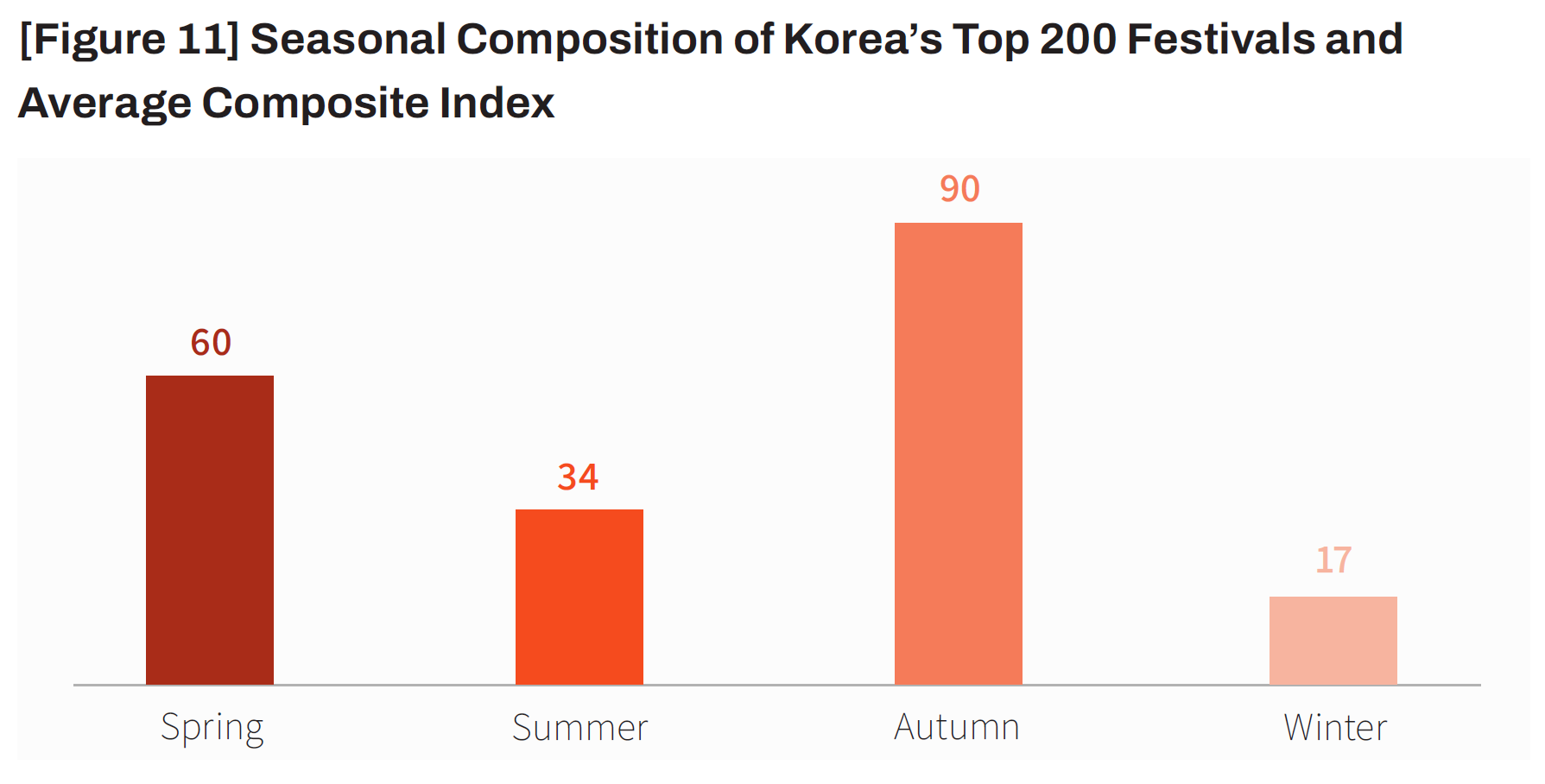
Figure 12. Korea Festival Attractiveness — Rankings by Season
Implications of the Results
Four Structural Features the Evaluation Revealed
This evaluation of Korea’s representative festivals is the first to turn the landscape of the Korean festival market into data along the two axes of awareness and attractiveness, and the result revealed four structural features. First, in terms of content, fireworks and lantern festivals that foreground night scenery were strong. Second, in terms of region, festivals in large metropolitan areas and in Chungnam and Gangwon took the upper ranks. Third, in terms of timing, festivals clustered most in autumn, yet composite scores were relatively higher for winter and spring festivals. Fourth—and most important—the two axes of festival evaluation, awareness and attractiveness, do not necessarily move in proportion.
Competitiveness Comes from “Experience,” Not “Scale”
These four are not separate facts but converge on a single message: a festival’s competitiveness comes not from scale or frequency of hosting but from “what visitors directly experience, in that place.” The results therefore point to three directions for action. ① Develop festivals grounded in regional uniqueness—start from assets a region already holds, rather than transplanting materials reproducible anywhere. ② Strengthen participatory, experiential content—shift from a “festival that shows” to a “festival that visitors do.” ③ Spread awareness through promotion—prioritizing festivals whose experience quality is already proven but that are less well known. These three are not sequential tasks but a single virtuous cycle to be pursued together: design good experiences (①·②) and make them widely known (③).
Practical Tools for Festival Stakeholders
This diagnosis does not stop at abstract recommendations; it provides concrete grounds for action to the three parties surrounding a festival.
For festival operators, it becomes a diagnostic tool for budget allocation. If the problem is awareness, promotion and branding come first; but if awareness is high while attractiveness is low, one should first improve the quality of programming, on-site operations, and content rather than buy more advertising. For the same “underperformance,” the prescriptions are opposite—so separating the two indicators is itself the starting point for preventing wasted budget.
For governments and local authorities, it provides a new data axis for performance management. Moving beyond evaluation centered on visitor counts, budget execution, and economic effects, they can also see tourists’ actual responses; and because it is measured the same way every year, they can track year by year whether consumer perception actually improved after a specific policy or marketing investment.
Through nationwide comparison, it enables benchmarking and portfolio strategy. Placing all festivals on the same coordinates makes it possible to discover festivals that are small in scale yet high in attractiveness, or to identify which festival among similar types built distinctive competitiveness. This becomes the basis for investing selectively according to growth potential and strategic role, rather than dividing a limited budget equally among all festivals.
The Tool’s Limits: A “Wide Ear,” But Not Everything
Great as this value is, one must guard against treating the Korea Festival Index as a replacement for all festival evaluation. Social data is very strong at continuously measuring consumers’ voluntary responses across a broad range. It is limited, however, in probing deeply why such evaluations arose, or in representing the views of visitors and residents who do not use social media. Social data therefore listens broadly; visitor surveys ask deeply; card and reservation data confirm actual consumption behavior; mobility data measures spatial ripple effects; and resident surveys verify community acceptance. Among these, the Korea Festival Index plays the role of an ear that listens broadly and continuously, every year, to the digital voices of tourists and potential tourists across the national festival market.
Beyond Rankings: What Must Change
This is the greatest distinction of the Korea Festival Evaluation. It looks at experience rather than scale, at tourists’ responses rather than budgets, and—rather than simply judging success or failure—uses data to pinpoint where the problem lies and what must change. The question this evaluation seeks to answer therefore does not end with “Which is Korea’s best festival?” It is a question beyond ranking: “Why are some festivals chosen and loved by tourists, and what must other festivals change to become more attractive?” Only when we can answer this question continuously, year after year, can Korea’s festival policy finally shift from a policy that manages the number of festivals to one that grows their competitiveness, and from festivals evaluated by suppliers to festivals proven by the experiences of tourists.
Strategies to Revitalize Local Festivals and Strengthen Korea’s Festival Competitiveness
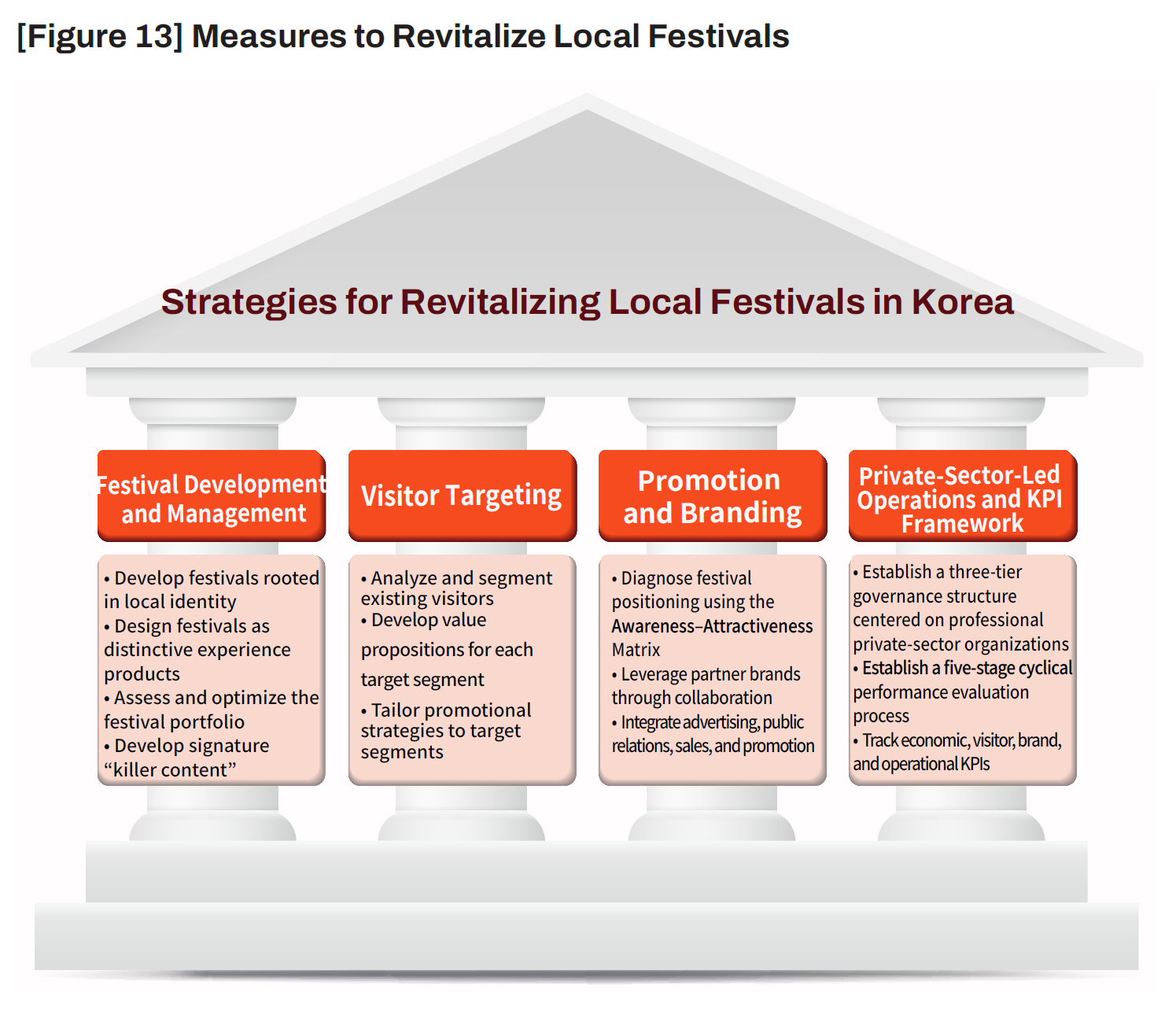
The reason the Korea Festival Evaluation results matter for cultural-tourism policy lies less in the rankings themselves than in the strategic grounds they provide for raising festival attractiveness. Because a festival is bound to the place of its region and predicated on continuity, crafting a detailed strategy is important. Rather than being led by the plans of festival agencies, local governments themselves need to plan and manage festivals grounded in their region’s own uniqueness. Where a region’s uniqueness is lacking, it can develop various types of festivals related to music, art, and entertainment. This study proposes strategic measures for revitalizing local festivals in four areas: (1) festival development and management, (2) customer targeting, (3) promotion and branding, and (4) private-led operation and building KPIs.
Figure 13. Measures to Revitalize Local Festivals
1. Festival Development & Management: What Festival Will You Show?
A festival’s competitiveness arises not from the buzz of its subject matter but from the festival’s “reason it must be that region” (only-ness). A festival that borrows material unrelated to regional identity may secure awareness but fails to build depth of experience or an inducement to revisit, and does not give visitors satisfaction rooted in uniqueness. In other words, the starting point of festival development is not “what is trending?” but “what does only our region have?” Comparing the top 50 and bottom 50 festivals in overall rank in this study, the more a festival’s subject matter is reproducible anywhere, the lower its attractiveness tends to be. A festival, moreover, should be made not an object of spectatorship but a product that residents lead and visitors directly experience. In the course of experiencing, it should induce immersion and evoke multiple senses, while memory devices act as a medium for voluntary diffusion. A festival that cannot be reproduced elsewhere—one with uniqueness—must be made into killer content. This is a matter not of the number of programs but of whether there exists a single experience that becomes the reason to visit. As killer content, a festival’s key requirements are singularity, participation, visual impact, and repeatability.
2. Customer Targeting: Who Will Truly Come to Our Festival?
Most domestic festivals aim to be “a festival for everyone,” yet fail to define whom the festival is actually for. Programs are organized without a clear value proposition for visitors and without an understanding of the customer, so festivals often fail to secure identity and uniqueness. It must be clearly defined who visits our festival, which visitors we will strategically focus on, and what value we will provide to our target customers. For example, if a festival is highly accessible to the MZ generation and targets that segment, then the festival’s program composition, products, and SNS-based promotion should all be organized accordingly.
3. Festival Branding & Promotion: How Will You Publicize Our Unique Festival?
A festival is a branded product. It needs a clear brand identity, core brand associations, and differentiated brand positioning. A systematic marketing approach tied to brand strategy is required—whether the festival holds clear and distinctive value, and what its core content and keywords are. Festival promotion through advertising/PR and sales promotion must also be conducted efficiently. That is, advertising and PR should make the festival’s existence and appeal known to arouse interest, and integrated marketing activities should convert that interest into visits. For sales promotion, for example, one should prepare diverse measures such as inducing advance reservations and pre-booking, bundling with travel products, generating group demand, and increasing on-site spending. Where awareness is low and attractiveness high, use promotion that raises awareness; where attractiveness is low and awareness high, use promotion that raises attractiveness—thereby improving marketing efficiency.
4. Private-Led Festival Operation & Building KPIs
Domestic festival operation suffers from single-year budgets, rotational personnel assignments, and organizing committees reconstituted each year, so planning capacity and content do not accumulate in the organization—often resulting in weak festival performance. A sustainable festival should be designed as a three-tier structure: a private professional organization ensuring continuity of planning and operation; the local government focusing on policy, support, and coordination; and the local community participating in execution. Multi-year budgets and continuity of participation for festival planners and operators must be guaranteed. For performance evaluation, a feedback loop of goal-setting → execution → evaluation → improvement should be built, and objectified “report cards” should be confirmed through KPIs constructed from multiple angles.
Conclusion: Toward an Era of “Experience Capital” Etched in Memory
The message this NOL Korean Festival Index (KFAI) sends to tourism policymakers and to the planners who lead the industry is clear. At this turning point away from an old tourism paradigm obsessed only with numbers and scale, supplier-centered administrative briefings—mobilizing charter buses nationwide to boast that “hundreds of thousands attended our festival this year” and leading with estimated economic effects—can no longer be sufficiently persuasive.
A festival of true greatness and sustainable competitiveness is never an event that pours in vast public taxes to build a giant stage, summons high-fee celebrities, and mobilizes a one-off crowd. Even for a single-day visitor who came from afar, it must become a place that leaves lasting joy of escape from the everyday, the communal bond felt together with strangers, and the emotion of positive energy. In this evaluation, Namwon’s Chunhyangje earned a perfect attractiveness score (10.00), and the Hwacheon Sancheoneo Festival won nationwide affection from a mountain valley of barely 20,000 people—showing, in the end, that a region’s own identity and the experience of participation, which no budget can easily imitate, are the most powerful competitive assets.
The three structural facts this analysis revealed point clearly to the path Korean festivals should take. First, awareness and attractiveness operate separately. A “widely known festival” is not a “festival that was good,” and the two must not be treated with the same prescription. Second, regional uniqueness and participation govern attractiveness. A festival that transplants material reproducible anywhere leads only on awareness and fails to create depth of experience. Third, festivals can now be diagnosed and managed with data. As a strategic map showing where each festival sits in tourists’ perception, KFAI enables different prescriptions—cultivation, diffusion, revitalization, and rationalization.
A still more important change is that the thrill and emotion—or the anger and disappointment—visitors feel on-site no longer scatter into thin air. They spread in real time across borders through the digital networks of global social media such as Instagram, TikTok, and YouTube, and accumulate, bit by bit, on servers worldwide as digital big data—that is, as Experience Capital. This accumulated emotional data influences a new traveler on the other side of the globe at the next opportunity, converting into a sustainable “pull” that makes them buy a plane ticket toward that city and festival.
The NOL Korean Festival Index released here will be published regularly each year, becoming a compass by which festival planners in each region and city track and improve, over time, the quality of experience that tourists actually feel. When Korea’s festival policy shifts from managing the number of festivals to growing their competitiveness, and from festivals evaluated by suppliers to festivals proven by the experiences of tourists, the powerful cultural premium of K-culture will finally be completed as a genuine tourism competitiveness that draws the world into Korea’s regions. The question remains simple: not “how many festivals should we create?” but “how do we create festivals that tourists want to return to?” The journey to find that answer with data has now begun.
References
Caillois, R. (1958). Les jeux et les hommes: Le masque et le vertige. Gallimard.
Crompton, J. L. (1979). Motivations for pleasure vacation. Annals of Tourism Research, 6(4), 408–424.
Dann, G. M. S. (1977). Anomie, ego-enhancement and tourism. Annals of Tourism Research, 4(4), 184–194.
Getz, D. (2008). Event tourism: Definition, evolution, and research. Tourism Management, 29(3), 403–428.
Turner, V. (1969). The ritual process: Structure and anti-structure. Aldine.
van Vliet, H. (2019). Events as interfaces: A framework for planned events.
[Appendix] Korea Festival Attractiveness — Overall Rankings (Download the full report, or check out our dashboard to see the full list: https://www.yanolja-research.com/festival/korea/score?lang=en)
 Prev
Prev  Back
Back