
Vol16. The Role of Daegu Airport in Inbound Tourism: Dual-Gateway Strategy for the Gyeongsang Region
- Reg Date
- 2026.08.31


The Role of Daegu Airport in Inbound Tourism:
A “Dual-Gateway” Strategy for the Gyeongsang Region
SooCheong Jang, Director at Yanolja Research & Professor at Purdue University / [email protected]
Kyuwan Choi, Professor at Kyung Hee University & Director at H&T Analytics Center / [email protected]
Dohyung Bang, Assistant Professor at the University of Houston / [email protected]
Deachul (David) Seo, Senior Researcher at Yanolja Research / [email protected]
Regional airports are becoming increasingly important as a means of easing the concentration of rapidly growing inbound tourism demand in the Seoul metropolitan area and revitalizing regional tourism. Recent discussions on regional-airport revitalization have moved beyond simply expanding international routes toward connecting foreign visitors arriving through regional airports with nearby attractions, thereby extending their stays and spreading tourism expenditure within the region. Local governments are likewise promoting cross-regional tourism linkages that connect tourism hubs across neighboring jurisdictions rather than focusing only on individual destinations.
In this context, Daegu Airport is also expected to expand its role as a regional inbound tourism hub by connecting foreign visitors not only to Daegu but also to major attractions in Gyeongbuk and other neighboring areas. In particular, if the wider transport network centered on Daegu is actively utilized, an expansion of international services at Daegu Airport could stimulate tourism demand not only in Daegu and Gyeongbuk but across the broader Gyeongsang region, including Busan. As a centrally located airport in inland Gyeongsang, Daegu Airport could further evolve from a regional airport focused mainly on short-haul routes into an international gateway capable of serving medium- and long-haul markets.
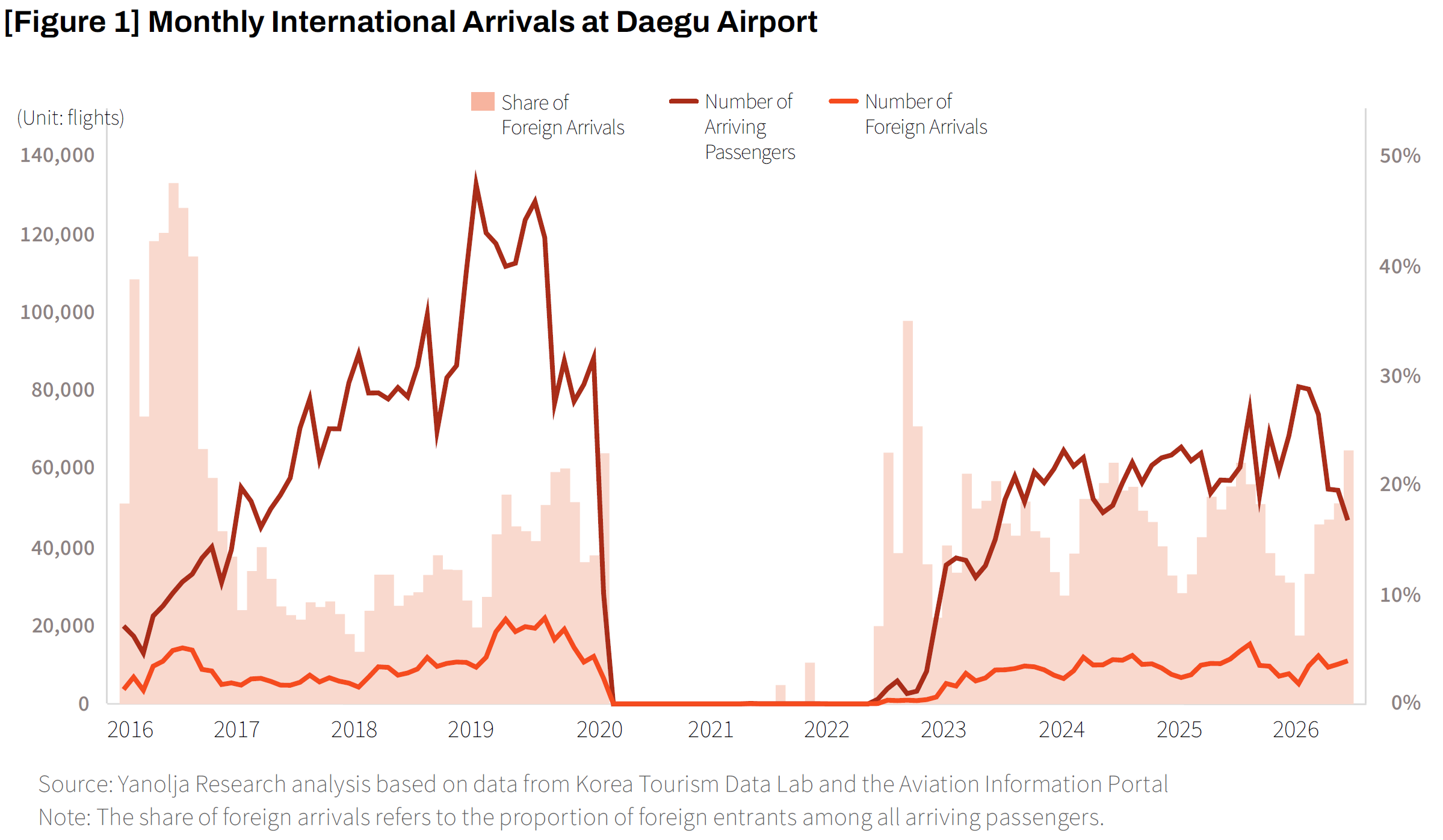
International passenger demand at Daegu Airport has been gradually recovering since the COVID-19 pandemic. However, the volume of international arriving passengers has yet to fully return to pre-pandemic levels. In 2019, monthly international arrivals exceeded 100,000 passengers at times, whereas during the recovery since 2023 they have generally remained below that level.
The recovery in foreign inbound demand has been even more limited. Before the pandemic, foreign nationals accounted for more than 40% of international arriving passengers at Daegu Airport in some periods, but recently the share has generally remained around 20%. This suggests that inbound demand through Daegu Airport has not yet fully recovered and that the airport’s current international demand structure still depends relatively heavily on outbound travel by Korean residents.
This outbound-heavy demand structure is closely related to Daegu Airport’s current route network. As of 2025–2026, the airport operates approximately 16 international routes, including services to Japan (Tokyo, Osaka, Fukuoka, and Sapporo), China (Shanghai and Zhangjiajie), Taiwan (Taipei), short-haul Southeast Asian destinations such as Bangkok, Da Nang, Nha Trang, Cebu, Chiang Mai, and Vientiane, as well as Guam. Most international routes are operated by low-cost carriers, and the current network is strongly characterized by short-haul leisure services shaped around Korean residents’ short overseas trips. At the same time, the relatively large share of routes to Taiwan and the greater China market provides a potential foothold for attracting inbound demand and suggests room to redesign the route portfolio with inbound tourism in mind.
[Figure 1] Monthly International Arrivals at Daegu Airport
When discussing Daegu Airport’s role as an inbound tourism hub, treating Daegu and Gyeongbuk as a single region is a natural starting point. In practice, however, tourists do not move according to administrative boundaries. To understand an airport’s effective tourism catchment area, it is necessary to examine where visitors actually travel rather than relying solely on jurisdictional borders. Accordingly, assessing the role Daegu Airport could play in regional inbound tourism requires looking at where foreign visitors to Daegu actually travel afterward.
Tourists Visiting Daegu Continue on to Busan
This study analyzed tourist movements from Daegu to major cities using foreign visitors’ travel paths derived from mobile-device data. The analysis covers 2025 and therefore involves some time lag relative to the present. The telecom data are estimates based on LG U+ data adjusted by the data provider, and may therefore differ from actual foreign visitor counts. For this reason, the analysis focuses on the relative structure of foreign visitor movements from Daegu to major external cities rather than on absolute visitor volumes.
The population analyzed here consists of “foreign visitors to Daegu,” which does not necessarily coincide with “foreign visitors who entered Korea through Daegu Airport.” The mobility data therefore do not directly track the itineraries of Daegu Airport users. Rather, the analysis infers Daegu Airport’s potential tourism catchment area from actual tourism movement patterns centered on Daegu.
The cities included in the analysis were limited to those with at least 300,000 foreign visitors in 2025 according to telecom data from the Korea Tourism Data Lab. Foreign visitors traveling from Daegu to these major cities were indexed to 100, and destination shares were compared. The percentages below therefore do not represent the share of all foreign visitors to Daegu who traveled to each city; rather, they represent each city’s share among foreign visitors who moved from Daegu to the major cities included in the analysis.
The results show that Busan accounted for the largest share, at 62.4%, of foreign visitors moving from Daegu to major external cities. Gyeongju followed at 15.1%, Ulsan at 13.0%, Pohang at 6.6%, and Andong at 2.9%. The share traveling to Busan alone exceeded the combined share traveling to Gyeongju, Ulsan, Pohang, and Andong. This indicates that foreign tourism movements after a visit to Daegu are more strongly connected to Busan than to destinations within the administratively adjacent Daegu–Gyeongbuk area.
[Figure 2] Main Subsequent Destinations of Foreign Visitors to Daegu
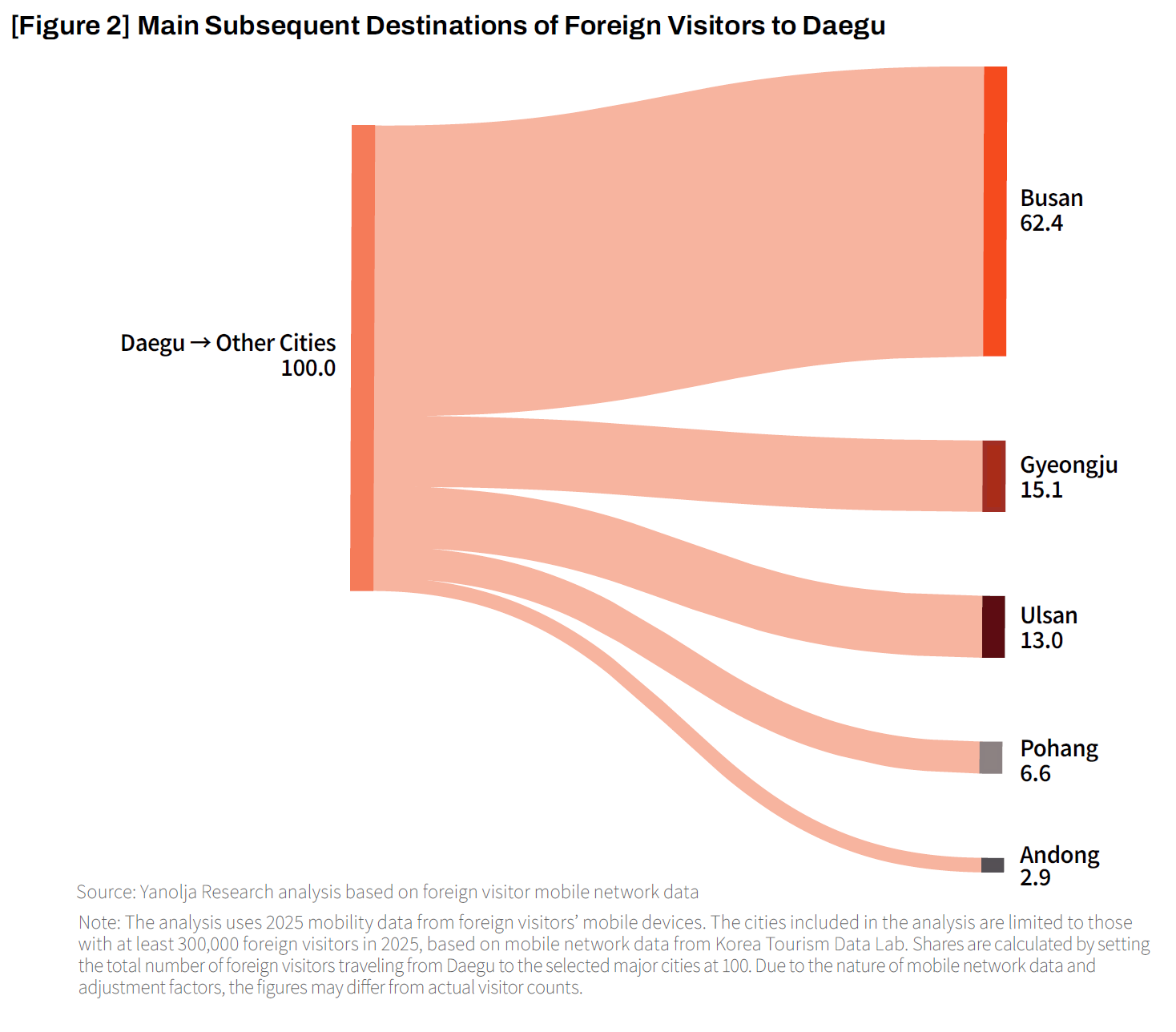
These results indicate that the actual travel range of foreign visitors centered on Daegu may extend beyond the administrative boundaries of Daegu and Gyeongbuk. In particular, the high share of onward travel to Busan suggests that Daegu may be closely linked not only to tourism hubs within Daegu and Gyeongbuk but also to broader tourism movements across the Gyeongsang region, including Busan.
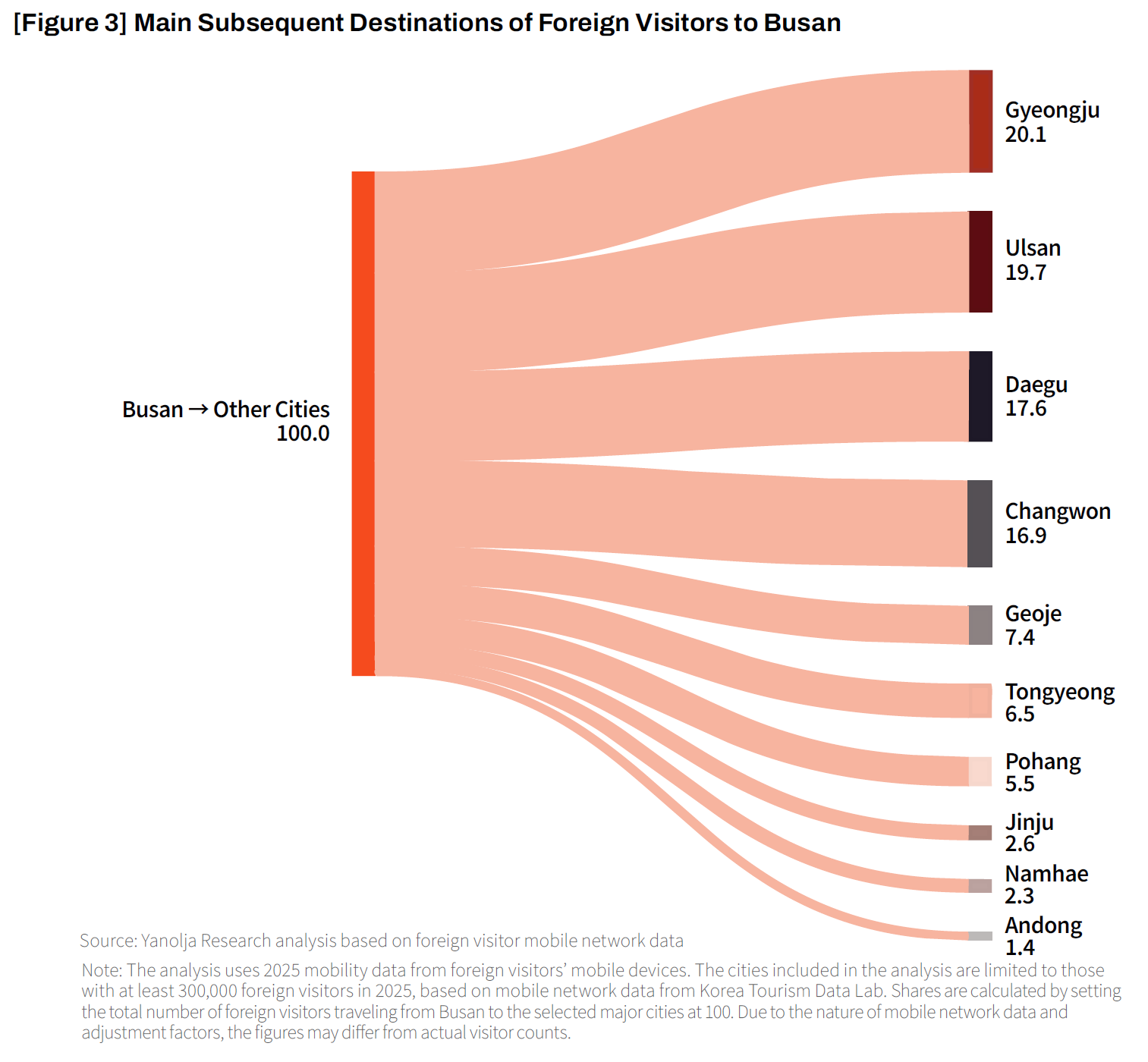
For comparison, foreign visitors to Busan display a more dispersed movement pattern. Among those traveling from Busan to major external cities, 20.1% went to Gyeongju, 19.7% to Ulsan, 17.6% to Daegu, and 16.9% to Changwon. In fact, the top four destinations each accounted for roughly 16–20% of outbound movements from Busan, followed by a long tail extending to Geoje, Tongyeong, Pohang, Jinju, Namhae, and other destinations.
By contrast, more than 60% of Daegu’s movements to major external cities are concentrated in Busan alone. Taken together, Daegu exhibits an “axis-oriented” movement structure strongly connected to a specific hub—Busan—whereas Busan exhibits a “dispersal-oriented” structure that distributes visitors across multiple cities in the Gyeongsang region. Although the two cities display different movement patterns, the findings also suggest that they can function as interconnected destinations within a single broader tourism region.
[Figure 3] Main Subsequent Destinations of Foreign Visitors to Busan
Rethinking Daegu Airport’s Role: From Administrative Boundaries to Actual Tourism Mobility
Daegu Airport is a major gateway that improves international accessibility to Daegu and Gyeongbuk. Alongside attracting tourism, medical, and business demand to Daegu through expanded international services, it also plays an important role in connecting foreign visitors to key destinations in Gyeongbuk such as Gyeongju, Andong, and Pohang.
The preceding analysis, however, suggests that the actual travel range of foreign visitors centered on Daegu may extend beyond the administrative region of Daegu and Gyeongbuk. In particular, the fact that more than 60% of travelers moving from Daegu to major external cities headed to Busan indicates that Daegu is closely linked to tourism movements across a broader Gyeongsang region that includes Busan.
Busan is one of Korea’s leading inbound tourism destinations outside the Seoul metropolitan area, with substantial foreign visitor demand and extensive accommodation, tourism, and MICE infrastructure. However, Gimhae Airport, Busan’s international gateway, is facing increasing capacity constraints as international demand grows. According to Korea Airports Corporation aviation statistics, Gimhae Airport handled approximately 10.44 million international passengers in 2025, becoming the first regional airport in Korea to exceed 10 million international passengers in a year. Further expansion of new routes is increasingly difficult because of constraints related to slots, facilities, and CIQ staffing. Moreover, in November 2025, the target opening date for Gadeokdo New Airport, which is expected to take over Gimhae Airport’s international functions, was postponed from 2029 to 2035, delaying the expansion of international aviation capacity in the Busan area until the mid-2030s.
Considering these aviation supply conditions together with actual tourist movements, Daegu Airport need not be viewed solely as a regional airport serving demand from Daegu and Gyeongbuk. Its potential as an additional international access point connected to the broader Gyeongsang region, including Busan, should also be considered. This means defining an airport’s catchment area not by administrative boundaries but by the actual mobility range of tourists.
In particular, with Gimhae Airport facing capacity constraints and a substantial gap remaining before Gadeokdo New Airport opens, Daegu Airport could become effectively the only alternative gateway capable of supplementing international demand across the Gyeongsang region. The fact that Dongdaegu and Busan are connected by KTX in roughly one hour further strengthens the feasibility of this concept.
Importantly, the complementary-gateway concept is not based solely on aviation supply logic. Mobility data show that onward movements by foreign visitors to Daegu are overwhelmingly concentrated toward Busan, indicating that a substantive tourism corridor already exists between the two cities. In other words, a Gyeongsang gateway strategy centered on Daegu Airport would not artificially create a new tourism region; rather, it would connect and reinforce an existing pattern of tourism mobility through coordinated aviation, transport, and tourism-product policies.
At the same time, caution is needed in interpreting the high share of movement from Daegu to Busan simply as a tourist “leakage.” This analysis focuses on intercity movement and does not capture length of stay or detailed movement characteristics within each destination. Some foreign visitors may, for example, have stayed and traveled in Daegu for a period before continuing to Busan. It is therefore also possible to view Daegu and Busan not as separate tourism destinations, but as destinations jointly visited along a continuous travel itinerary.
Even so, the strong concentration of onward movement from Daegu to Busan demonstrates the need to view Daegu’s tourism function from a broader perspective. Daegu can serve both as an initial destination for foreign visitors and as a regional connector linking them to major neighboring destinations such as Busan. Evaluating the role of Daegu and Daegu Airport should therefore go beyond asking simply “how many foreign visitors stayed in Daegu” and also examine where travelers connect through Daegu and what broader tourism region those movements collectively form.
A nearby example of tourism expanding into a supra-regional destination can be found in Japan’s Kansai region, centered on the Kobe–Osaka–Kyoto axis. Kansai resembles Korea’s Gyeongsang region in several respects. If both the Korean Peninsula and the Japanese archipelago are divided into eight broad regions, Gyeongsang is the second most populous region in Korea, while Kansai is the second most populous region in Japan. Busan in Gyeongsang and Osaka in Kansai are often compared, while Gyeongju–Kyoto, Daegu–Kobe, and Andong–Wakayama are also sometimes compared in terms of regional characteristics. Interestingly, even stereotypes about strong accents and dialects and a perceived tough local temperament show curious parallels.
Kansai is not merely a well-known tourism destination within Asia. In Yanolja Research’s 2026 Global Tourism City Attractiveness Ranking, Osaka ranked third and Kyoto fourth (after New York and Paris, with Seoul fifth). Taken together, the two cities make Kansai arguably the world’s leading tourism region in terms of destination attractiveness. Kansai has two international gateway airports: Kansai International Airport in Osaka and Kobe Airport. These two airports receive international arrivals and effectively disperse visitors across major destinations such as Osaka, Kyoto, Kobe, and Nara, thereby expanding the functional reach of the tourism region. Korea should similarly consider using Gimhae Airport and Daegu Airport as gateway airports to develop the Gyeongsang region as a broader tourism region and disperse foreign visitors more widely. Within such a regional system, Gimhae Airport could function as the entry and exit gateway for coastal tourism, while Daegu Airport could serve as the gateway for inland tourism. If the two airports divide these roles and efficiently distribute foreign visitors across the Gyeongsang region, the area could emerge as a globally competitive tourism region in the foreseeable future.
In summary, the findings support viewing Daegu Airport and the airports serving the Busan area as complementary components of a “Dual-Gateway” system for the Gyeongsang region. Rather than treating Daegu and Busan as separate airport catchment areas, this approach would connect Daegu Airport with Gimhae Airport and Gadeokdo New Airport as complementary international gateways and design major tourism cities along the Daegu–Gyeongju–Ulsan–Busan corridor as a single travel region.
Policy Implications for Central Government, Local Governments, and Industry
The analysis above points to the need to redefine Daegu Airport’s role based on tourists’ actual mobility patterns rather than administrative boundaries. In particular, leveraging the strong tourism corridor between Daegu and Busan requires airport, transport, and tourism-product policies to be designed at a supra-regional rather than individual-jurisdiction level. The implications for the central government, local governments, and industry are as follows.
Central Government: Redefine Airport Catchment Areas Using Actual Foreign-Visitor Mobility Data
At the national level, airport tourism catchment areas should be redefined based on tourists’ actual mobility patterns rather than administrative boundaries. Shifting key policy frameworks—such as regional-airport revitalization, traffic-rights allocation, and the designation of tourism hub cities—toward mobility-based criteria would allow policy to capture benefits of Daegu Airport that extend beyond Daegu and Gyeongbuk to the wider Gyeongsang region.
Daegu Airport’s available capacity, Gimhae Airport’s capacity constraints, the target opening of Gadeokdo New Airport in 2035, and the target opening of the Daegu–Gyeongbuk Integrated New Airport in 2030 should likewise be considered within a single Gyeongsang-region international aviation supply roadmap rather than in isolation. In particular, the use of Daegu Airport as a complementary gateway should be examined during the capacity-constrained period before Gadeokdo New Airport opens. Looking further ahead, the medium- and long-haul route strategy for the integrated airport system in the Gyeongsang region should be designed not merely to expand aviation demand, but in connection with Korea’s broader inbound tourism strategy. Institutionalizing mobile mobility data as a regular evaluation indicator for tourism and airport policy should also be considered an important task.
Local Governments: Supra-Regional Governance Based on Shared Tourism Mobility, Not Competition
At the local-government level, Daegu, Gyeongbuk, Busan, and Ulsan can pursue cross-regional tourism products and joint marketing based on actual travel patterns such as “Daegu IN → Busan, Gyeongju, Ulsan.” The key is to establish infrastructure that supports these movements in practice, including airport shuttles, KTX-linked passes, and integrated transport-and-tourism passes. Daegu should not treat tourist movement to Busan as “leakage,” but instead reposition itself as both a gateway and a stay-oriented hub within a wider tourism region. To move from a “place tourists pass through” to a “destination where they stay,” it will be necessary to strengthen content and experiences that encourage longer stays.
Industry: Redesign Products and Networks Around Supra-Regional Itineraries
Different opportunities emerge across industry segments. Airlines can strengthen specialized routes targeting markets with relatively high inbound potential for Daegu Airport, such as Taiwan, the greater China region, and Southeast Asia, while preparing network and fleet strategies for the expansion of medium- and long-haul services after the integrated new airport opens. Daegu Airport’s strength as a low-cost carrier (LCC) hub can also be extended from outbound travel to inbound demand.
Travel platforms and online travel agencies (OTAs) can pursue opportunities in multi-city, open-jaw products such as “Daegu IN–Busan OUT” or “Busan IN–Daegu OUT,” accommodation-and-tour bundles built around cross-regional itineraries, and demand forecasting and product curation using booking and mobility data. Platforms such as OTAs are particularly well positioned to combine booking, movement, and stay data to design visitor journeys within a supra-regional tourism area. In the accommodation and MICE sectors, product development can also target complementary intercity demand, including accommodation demand distributed between Daegu and Busan and supra-regional conventions and incentive tours.
Conclusion: Beyond Administrative Boundaries to a “Dual-Gateway” Gyeongsang Region
The key to revitalizing regional tourism through regional airports is to avoid confining an airport’s role within administrative boundaries and instead expand that role according to tourists’ actual mobility patterns. While strengthening its core function as the international gateway to Daegu and Gyeongbuk, Daegu Airport can also use the already established travel corridor with nearby tourism areas such as Busan to develop into a key gateway supporting supra-regional inbound tourism across the Gyeongsang region.
From this perspective, the “Dual-Gateway” strategy for the Gyeongsang region proposed in this study can serve as a starting point for redefining Daegu Airport and Gimhae/Gadeokdo New Airport not as competing gateways, but as complementary ones. The Gyeongsang region has the potential to develop into a globally competitive tourism region comparable to Japan’s Kansai. From an aviation perspective, continued inbound tourism growth centered primarily on Seoul may eventually face limits in both visitor expansion and regional dispersal. The Gyeongsang region possesses diverse tourism assets and, over the long term, is expected to operate a multi-airport international gateway system. Its aviation strategy could therefore play a significant role in accelerating Korea’s path toward 30 million foreign visitors and, ultimately, making 40 million foreign visitors achievable.
 Prev
Prev  Back
Back 