
Vol.15 Changes in South Korea’s International Aviation Market Following the Middle East Conflict
- Reg Date
- 2026.08.12


Analysis of Changes in South Korea’s International Aviation Market Following the Middle East Conflict
Deachul (David) Seo
Senior Researcher at Yanolja Research
The escalation of armed conflict between the United States and Iran, together with restrictions on transit through the Strait of Hormuz, has substantially increased volatility in global oil and jet fuel markets. The Strait of Hormuz is a critical artery for global crude oil transportation, with limited alternative routes; disruptions to transit or vessel operations can therefore have an immediate impact on global oil supply and prices. International aviation is a core tourism infrastructure connecting inbound tourism—foreign visitors entering Korea—and outbound tourism—Korean residents traveling overseas. Accordingly, these geopolitical developments may affect not only airline profitability but also Korea’s international accessibility and tourism demand.
One of the principal transmission channels is the rise in jet fuel prices. On the supply side, airlines may adjust routes and capacity in response to cost and profitability conditions, thereby changing tourism accessibility across countries and regions. On the demand side, higher fuel surcharges and airfares may increase the cost burden on international travelers and dampen international tourism demand. It is therefore necessary to examine, from a tourism-industry perspective, how Korea’s international aviation market has changed since the escalation of armed conflict in the Middle East and the rise in jet fuel prices.
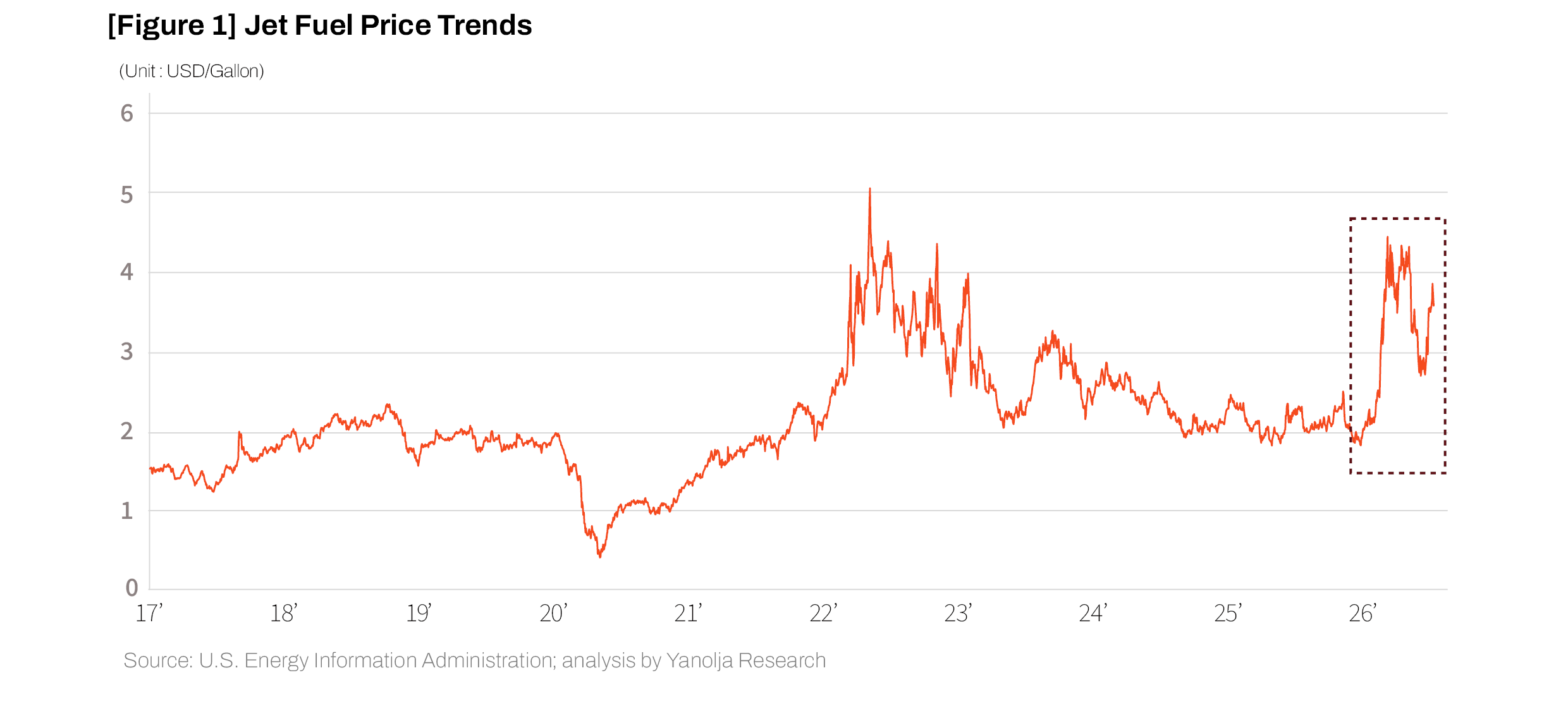
Restrictions on transit through the Strait of Hormuz have in fact disrupted crude oil supply and triggered an immediate price shock in the jet fuel market. Jet fuel prices rose by approximately 83%, from USD 2.43 per gallon on February 27, immediately before the escalation of the conflict, to USD 4.45 per gallon just three weeks later on March 20. Even now, six months into the conflict, jet fuel prices remain around USD 3.50 per gallon. This is approximately 20% below the peak, but still about 44% higher than the pre-conflict level. Although jet fuel prices have eased from their peak, airlines continue to face a substantial fuel-cost burden.
[Figure 1] Jet Fuel Price Trends
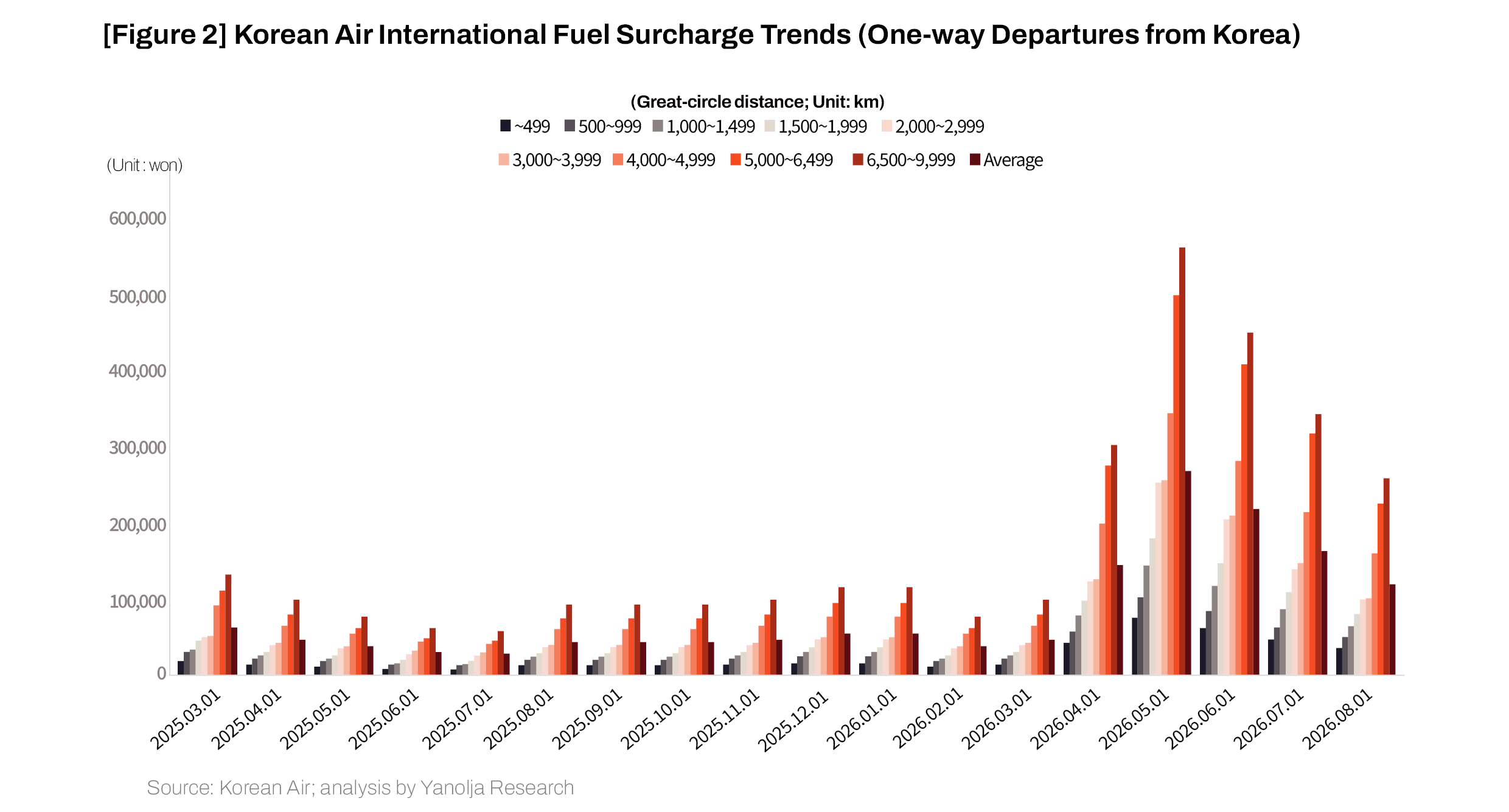
In response to rising jet fuel prices, Korean airlines also raised fuel surcharges across the board. Because fuel surcharges are generally calculated based on average jet fuel prices over the preceding one to two months, the sharp increase in jet fuel prices in March was reflected in April surcharges with roughly a one-month lag. In other words, increases in jet fuel prices are not immediately passed through to ticket prices; rather, the burden is transferred to passengers through fuel surcharges after a certain time lag. This is similar to how credit card spending is reflected in the following month’s bill. Korean airlines raised international fuel surcharges in April to roughly three times the March level and implemented further increases in May, meaning that the higher fuel-cost burden began to be passed on more fully to travelers. Fuel surcharges peaked in May and began to decline in June, but they remain above pre-conflict levels. As a result, the cost burden of international air travel is likely to persist for some time.
[Figure 2] Korean Air International Fuel Surcharge Trends (One-way Departures from Korea)
However, higher jet fuel prices and fuel surcharges do not necessarily lead immediately to flight reductions or capacity cuts. Airlines adjust routes after considering aircraft and crew allocation, airport slots, traffic rights, booking and sales conditions, and other operational factors. Rather than changing flight schedules immediately, they often reduce capacity gradually over several months or deploy aircraft to alternative routes while taking into account existing bookings, contracts, and slot conditions. International air tickets are also typically booked several months before departure, meaning that changes in travel sentiment after the conflict take time to appear in actual passenger volumes and load factors. In short, jet fuel price increases occur relatively quickly, whereas airline supply adjustments and changes in passenger demand take longer to be reflected in aviation statistics.
Since the conflict began, uncertainty in oil prices has risen sharply, actual jet fuel prices and fuel surcharges have increased, and aviation safety concerns in the Middle East have intensified. Against this backdrop, expectations have grown that airlines would inevitably need to readjust routes and capacity. The transportation and tourism industries have raised concerns that such adjustments could also affect international flight operations to and from Korea, potentially reducing both the number of flights and available seats.
As noted above, however, the structure of the aviation industry means that it generally takes at least several months for airline route adjustments and changes in passenger demand to appear in actual statistics. With approximately six months having passed since the outbreak of the conflict, it is now possible to assess whether the previously raised concerns over reductions in flights and capacity are becoming visible in the data. In other words, the market has reached a point at which the effects of geopolitical uncertainty in the Middle East on Korea’s international aviation market can be examined using concrete figures. Changes in international capacity and route structure are not merely internal issues for the airline industry. Fewer international flights and available seats could reduce accessibility to Korea for inbound travelers, while capacity adjustments in particular regions could affect demand for travel to Korea by country and region. Changes in route structure may also have implications for Incheon International Airport’s transfer function and its competitiveness as an international tourism hub.
This report therefore uses international aviation statistics for flights departing from or arriving in Korea to examine whether the flight reductions anticipated by the transportation and tourism industries after the outbreak of the conflict have actually materialized. Changes in flight frequencies, available seats, passenger volumes, and route structures are assessed for the overall market, by airline group, and by region. The analysis aims to identify, through data, the nature of the changes that geopolitical uncertainty in the Middle East has brought to Korea’s international aviation market and to assess their implications for inbound tourism accessibility, international tourism demand, and the transfer market.
Changes in International Air Routes
Overall Market: International Growth Continues, but Supply and Demand Expansion Slows After April
Even after the outbreak of the Middle East war, both supply and demand in Korea’s international aviation market remained above their year-earlier levels, maintaining growth in absolute market size. The more appropriate interpretation is not that the market has contracted, but that the pace of growth has gradually begun to moderate.
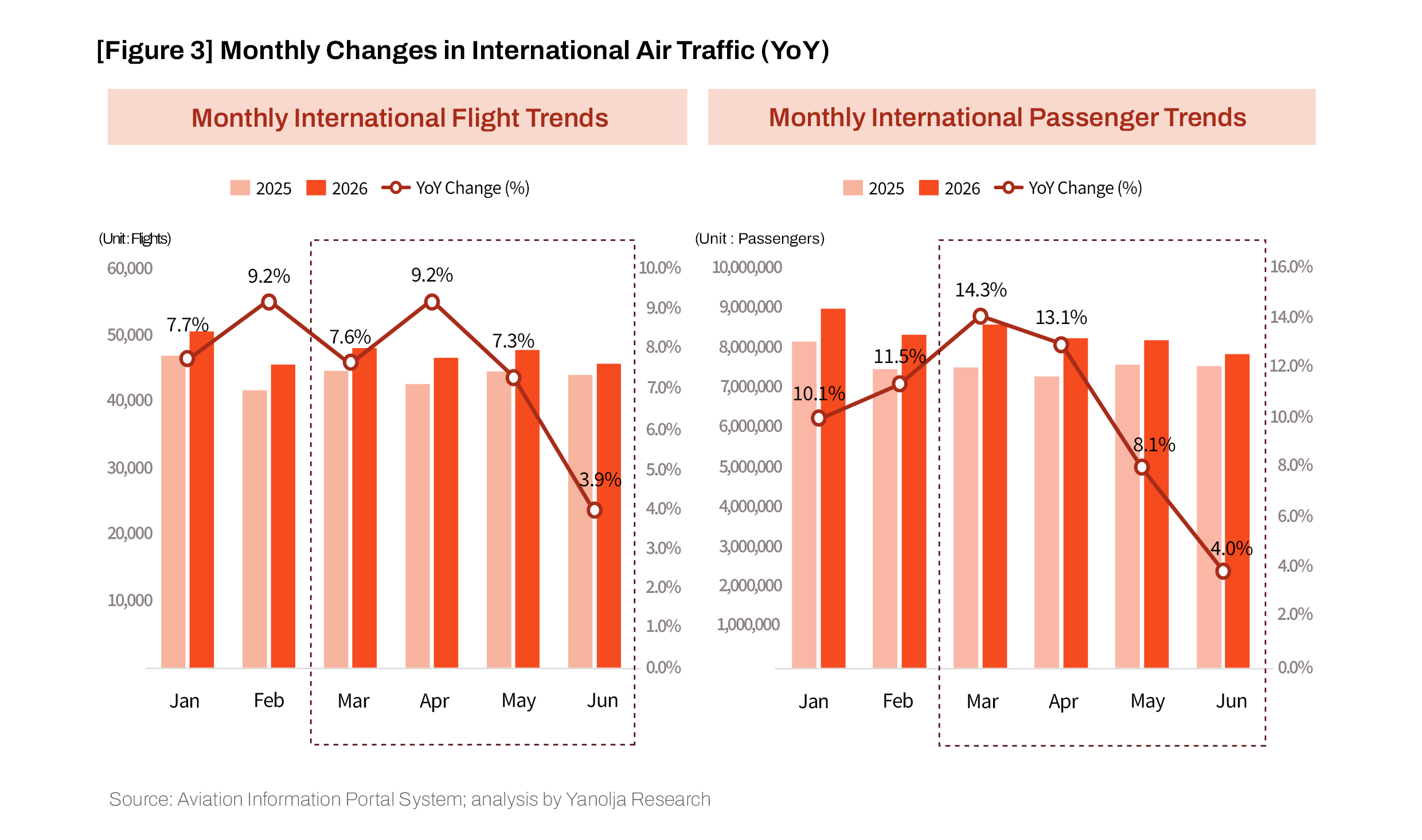
The number of international flights increased year on year in every month from March through June 2026. However, the growth rate peaked at 9.2% in April before slowing to 7.3% in May and 3.9% in June, indicating a gradual deceleration in capacity expansion. International passenger volumes also continued to increase over the same period, but the pace of growth slowed even more rapidly than flight frequencies. Year-on-year passenger growth declined from 14.3% in March and 13.1% in April to 8.1% in May and 4.0% in June.
In June in particular, year-on-year growth in international flights and passengers slowed to 3.9% and 4.0%, respectively, indicating that the pace of supply and demand expansion had weakened considerably compared with the beginning of the year. Because flight and passenger growth slowed to similar levels, the current pattern appears closer to a simultaneous slowdown in new capacity expansion and overall market growth than to a sharp deterioration in load factors. However, the deceleration since April cannot be attributed solely to the Middle East war and higher fuel costs. Other factors may also have contributed, including the normalization of the international aviation market, base effects from the previous year, exchange-rate and economic conditions, and changes in travel demand by country.
[Figure 3] Monthly Changes in International Air Traffic (YoY)
By Airline Group: Korean Carriers Maintain Growth, while Foreign Carriers See Slower Capacity and Passenger Growth
To compare changes before and after the outbreak of the war for Korean and foreign carriers, the main aviation indicators were aggregated separately for the pre-war period of January–February and the post-war period of March–June, and year-on-year changes were calculated for each period. In other words, the analysis compares January–February 2026 with January–February 2025, and March–June 2026 with March–June 2025.
For available seats, flight frequencies, and passenger volumes, year-on-year changes were calculated using the total for each period. Load factors were calculated as period averages and compared with the corresponding period of the previous year. This approach helps reduce some of the effects of monthly volatility and seasonality and allows us to examine how the growth trajectories of Korean and foreign carriers differed before and after the war.
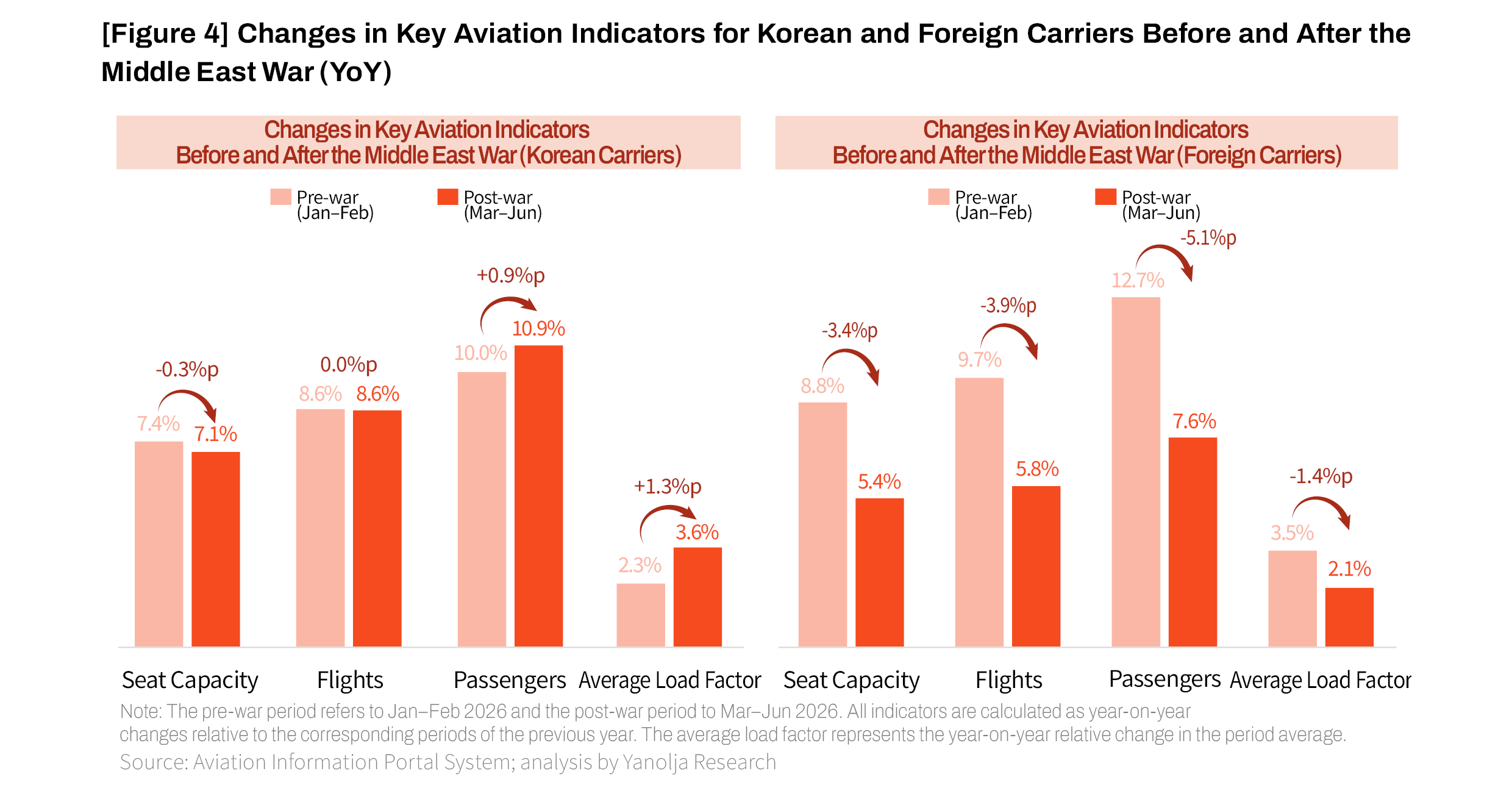
The analysis shows that the growth trajectories of Korean and foreign carriers diverged during the post-war period of March–June. For Korean carriers, available-seat growth remained stable, edging down from 7.4% before the war to 7.1% afterward, while flight growth held steady at 8.6% in both periods. Passenger growth increased slightly from 10.0% to 10.9%. The average load factor also improved year on year, rising by 2.3% in the pre-war period and 3.6% in the post-war period, indicating better utilization of available seats. This suggests that Korean carriers continued to expand capacity while passenger growth and load factors also improved, meaning that the additional capacity was absorbed relatively steadily by actual passenger demand.
By contrast, foreign carriers experienced slower growth in both supply and demand after the war. Available-seat growth fell by 3.4 percentage points, from 8.8% to 5.4%, while flight growth declined by 3.9 percentage points, from 9.7% to 5.8%. Passenger growth also slowed by 5.1 percentage points, from 12.7% to 7.6%, and the year-on-year improvement in the average load factor narrowed from 3.5% to 2.1%. Thus, although Korea’s overall international aviation market continued to grow after the war, foreign carriers moderated the pace of capacity expansion, unlike Korean carriers, which maintained their previous expansion trend. Passenger growth and improvements in load factors among foreign carriers also weakened.
This divergence may reflect differences in hub-market structures and aircraft-allocation flexibility between Korean and foreign carriers. Korean carriers operate Korea as a core home market, making it relatively difficult to reduce capacity or shift aircraft to markets in other countries in the short term. For foreign carriers, by contrast, Korea is one of several international markets they serve, giving them comparatively greater flexibility to reallocate capacity and aircraft to other routes depending on profitability and cost conditions. However, the current statistics are insufficient to conclude that the slowdown in foreign-carrier capacity was directly caused by aircraft reallocation in response to the Middle East war or higher fuel costs. Confirming this would require further analysis of changes in foreign-carrier operations by region and airline, actual aircraft deployment, and route-level profitability.
[Figure 4] Changes in Key Aviation Indicators for Korean and Foreign Carriers Before and After the Middle East War (YoY)
By Route: Middle East, Oceania, and Southeast Asia Weaken, while Northeast Asia, the Americas, and Europe Remain Resilient
A closer look at regional trends shows that, after the war, international routes moved differently depending on underlying demand, operating costs, and airline capacity strategies. Although growth on routes to Japan and China slowed somewhat after the war, passenger volumes still increased by 17.7% and 21.9% year on year, respectively, maintaining double-digit growth. This suggests that major short-haul markets with solid demand fundamentals and relatively low operating-cost exposure due to shorter flight distances remained resilient despite higher fuel costs and geopolitical uncertainty. That said, country-specific factors such as exchange rates, base effects, and the recovery of air capacity may also have contributed to this growth.
[Figure 5] Changes in Flights and Passengers by Region (YoY)
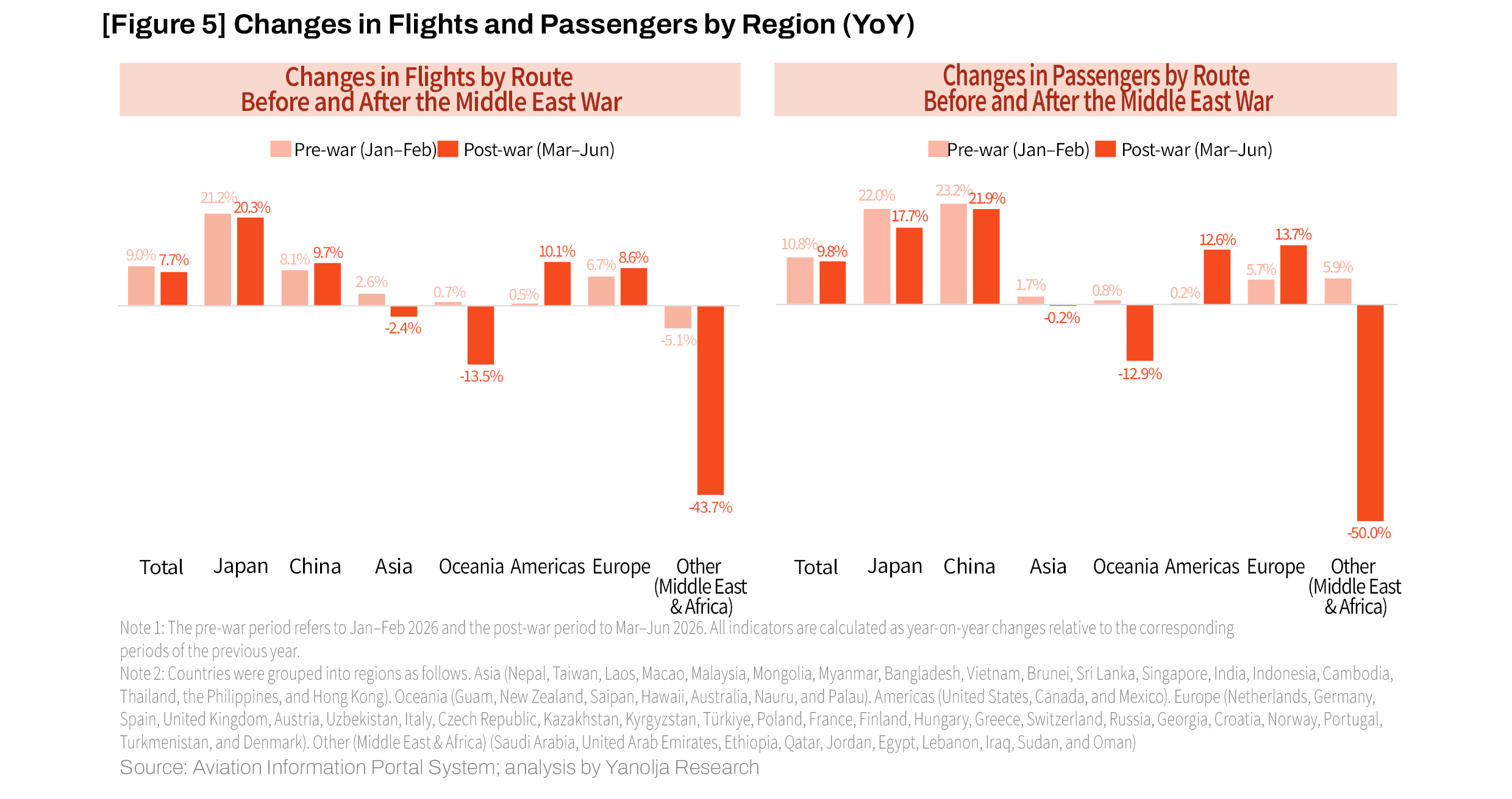
Asian routes excluding Japan and China showed a slight contraction in supply and broadly stagnant passenger demand after the war. Year-on-year flight growth fell from 2.6% before the war to -2.4% afterward, turning negative, while passenger growth declined from 1.7% to -0.2%. However, this apparent stagnation is an average for the region as a whole and includes submarkets moving in different directions. It would therefore be misleading to interpret the entire Asian market excluding Japan and China as uniformly weakening.
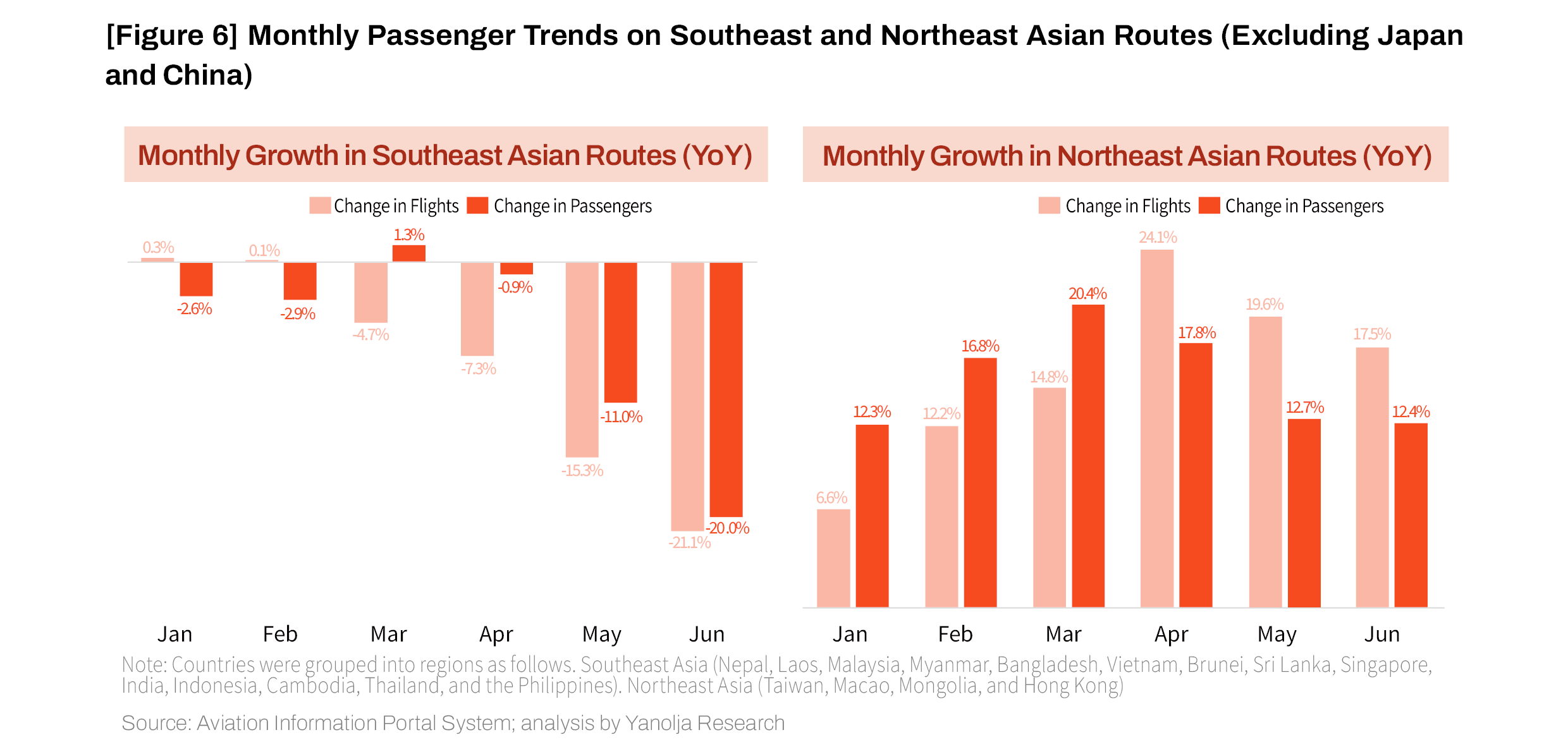
When Asian routes are divided into Southeast Asia and Northeast Asia, the regional divergence becomes much clearer. Routes to Southeast Asia—including the Philippines, Thailand, Malaysia, and Vietnam—briefly rose above year-earlier levels in March but subsequently returned to decline, with the year-on-year decrease widening further in May and June. By contrast, routes to Northeast Asia—including Taiwan, Macao, Mongolia, and Hong Kong—remained above year-earlier levels throughout the first half of the year and maintained relatively stable growth. The stagnation in Asian routes excluding Japan and China is therefore better understood not as broad-based weakness across the market, but as the result of declines in Southeast Asia offsetting continued growth in Northeast Asia.
Routes to the Americas and Europe, by contrast, recorded stronger growth after the war. On routes to the Americas, flight frequencies and passenger volumes increased by 10.1% and 12.6% year on year, respectively, exceeding their pre-war growth rates. In Europe, flight growth rose from 6.7% before the war to 8.6% after the war, while passenger growth accelerated from 5.7% to 13.7%. Growth in these long-haul routes may reflect relatively resilient inbound demand from the Americas and Europe, as well as travel demand originating in Korea. Airlines may also have maintained or expanded capacity on major routes to these regions on the back of relatively high fares, cargo demand, and stable inbound demand.
[Figure 6] Monthly Passenger Trends on Southeast Asian and Northeast Asian Routes (Excluding Japan and China)
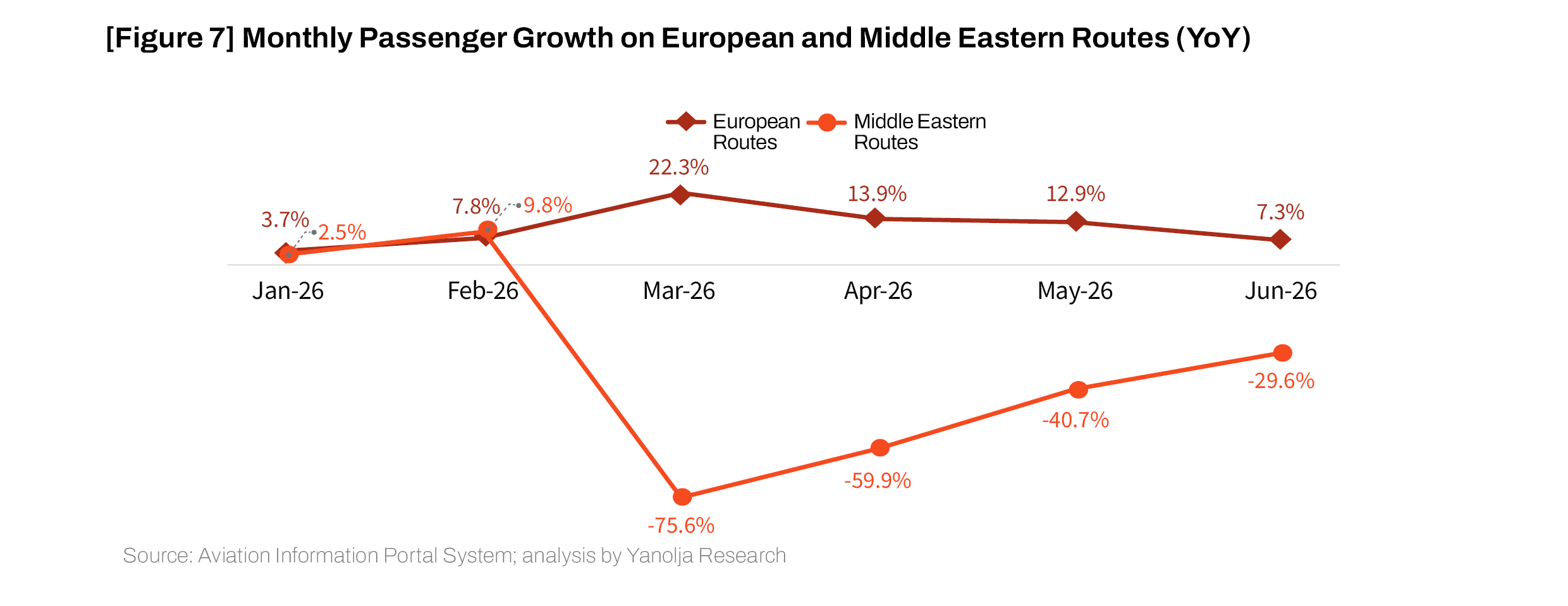
Notably, the strong growth of European routes occurred at the same time as a sharp contraction in Middle Eastern routes. In March, when the effects of the war became more pronounced, passenger volumes on Middle Eastern routes fell by 75.6% year on year, while passenger volumes on European routes increased by 22.3% and continued to post double-digit growth through June.
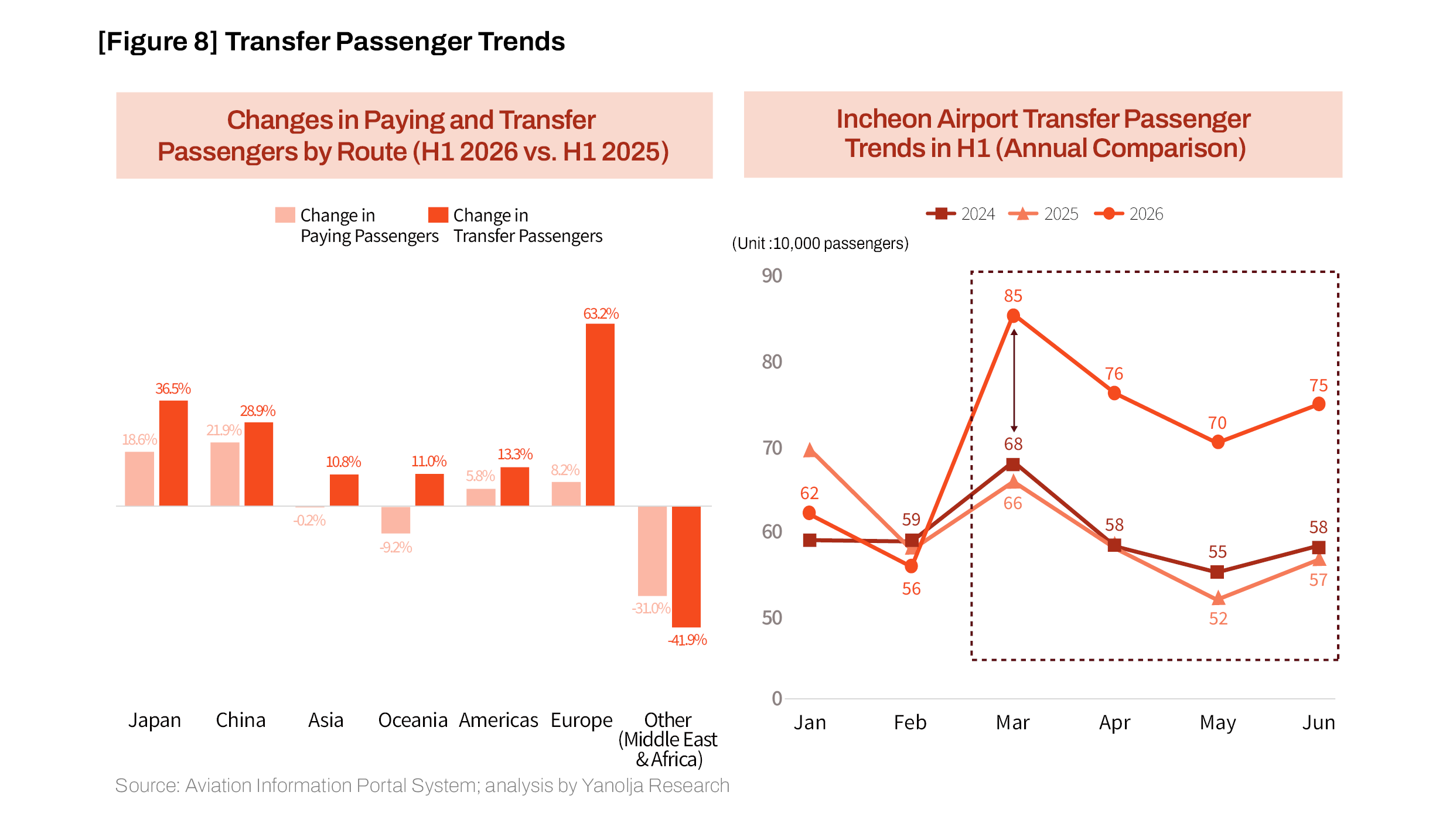
For the first half as a whole, revenue passengers and transfer passengers on Middle Eastern routes declined by 31.0% and 41.9%, respectively. By contrast, on European routes, revenue passengers increased by 8.2% while transfer passengers surged by 63.2%. Total transfer passengers at Incheon International Airport also recorded high year-on-year growth of around 30% over the same period. The simultaneous decline in transfer passengers on Middle Eastern routes and increase in transfer passengers on European routes and at Incheon Airport overall suggests that some transfer demand displaced by weaker connectivity at Middle Eastern hubs may have shifted to Northeast Asian hubs, including Incheon.
However, the current statistics do not identify transfer passengers’ origins, final destinations, or previously used connecting airports. It is therefore difficult to conclude that Incheon Airport directly replaced transfer demand previously handled by Middle Eastern hubs. Further analysis using itinerary-level transfer data is needed to identify actual changes in connecting routes. The expansion of European routes should therefore be understood as potentially reflecting a combination of factors, including inbound demand from Europe, airline strategies for long-haul capacity, and possible shifts in transfer demand caused by weaker connectivity at Middle Eastern hubs.
[Figure 7] Monthly Passenger Growth on European and Middle Eastern Routes (YoY)
[Figure 8] Transfer Passenger Trends
Oceania routes, by contrast, shifted into a clear decline after the war. Flight frequencies moved from 0.7% growth before the war to a 13.5% decline afterward, while passenger volumes shifted from 0.8% growth to a 12.9% decline. The contraction in Oceania routes is consistent with the possibility that airlines prioritized limited aircraft and operating resources for routes to markets with relatively resilient demand, such as the Americas and Europe.
Limitations of the Analysis
This analysis is descriptive, comparing aviation statistics before and after the outbreak of the war in 2026 with the corresponding periods of the previous year. The observation windows differ in length—two months before the war and four months after—and March performance, immediately after the outbreak, still reflects a substantial share of flight schedules and bookings that had already been finalized before the war. The analysis also does not separately control for other factors that may affect the international aviation market, including exchange rates, base effects, country-specific travel demand, and airlines’ aircraft-operating conditions.
The findings therefore should not be interpreted as the pure causal effect of the war on Korea’s international aviation market. Nevertheless, the analysis is meaningful in that it provides an early assessment of market changes by airline, region, and route after the onset of the crisis, and offers baseline evidence for continued monitoring of future supply and demand developments. As longer time-series data and more granular airline- and route-level data become available, further analysis will be needed to determine whether the changes observed so far represent temporary market adjustments or a more structural reconfiguration of routes.
Conclusion: Diverging Changes in Korea’s International Aviation Market After the Middle East War and Their Implications
Korea’s international aviation market continued to grow year on year after the Middle East war, but the pace of growth in flights and passenger volumes gradually slowed after April. These changes, however, differed across airlines and routes. Korean carriers maintained relatively stable growth in both supply and passenger volumes, while foreign carriers experienced slower growth in available seats, flights, and passengers. By route, the Middle East, Oceania, and Southeast Asia were weak, while Northeast Asia—including Japan and China—the Americas, and Europe remained comparatively resilient.
These findings suggest that the Middle East war and higher fuel costs may have contributed not to an immediate contraction of Korea’s international aviation market as a whole, but rather to greater differentiation in growth trajectories across airlines and regions. At the same time, the observed changes may also reflect a range of other factors, including base effects from the previous year, exchange rates, the recovery of country-specific demand, airlines’ aircraft operations, and route-specific market conditions. The results should therefore be interpreted as early patterns emerging in the international aviation market after the war, rather than as the pure causal effect of the conflict.
Continued monitoring of route changes by region and airline, as well as the share of foreign passengers, is needed to ensure that slower capacity expansion by foreign carriers does not become a constraint on accessibility in certain inbound markets. If weakness on Southeast Asian and Oceania routes persists, policymakers could first assess inbound demand and each market’s contribution to inbound tourism, and then selectively consider market-specific measures to support route recovery, including incentives for new services and additional frequencies, support for airport charges, and joint marketing. Measures involving airport slots and traffic rights, however, are tied to bilateral air service agreements and airport operating conditions and should therefore be approached from a medium- to long-term perspective, separately from short-term support measures.
The decline in transfer passengers on Middle Eastern routes, alongside increases on European routes and at Incheon Airport overall, suggests that Incheon may have absorbed some displaced transfer demand. Confirming this would require itinerary-level analysis that identifies passengers’ origins and final destinations, the connecting airports they previously used, and their actual transfer routes.
To strengthen Incheon Airport’s competitiveness as a hub, efforts are needed to reduce minimum connection times, improve baggage connectivity, and streamline transfer flows. At the same time, long-dwell transfer passengers could be converted into stopover visitors through free transit tours, accommodation and transport support for stopovers, and K-culture experiences and locally distinctive culinary products bundled with air tickets. Joint development of transfer products and promotions by airports, airlines, accommodation providers, and travel companies could help translate growing transfer demand into longer stays and greater tourism spending in Korea.
Overall, the key change observed so far in Korea’s international aviation market after the Middle East war is better characterized as a reconfiguration of growth trajectories across airlines, routes, and regions than as a broad-based market contraction. Going forward, jet fuel prices and fuel surcharges, foreign-carrier capacity, route-level load factors, and transfer demand should be monitored continuously to distinguish temporary market adjustments from structural changes.
 Prev
Prev  Back
Back 