
[PR] Capacity of 50,000 Is Not Enough for Venue Feasibility—Ancillary Revenue Makes the Difference
- Reg Date
- 2026.10.02
Financial Feasibility of 50,000-Seat Venues: Selling Out Isn't Enough—Ancillary Revenue Is the Key
While ticket sales for large-scale domestic venues with over 10,000 seats have nearly tripled in three years, a new study reveals that building a 50,000-seat venue remains financially difficult unless location, financing, and operating models work in unison. Although public support—such as providing land or sharing construction costs—reduces initial private burdens, it alone does not guarantee investment recovery. The analysis emphasizes that project viability is achievable only when venue bookings and ancillary revenues are comprehensively designed and validated from the initial planning stage.
This report, titled "Financial Feasibility of Constructing a Large-Scale 50,000-Seat Peformance Venue: Business Viability Conditions and Policy Tasks," was published on October 1 by Yanolja Research (Director: SooCheong (Shawn) Jang), a research institute specializing in the travel and tourism industry. The report evaluates project viability through Net Present Value (NPV) and Internal Rate of Return (IRR) analysis across 12 demand and revenue scenarios alongside various investment structures.
Despite Rapid Expansion in Large-Scale Shows, Indoor Infrastructure Remains Stuck Behind the "20,000-Seat Wall"
Ticket sales for performances in venues with over 10,000 seats surged from 180.2 billion KRW in 2022 to 532.0 billion KRW in 2025—nearly a threefold increase in three years—raising their market share from 17.5% to 30.7%. Popular music accounted for 99.5% of ticket sales in venues exceeding 10,000 seats in 2025, driven largely by K-pop's global fandom.
However, indoor infrastructure remains severely constrained. Korea has only six indoor facilities capable of holding over 10,000 people, all under 20,000 seats. In 2025, Olympic Park KSPO Dome hosted performances for 115 days (an estimated operating rate of 78.1%), while Inspire Arena hosted events for 60 days. Gocheok Sky Dome and Jamsil Arena frequently face scheduling conflicts with sports events, forcing shows exceeding 20,000 attendees to rely on outdoor stadiums. The report notes that 50,000 seats should be viewed not as a definitive answer, but as a benchmark size to evaluate both the economics of global tours and actual domestic demand.
[Figure] Ticket Sales Volume and Revenue in South Korea's Performance Market
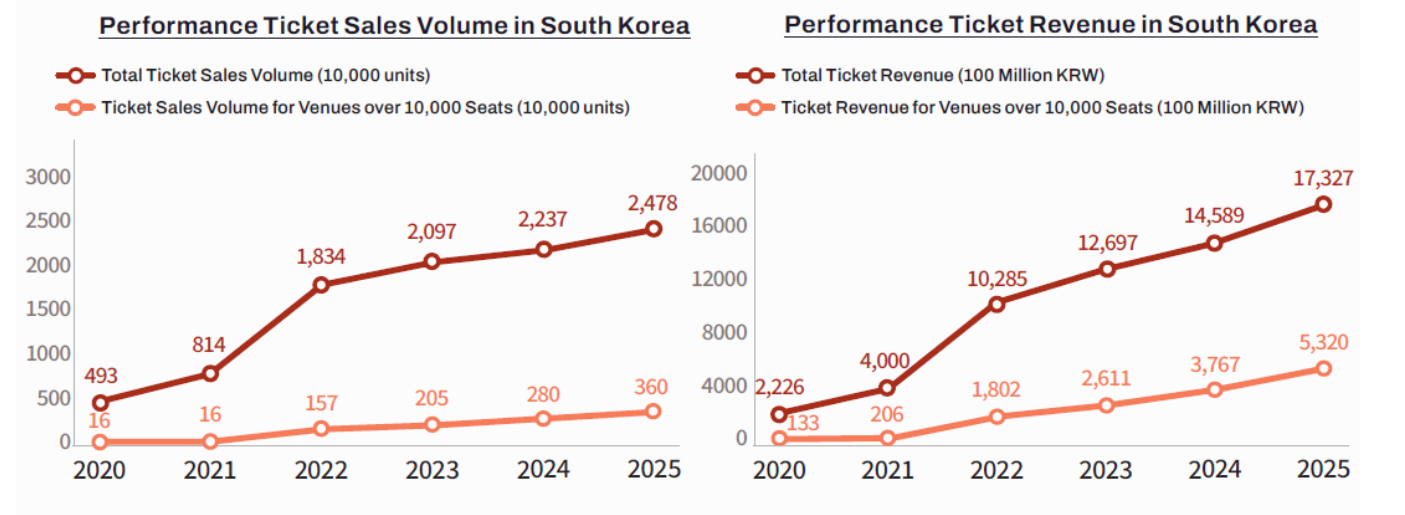
Source: Korea Performing Arts Box Office Information System (KOPIS), Yanolja Research Analysis.
Construction Costs Around 601 Billion KRW… Operating Surplus Possible Only Under ‘Upper-Bound Conditions’
In a benchmark model for constructing a 50,000-seat venue in Seoul, the report estimates construction-related costs—including building works, stage technology infrastructure, parking facilities, architecture design, and supervision—at approximately 601 billion KRW. Land acquisition costs for the required site of roughly 95,000 square meters are estimated at approximately 1.2072 trillion KRW; if a private entity purchases the land directly, initial investment costs reach nearly 1.989 trillion KRW. Even if the public sector provides the land free of charge, the initial private burden remains substantial through construction-related investment alone.
Following the opening, annual operating expenses—including depreciation—are estimated at around 40.7 billion KRW (with cash operating expenses accounting for roughly 22.5 billion KRW). Because maintenance and labor costs occur significantly even on non-performance days, securing ancillary business revenues—such as naming rights, F&B, merchandise, and advertising—alongside rental fees and ticketing commission fees serves as the core determinant of profitability.
The report evaluated 12 scenarios combining 4 performance demand levels and 3 revenue structure tiers. The sole combination capable of yielding an operating surplus was the upper-bound condition, where all of the following were simultaneously realized: 36 performances per year, full sell-outs, an average ticket price of 176,000 KRW, a 10% ticketing commission rate, and an ancillary revenue-to-venue rental revenue ratio of 50%. Under these conditions, annual gross revenue is estimated at approximately 53.7 billion KRW with an operating profit of roughly 13.0 billion KRW. Conversely, applying lower-bound assumptions results in an operating loss of approximately 12.7 billion KRW. This demonstrates that all three variables—performance frequency, ticket pricing, and ancillary business earnings—must concurrently achieve peak levels.
Public Land Provision + 60% Construction Cost Support Represents a ‘Boundary Condition,’ Not a ‘Final Solution’
An operating surplus and the recovery of initial investment costs are distinct challenges. The report calculated the Internal Rate of Return (IRR) based on a 33-year cash flow model (3 years of construction and 30 years of operation) using discount rates between 7% and 10% per annum.
Under the private land acquisition model, Net Present Value (NPV) remained negative across all scenarios. Even when the public sector supplied the land at no cost, the upper-bound condition yielded an IRR of merely 1.85%. With public construction cost support of 20% and 40%, IRRs rose to 3.42% and 5.68%, respectively. When a 60% construction subsidy lowered initial private investment to approximately 264.4 billion KRW, the IRR reached 9.47%. However, at a 10% discount rate, NPV remained negative—indicating that 60% public support functions as a critical boundary condition where project viability hinges, rather than a threshold that guarantees financial feasibility.
Furthermore, this outcome is highly sensitive to optimistic upper-bound assumptions. Under the same 60% subsidy framework, if the demand realization factor drops to 70%, the IRR falls to 3.03%; if the ancillary revenue ratio caps at 30%, it drops to 6.94%; and if cash operating expenses increase by 10%, it decreases to 8.71%. Consequently, the 60% figure should not be interpreted as a blanket policy recommendation, but rather as an illustration of the underlying project structure: mitigating initial investment burdens must be coupled with strong operational performance for the venue to be viable.
[Table] Private Initial Investment Costs and Internal Rate of Return (IRR) by Investment Structure for 50,000-Seat Venues
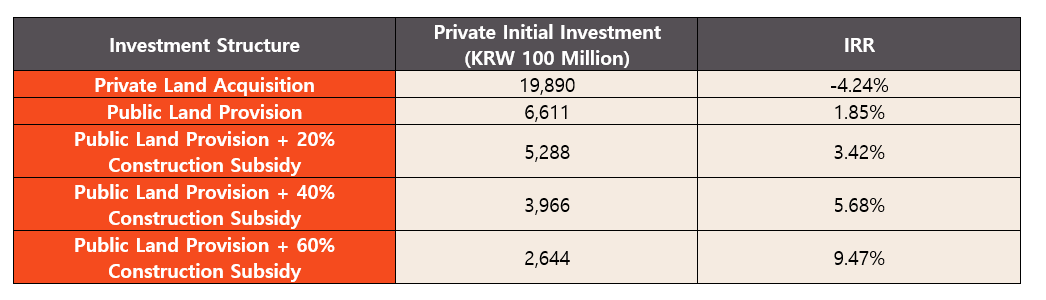
Note: Based on upper-bound operating conditions assuming 36 performances per year, full sell-outs, an average ticket price of 176,000 KRW, a 10% ticketing commission rate, and an ancillary revenue ratio of 50% relative to rental revenue.
Source: Korea Performing Arts Box Office Information System (KOPIS), Yanolja Research Analysis.
Suckwon Hong, Senior Researcher at Yanolja Research, emphasized that the critical factor is not a specific subsidy rate like 60%, but rather designing a system structure where public initial investment support directly translates into venue bookings and revenue generation. He explained that prior to opening, venue management must secure performance schedules through long-term partnerships with domestic and international promoters, contractually define ancillary revenues such as naming rights, F&B, and merchandise, and establish clear loss-sharing agreements for early ramp-up operational losses.
‘How to Operate for What Demand’ Matters More Than ‘How Many Seats’… Key Takeaways for Central and Local Governments
The report outlined four key conditions to increase project feasibility: reasonable public-private risk-sharing, pre-securing performance schedules via long-term promoter partnerships, designing multi-stream revenue sources (naming rights, F&B, merchandise, tourism integration) prior to opening, and selecting locations that satisfy requirements for demand, transit accessibility, lodging, commercial districts, and noise control. It suggested prioritizing regions with proven demand while noting that non-capital regional projects require separate feasibility studies combining transportation, tourism, accommodation, and cultural content strategies. Additionally, it proposed a 'conditional decision-making' model where projects proceed only after passing phased assessments for demand verification, traffic impact evaluations, private operating plans, and ancillary revenue generation strategies.
SooCheong (Shawn) Jang, Director of Yanolja Research, highlighted that a large-scale venue is not merely a construction project, but a platform business that simultaneously drives performance content, transportation, tourism, and commercial ecosystems. He stressed that central and local governments must prioritize answering what level of performance demand can be secured and who will operate it sustainably under what accountability, rather than simply deciding how many seats to build.
Kyuwan Choi, Professor at Kyung Hee University's College of Hotel and Tourism Management, also noted that large venues serve as anchor facilities that draw domestic and international fans into a city. He advised that securing schedules through long-term promoter partnerships before opening, alongside designing international visitor services that connect airport transit, accommodation, and late-night transportation, is essential to transforming concert attendance into stayover tourism.
 Prev
 Back
