
[PR] K-Medical Tourism Has Surged, but Its Rules Remain ‘Fragmented’
- Reg Date
- 2026.10.01
K-Medical Tourism Has Surged, but Its Rules Remain ‘Fragmented’
“Advertising, platform, and tax rules must be linked along the tourist journey to sustain growth”
A new analysis finds that fragmented rules—including those on online medical advertising, the scope of entities permitted to attract foreign patients, and the special VAT refund for cosmetic medical procedures—must be realigned with the tourist journey if K-medical tourism is to function as a strategic pillar for making inbound tourism higher-value. Although visitor arrivals to Korea hit a record high in 2025, per-capita spending by foreign tourists fell below its 2019 level. By contrast, foreign patients spend 2.5 times as much per person as general tourists, and 61.7% of that spending occurs outside the hospital, on accommodation, shopping, food and beverages, and more, making medical tourism one of the most promising ways to raise the value of inbound tourism.
In its report, “K-Medical Tourism as an Anchor for High-Value Inbound Tourism: An Institutional Reform Agenda Centered on the Tourist Journey,” Yanolja Research (President SooCheong Jang), a research institute specializing in the travel and tourism industry, defines medical care as an inbound ‘anchor’ that captures both length of stay and spending. The report also points out that rules designed at different times and for different purposes are misaligned along the tourist journey, and stresses that rather than pursuing across-the-board deregulation, Korea should clarify the standards for ‘what is permitted, and to what extent’ while safeguarding medical safety and consumer protection, reconnecting these rules in the order in which the journey unfolds.
Foreign Patients Tripled in Two Years… About 62% of Their Spending Occurs Outside Hospitals
According to the report, visitor arrivals to Korea reached a record 18.94 million in 2025, but per-capita spending by foreign tourists fell from US$1,185 in 2019 to US$1,156 in 2025, only 77% of the level in Japan (US$1,501). A weak won can be a ‘double-edged sword’: while it helps boost demand for travel to Korea, it also lowers the dollar value of the same won-denominated spending.
By contrast, the number of foreign patients visiting Korea more than tripled in two years, from 610,000 in 2023 to 2.01 million in 2025. As of 2024, per-capita spending was KRW 3.99 million, 2.5 times that of general tourists (KRW 1.6 million); 38.3% went to the medical sector, while 61.7% was spent outside the hospital on accommodation, shopping, food and beverages, transportation, and more. Dermatology and plastic surgery accounted for 68% of all foreign patients in 2024. The Korean market’s high share of outpatient procedures centered on dermatology and plastic surgery makes it easy to combine treatment with travel itineraries, and is one reason out-of-hospital spending is so large. In addition, 38.6% of medical tourists have visited Korea four or more times, clearly underscoring the repeat-visit nature of the market.
“The fact that a substantial share of spending occurs outside the hospital means that the growth of medical tourism goes beyond health-sector performance and translates into greater value added across inbound tourism as a whole,” said Kwanyoung Lee, Associate Research Fellow at Yanolja Research. “In a market where per-capita spending has stalled, this is a segment with strong potential to lift the average.”
[Figure 1] Number of Foreign Patients and Composition of Per-Capita Spending
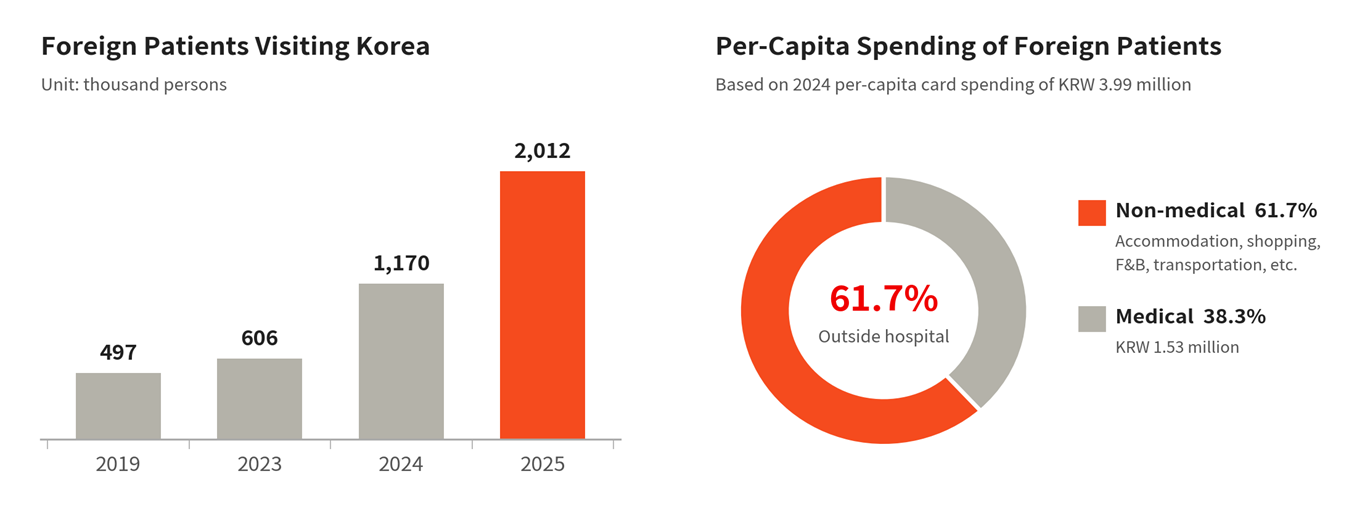
Source: Korea Health Industry Development Institute (KHIDI); analysis by Yanolja Research
Online Advertising, Travel Platforms, VAT… Reconnecting the ‘Three Gateways’ of Medical Tourism
The report finds that for medical care to function as an anchor, institutional improvements are needed at three stages: ‘awareness,’ when Korean medical services become known to overseas consumers; ‘connection,’ when interest is converted into bookings and travel itineraries; and ‘base expansion,’ when first-time and repeat visits accumulate.
At the awareness stage, foreign patients compare hospitals online before departure, yet the special provision for foreign-language medical advertising is limited to physical locations such as airports and duty-free shops, with no separate provision applying to foreign-language websites or overseas-targeted social media. As a result, the use of treatment testimonials and before-and-after photos is restricted. By contrast, Singapore’s Mount Elizabeth Hospital and Thailand’s Bumrungrad International Hospital publish patient reviews on their websites. Singapore bans before-and-after photos and Thailand requires prior approval for medical advertising, so their regulations are by no means lax; what sets them apart from Korea is that they clearly define the permitted scope through statutory provisions and guidelines.
“Korea is a rare medical tourism destination that combines quality of care, price competitiveness, and the global recognition built by K-culture,” said Kyuwan Choi, Professor at the College of Hotel & Tourism Management, Kyung Hee University. “For these strengths to translate into the choices of overseas consumers, clear standards on what can be communicated, grounded in medical safety and consumer protection, must come first.”
[Table] Regulation and Permitted Scope of Online Medical Advertising Targeting Foreigners
| Category | Korea | Singapore | Türkiye | Thailand | Malaysia |
|---|---|---|---|---|---|
| Treatment testimonials | Restricted | Permitted (if four conditions are met, e.g., unpaid and unedited) | Permitted (overseas-targeted channels, patient consent, etc.) | Permitted (prior approval) | Permitted (facility/service reviews only) |
| Before-and-after photos | Restricted | Restricted | Permitted (taken under identical conditions, etc.) | Permitted (prior approval) | Restricted |
Discounts and promotions | Restricted | Restricted | Permitted (overseas-targeted channels only) | Permitted (prior approval) | Permitted |
Source: Yanolja Research
At the connection stage, some travel platforms that are registered as insurance agencies because they sell travel insurance face restrictions on participating as entities that attract foreign patients. In 2009, Article 27(4) of the Medical Service Act prohibited insurance agencies and similar entities from attracting foreign patients in order to limit insurers’ entry into the medical market; however, after travel platforms were permitted to sell travel insurance in 2018, some of them also fell within the scope of this restriction. Because violations are punishable by up to three years’ imprisonment, the issue is difficult to resolve through administrative interpretation alone. The report notes that while overseas platforms such as Klook and Trip.com took part in the Korea Tourism Organization’s medical tourism promotional events, no major domestic platform selling travel insurance could be found on the participant lists.
At the base expansion stage, the key issue is the expiry at the end of 2025 of the special VAT refund that had applied to dermatology and plastic surgery procedures for foreigners. In the first half of 2026, foreigners’ average medical-sector spending per card rose 30.1%, while the number of cards used increased by only 1.0%. Taking the number of cards as a proxy for the number of users, this can be interpreted as medical spending growing while the user base stagnated.
The report cautions, however, that other factors such as exchange rates and base effects were also at play, so this cannot be attributed conclusively to the end of the special refund. It nonetheless highlights that over the program’s ten years, the number of refunds grew more than 50-fold, from about 30,000 to 1.72 million, while the average refund per case fell from KRW 230,000 to KRW 110,000. The report suggests that the special refund may have lowered the barrier to visiting for price-sensitive foreigners seeking relatively minor cosmetic procedures, and also raises concern that its effect of bringing transactions into the open through refund claims could weaken.
Fragmented Medical Tourism Rules Should Be Woven into ‘a Single Journey’
The report sees 2026 as the right time for institutional reform. Following the Ministry of Justice’s improvements to medical tourism visas, the Ministry of Culture, Sports and Tourism’s implementation of the Healing Tourism Industry Act, and the Ministry of Health and Welfare’s establishment of a legal basis for telemedicine, amendment bills on the provision governing entities that attract foreign patients (Medical Service Act) and on the special refund (Restriction of Special Taxation Act) have also been introduced in the National Assembly.
However, these changes remain scattered across ministries and individual rules, and separate standards for assessing online medical advertising aimed at foreigners are still lacking. The report therefore proposes: (1) codifying standards for online medical advertising targeting foreigners; (2) revising the provision on entities permitted to attract foreign patients and establishing transparency standards for platform exposure and commissions; (3) re-examining the fiscal effects of the special refund, including out-of-hospital spending and tax revenue; (4) linking the qualification systems for the travel industry, the foreign patient attraction business, and healing tourism; and (5) building journey-based performance indicators such as length of stay and revisit rates. It adds that every measure must be designed together with trust and safety safeguards, including information verification, incident response, and follow-up care.
“Competing countries have not loosened their regulations; rather, they have clearly defined what is permitted and to what extent,” said SooCheong Jang, President of Yanolja Research and Professor at Purdue University (USA). “Korea, too, must establish predictable standards in key areas such as online advertising and entities permitted to attract foreign patients, while safeguarding medical safety and consumer protection. The performance of medical tourism should also be assessed at the journey level, not only by patient numbers and medical expenditures but also by length of stay, revisit rates, and local spending.” He added, “Now is the right time to connect these fragmented rules into a single tourist journey and turn them into real competitiveness for K-medical tourism.”
 Prev
 Back
