
[Press Release] Korea’s Lodging Industry Posts Broad-Based Growth Across All Segments in Q2 2026
- Reg Date
- 2026.08.07
Korea’s Lodging Industry Posts Broad-Based Growth Across All Segments in Q2 2026
5-Star Hotels and Vacation Rentals Lead Performance Growth…
Japanese Visitor Demand Concentrated in Hotels, Seoul and Busan, and FIT Travelers
Supported by the continued increase in inbound visitors and the onset of the seasonal peak period, including the May golden holiday, Korea’s domestic lodging market recorded performance improvements across all property types in Q2 2026. Pensions and mid-to-low-priced properties, which had been relatively left behind in the previous quarter’s recovery, also returned to growth, while 5-star hotels, vacation rentals, and resorts strongly led overall market expansion.
Yanolja Research, a research institute specializing in the travel and tourism industry, led by Director SooCheong Jang, released its Q2 2026 Quarterly Trends in the Korea Lodging Industry, based on proprietary data and a survey of lodging operators. The report analyzes Q2 2026 performance across major property types, including hotels, motels, pensions, and vacation rentals, while also examining how lodging operators perceive the recent recovery in demand from Japanese visitors to Korea.
All Segments Post Positive Year-over-Year Growth… Occupancy, Rather Than Pricing, Drives Performance
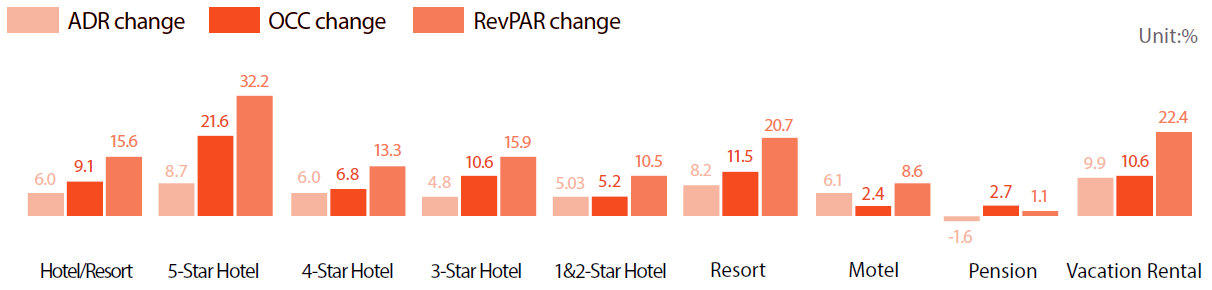
According to the report, all segments of Korea’s lodging industry improved in Q2 2026 compared with Q2 2025. ADR and OCC increased simultaneously across all property types except pensions. In the pension segment, an increase in OCC more than offset a decline in ADR, bringing the segment back to positive growth.
The highest growth was recorded by 5-star hotels, where OCC surged 21.6% year-over-year and RevPAR increased 32.2%. Vacation rentals (+22.4%) and resorts (+20.7%) also posted RevPAR growth of more than 20%, followed by 3-star hotels (+15.9%), 4-star hotels (+13.3%), 1&2-star hotels (+10.5%), motels (+8.6%), and pensions (+1.1%). A common feature among the fastest-growing segments was that improvements in OCC, rather than room-rate increases, were the primary driver of performance growth.
Notably, 1&2-star hotels and pensions, which had shown relatively weak performance in the previous quarter, also returned to year-over-year growth, indicating that the recovery had broadened beyond upscale hotels and selected lodging segments to the overall market.
However, the drivers of growth differed by property type. For hotels, resorts, and vacation rentals, improvements in OCC generally made a greater contribution to performance growth, whereas motel growth was primarily driven by ADR. Motel ADR rose 6.1% year-over-year and OCC increased 2.4%, resulting in an 8.6% increase in RevPAR.
For pensions, nationwide OCC increased 2.7%, but ADR declined 1.6%, limiting RevPAR growth to 1.1%. Regional disparities, however, were substantial. Major tourism destinations such as Busan (+18.3%) and Jeju (+13.4%) recorded double-digit RevPAR growth, while Jeolla, Gyeonggi, and Chungcheong posted declines as lower ADR weighed on performance, highlighting clear differences in the pace of recovery across regional pension markets.
ADR/OCC/RevPAR Changes by Property Type: Q2 2026 vs. Q2 2025
Seasonal Peak Demand Drives Broad-Based Quarter-over-Quarter Rebound… Increased Outdoor Activities Support Performance
The effects of entering the seasonal peak period were also evident when compared with the previous quarter, Q1 2026. As spring and early-summer travel demand increased, RevPAR rose quarter-over-quarter across all property types.
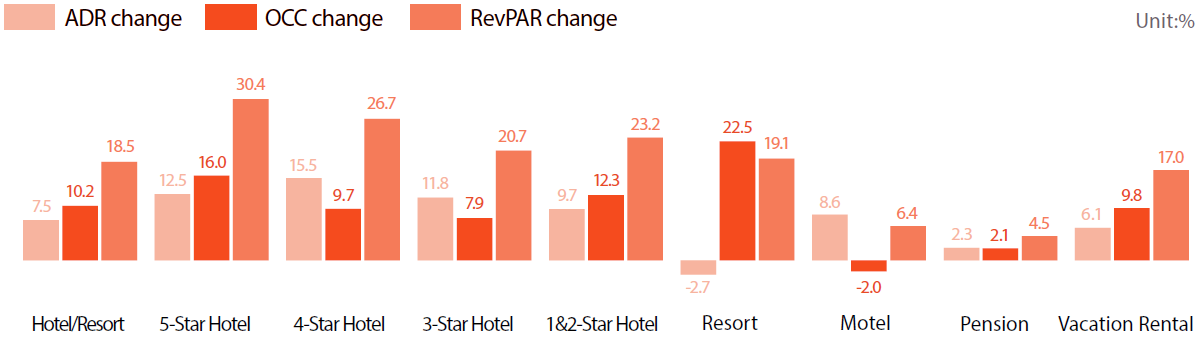
Across the overall hotel/resort segment, ADR increased 7.5% and OCC rose 10.2%, resulting in an 18.5% increase in RevPAR. By hotel star category, RevPAR increased sharply by between 20.7% and 30.4% quarter-over-quarter.
In the resort segment, ADR declined slightly by 2.7%, but OCC surged 22.5%, supported by increased outdoor travel activity, resulting in a 19.1% increase in RevPAR.
The motel segment also recorded a 6.4% increase in RevPAR, with ADR rising 8.6%. In particular, Busan (+25.6%), Seoul (+23.5%), and Jeolla (+19.1%) saw simultaneous increases in room rates and occupancy.
The pension segment, which had struggled in Q1, also returned to growth, with ADR and OCC increasing 2.3% and 2.1%, respectively, resulting in a 4.5% increase in RevPAR.
ADR/OCC/RevPAR Changes by Property Type: Q2 2026 vs. Q1 2026
Positive Outlook for the Q3 Summer Peak Season… Hotel and Motel Operators Expect Further Improvement
Lodging operators expressed a highly positive outlook for Q3 2026, which includes the summer vacation season. According to Yanolja Research’s Q3 2026 lodging industry outlook index, both hotel and motel operators expect ADR and OCC to rise, with all indices well above the baseline of 100.
For hotels, the ADR outlook index stood at 119.3, while the OCC outlook index reached 118.4. Motels recorded an ADR outlook index of 114.0 and an OCC outlook index of 119.0.
The hotel ADR outlook index of 119.3 was the highest among the four indicators, reflecting particularly strong expectations among hotel operators for higher room rates and revenue during the summer peak season.
By contrast, the motel OCC outlook index of 119.0 exceeded its ADR outlook index, suggesting that motel operators have stronger expectations for demand recovery than for room-rate increases, indicating a different expected path to performance improvement from the hotel sector.
1.60 Million Japanese Visitors to Korea in January–May… Perceived Impact Concentrated in Hotels and Major Gateway Cities
The report also analyzed lodging demand from Japanese visitors, Korea’s second-largest inbound tourism market, and how that demand is being perceived by lodging operators.
From January through May 2026, Japanese arrivals to Korea reached approximately 1.60 million, up 20.2% year-over-year. Japanese visitors accounted for an average 18.2% of total inbound arrivals during the period, continuing to serve as a significant source of Korea’s inbound lodging demand.
However, the perceived impact of increased Japanese demand varied considerably across the lodging industry. According to Yanolja Research’s survey of 487 lodging properties nationwide, 29.4% of hotels reported an increase in Japanese bookings compared with the previous year, substantially higher than the 9.9% recorded among motels.
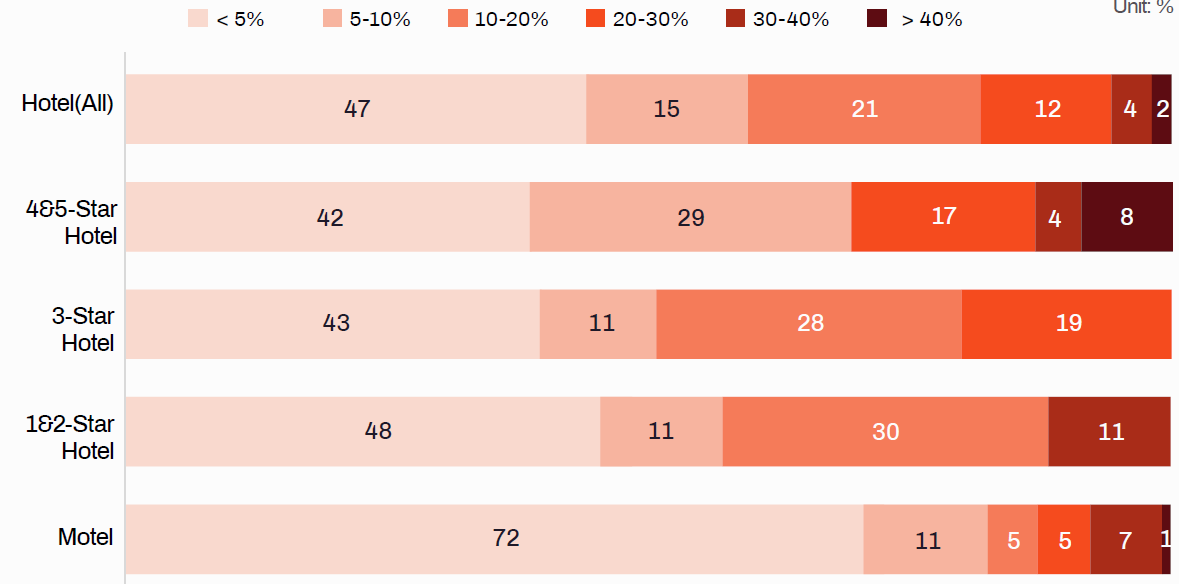
Similarly, 38.5% of hotels reported that Japanese guests accounted for at least 10% of their foreign guests, compared with 16.7% of motels. Among hotels, this share was higher for 3-star hotels (46.8%) and 1&2-star hotels (40.7%) than for 4&5-star hotels (29.2%), confirming that Japanese demand is broadly distributed across midscale and economy hotels as well as upscale properties.
Distribution of Japanese Guest Share Among Foreign Guests by Property Type and Hotel Grade
By region, the perceived increase in Japanese bookings was concentrated in major gateway cities with strong international accessibility and tourism appeal, including Seoul (35.6%), Busan (50.0%), and Incheon (21.4%).
Busan recorded the strongest result among the surveyed regions, with 77.8% of hotel operators reporting an increase in Japanese bookings. In Seoul, 47.8% of motel operators also reported an increase, indicating that the rise in Japanese lodging demand was clearly evident not only in hotels but also in the city’s motel sector.
By contrast, the perceived impact remained relatively limited in several non-capital and inland markets.
FIT Travelers Drive Growth in Japanese Demand… Proactive Response Strategies Becoming Increasingly Important
The increase in Japanese guests was overwhelmingly driven by FIT travelers, defined as groups of one to three people, accounting for 84.4% of hotels and 74.3% of motels that reported an increase in Japanese bookings.
Small groups followed, accounting for 25.0% of hotels and 34.3% of motels, while growth in large group tours was limited to 6.2% of hotels and 0% of motels. These findings indicate that the Japanese inbound tourism market is increasingly centered on individual and small-group travel.
Meanwhile, more than 40% of properties that perceived an increase in Japanese bookings—41.9% of hotels and 42.9% of motels—reported that they had no specific measures planned, indicating that a substantial share of operators remain in a monitoring phase rather than proactively pursuing Japanese demand.
Among properties taking action, the most frequently cited measures were strengthening Japanese-language services (hotels 35.5%, motels 37.1%) and enhancing OTA/channel marketing (32.3% and 28.6%, respectively).
SooCheong Jang, Director of Yanolja Research, said:
“Korea’s lodging market posted a clear rebound across all segments in Q2 2026, supported by the onset of the seasonal peak period and continued growth in inbound visitors. In particular, the steadily expanding demand from Japanese visitors is concentrated among FIT travelers, midscale and economy hotels, and major gateway cities. To broaden this demand to other regions and property types, the industry needs to connect region-specific tourism content with lodging products and strengthen its readiness for independent travelers through Japanese-language services, global OTA distribution, and greater convenience in payment and check-in.”
 Prev
Prev  Back
Back 