
The Yanolja City Competitiveness Index (YCCI), developed by Yanolja Research in collaboration with Purdue University’s CHRIBA and Kyung Hee University’s H&T Analytics Center, is an initiative designed to measure the competitiveness of Korean tourism cities from a “consumer’s perspective.” By analyzing online mentions and sentiment responses regarding these tourism destinations, the index evaluates and measures each city’s reputation and attractiveness.

The Push-Pull motivation theory explains the reasons why people travel through two distinct dimensions:

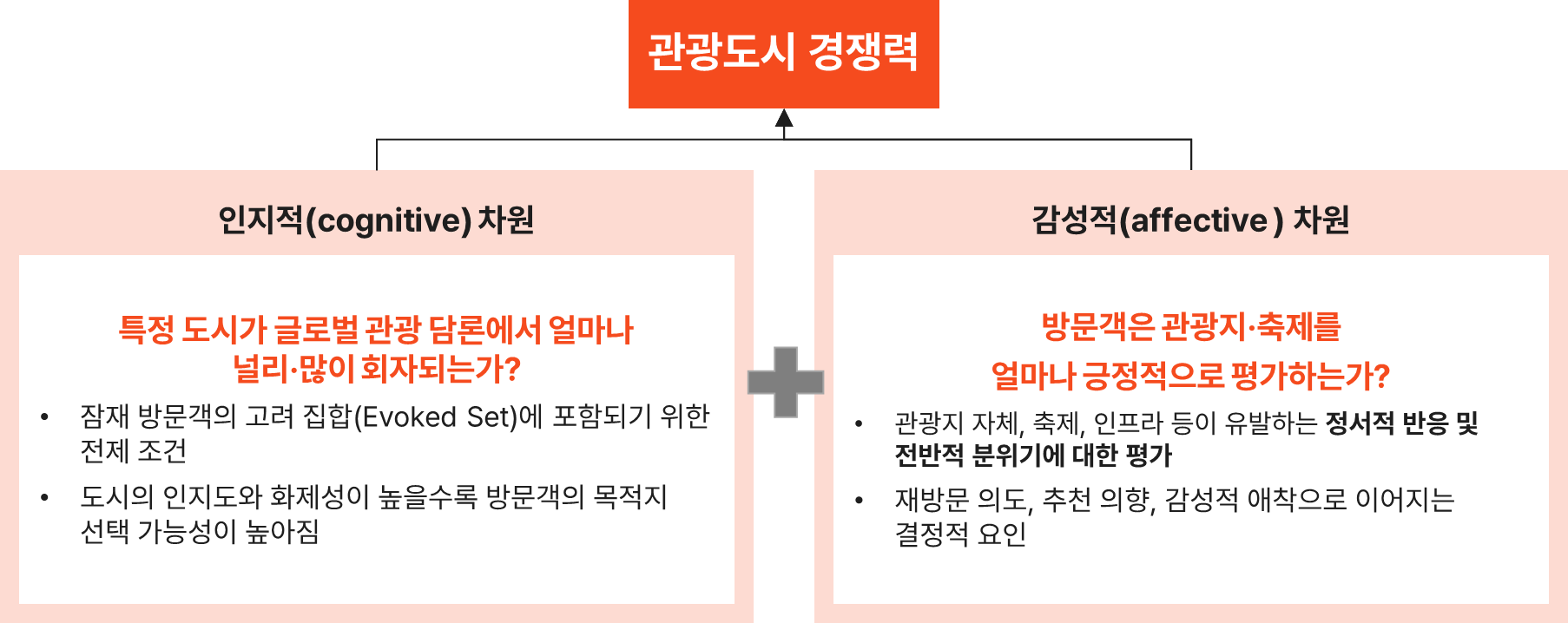
Tourists form a cognitive image of a city based on facts and information, alongside an affective image based on atmosphere and emotions. It is the combination of these two images that ultimately shapes their actual decision to visit.
The Resource-Based View posits that a sustainable competitive advantage stems from resources that are rare and difficult to imitate. Tourism resources naturally meet these criteria because they are uniquely rooted in a specific location. However, simply possessing these resources does not automatically guarantee competitiveness; they only become a true competitive advantage when they are successfully translated into actual tourist experiences.
The Yanolja City Competitiveness Index measures how widely a city’s unique resources are recognized by tourists and how positively those resources are evaluated through real-life visit experiences. This approach understands tourism city competitiveness as a continuous flow: Resources → Experience → Emotion → Sharing → Revisit Intention.
Based on the theoretical backgrounds mentioned above, the Korean Tourism City Competitiveness Index developed by Yanolja Research establishes evaluation criteria across two major dimensions. Specifically, the competitiveness of a tourism city is measured by:

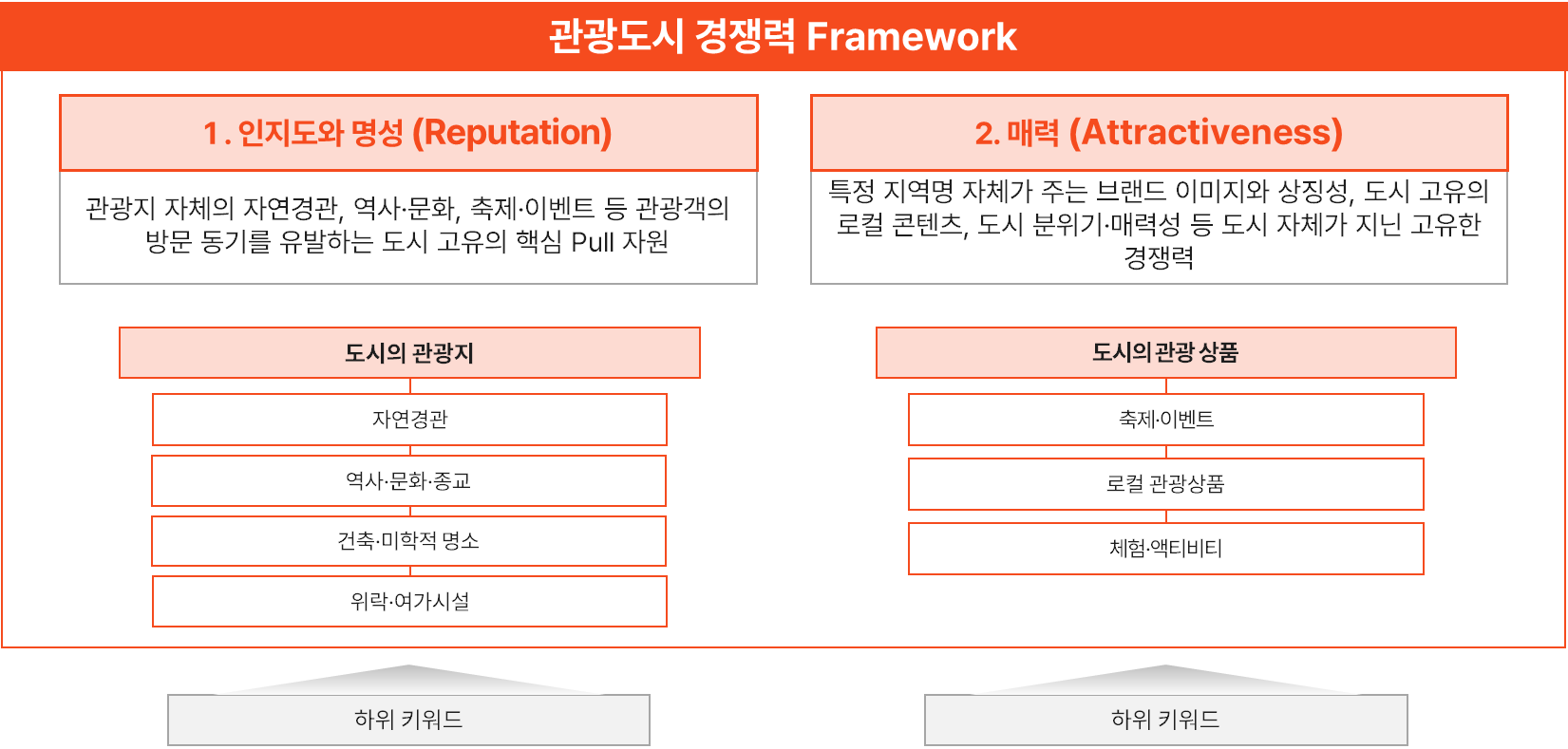
Considering that the competitiveness of a tourism city is determined by a complex combination of factors—such as tourist destinations and tourism products—we established two core dimensions of competitiveness based on a review of prior literature and expert consensus: “City Tourism Destinations” and “City Tourism Products.”
Furthermore, each core dimension is systematically structured by its respective sub-dimensions, which in turn are defined by keyword groups that most accurately reflect and represent each sub-dimension.
Explore the detailed process behind how the Yanolja City Competitiveness Index is calculated.