
[PR] Yanolja Research Forecasts 23.57 Million Foreign Tourists to Korea in 2026
- Reg Date
- 2026.09.28
Yanolja Research Forecasts 23.57 Million Foreign Tourists to Korea in 2026... Japan and Taiwan Increasingly Choose Korea, K-Culture Drives Record-High Inbound Tourism
A new forecast indicates that foreign tourist arrivals to South Korea will reach a record-high 23.57 million this year. In its brief titled "Forecast of Inbound Tourist Arrivals to South Korea in 2026" published on September 17, Yanolja Research (Director SooCheong Jang), a travel and tourism research institute, revised its annual inbound tourist projection for 2026 upward to 23.567 million. This represents a 24.5% increase compared to last year’s figure (18.937 million) and is approximately 2.31 million higher than the upper bound of 21.26 million projected in January of this year. Yanolja Research explained that the update reflects a "new reality," driven by a faster-than-expected rise in trips to Korea led by Japan and Taiwan since the beginning of the year, a momentum that has expanded to long-haul markets such as the United States.
12.8 Million Visitors from Jan–Jul, Up 21.3%… Growth Recorded in 53 Out of 59 Countries
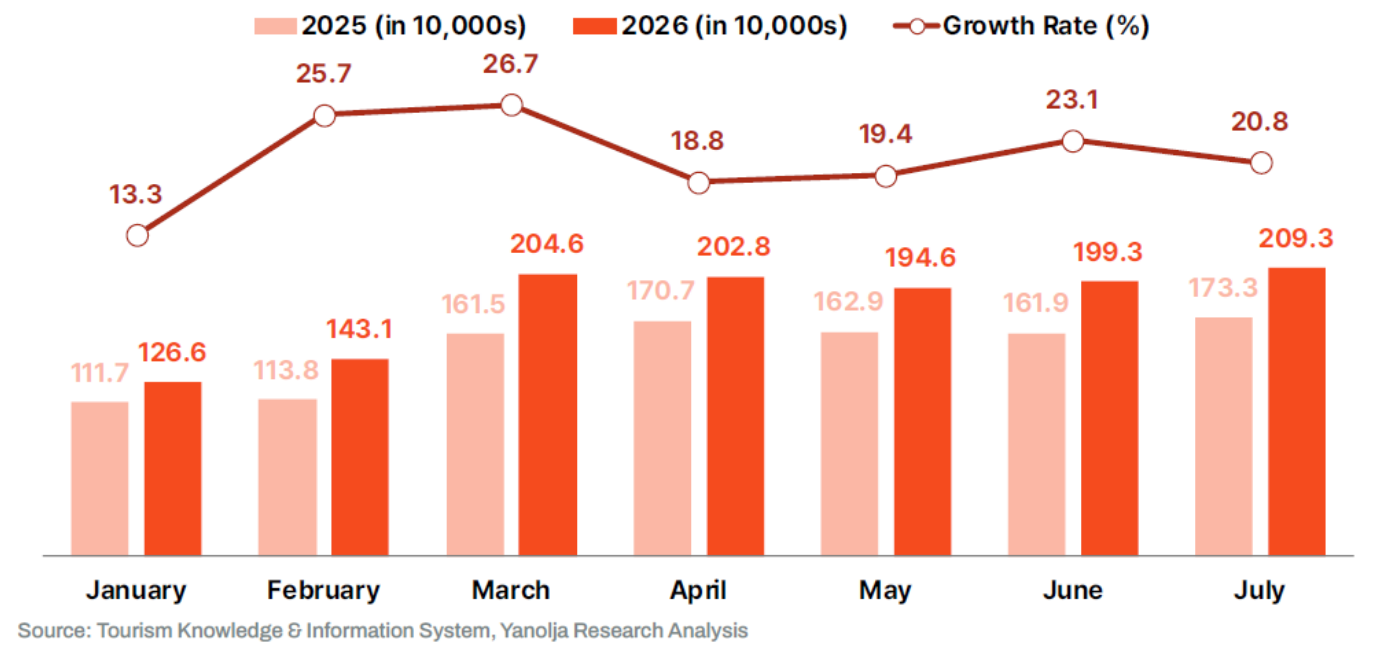
From January to July 2026, foreign tourist arrivals reached 12.803 million, up 2.244 million (21.3%) year-on-year, with July setting a single-month high for the year at 2.093 million. Even if growth moderates to just 10% year-on-year for the remaining period from August to December, annual arrivals are on track to reach approximately 22 million, comfortably surpassing the upper limit of the early-year forecast. While China (+859,000), Japan (+361,000), and Taiwan (+349,000) accounted for 70% of the growth, visitor numbers increased in 53 out of 59 analyzed countries—including key markets like Hong Kong, the Philippines, Indonesia, Canada, the UK, and Australia—demonstrating that the growth is broadly based rather than dependent on specific markets.
[Figure 1] Monthly inbound foreign visitors and growth rates (January-July, 2025-2026)
Japan Visits Korea at 4x the Rate of Outbound Travel Growth… 1 in 10 Taiwanese Travelers Chooses Korea
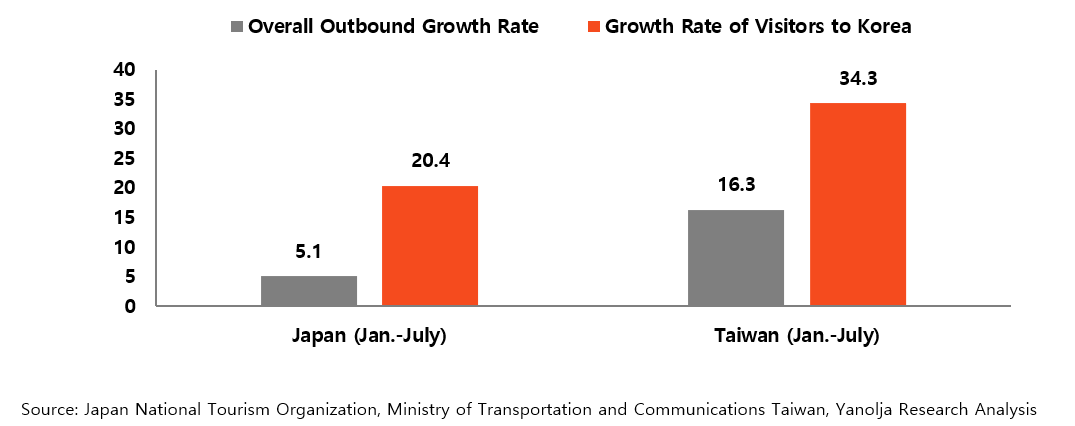
The most significant shift comes from Japan and Taiwan. Between January and July, overall outbound travel from Japan grew by just 4.1%, whereas Japanese visits to Korea jumped by 18.8%—a growth rate more than four times faster. Taiwan showed a similar pattern: trips to Korea (+34.3%) grew more than twice as fast as total outbound travel (+16.3%), pushing Korea’s share among Taiwanese overseas travelers up from 9.4% to 10.9%.
The driving force behind this trend is K-culture. According to Google Trends data, searches in Japan related to Korean "Arts & Entertainment" surged by 116.0% year-on-year, while "Food & Drink" searches skyrocketed by 198.3%. Taiwan saw similar interest, with searches in these categories increasing by 38.7% and 69.8%, respectively. Notably in Japan, foreign arrivals grew nearly 20% despite unfavorable pricing conditions caused by the stronger Korean Won against the Japanese Yen—serving as clear evidence that cultural content, rather than price, is driving destination choices.
Suckwon Hong, Senior Researcher at Yanolja Research, explained, "Japan and Taiwan are markets where travelers are actively choosing Korea over other destinations, rather than simply traveling abroad more overall. The shared pattern in both markets—where a spike in search interest is followed months later by an surge in actual visitors—formed the primary basis for this revised forecast."
[Figure 2] Outbound travel growth rate vs. inbound travel to Korea for Japanese and Taiwanese visitors
Chinese Visitors to Korea Up 27.5% Amid 56% Drop in Travel to Japan… Momentum Spreads to Long-Haul Markets Including the U.S.
Chinese tourist arrivals to South Korea rose 27.5% to 3.988 million. Following the Chinese government's advisory in November 2025 discouraging travel to Japan, Chinese visitors to Japan plunged 56.3%, while visits to South Korea continued to post double-digit monthly growth. Consequently, Korea’s share among 22 major travel destinations for Chinese tourists increased from 5.4% to 6.5%. U.S. visitor arrivals to Korea also grew by 11.6% to 962,000, while search interest in K-culture in the United States, Canada, the United Kingdom, and Australia rose by 32% to 55%. Yanolja Research analyzed that expanding interest in K-culture serves as a common driver establishing Korea as an "aspirational destination," while factors such as airline capacity, exchange rates, and market-specific events determined the speed at which this interest converted into actual visits across different markets.
Forecast Revised via AI Model Validation… Performance in Remaining 5 Months Will Be Key
The updated forecast utilized the LSTM deep learning time-series model, incorporating major variables including GDP, search interest, exchange rates, flight capacity, oil prices, and market events such as China-Japan geopolitical tensions. When the model was back-tested to predict the March–July period using data available up to February 2026, it demonstrated high reliability with an error margin of just 1.3%. The full-year projection of 23.57 million visitors combines actual performance from January through July with an estimated 10.764 million arrivals for the remaining August–December period. Reaching this total will require a 28.5% year-on-year increase (+2.386 million visitors) over the final five months of the year. This remains a conditional forecast assuming favorable factors—such as strong search interest, flight frequencies, and foreign exchange rates—persist through year-end. Furthermore, as the impact of China's travel destination shift enters the baseline starting in November, second-half growth will rely more heavily on simultaneous expansion across Japan, Taiwan, the U.S., and other international markets.
[Figure 3] 2026 Annual Inbound Demand Forecast Revision

“Shift the Focus from ‘Will They Return?’ to ‘How Do We Receive Them?’”
SooCheong Jang, Director of Yanolja Research, noted, "The fact that travel to Korea is growing much faster than overall outbound travel from Japan and Taiwan—and that Korea’s share as a chosen destination is rising—is the clearest signal that interest in K-culture and Korea is translating into actual destination choices." He emphasized, "The central question for policy and industry must now shift from 'Will foreign visitors return?' to 'How do we sustainably accommodate this expanding demand and connect it to tourism spending, regional distribution, and repeat visits?'"
To address this shift, Professor Kyuwan Choi at Kyung Hee University suggested a three-pronged strategy: linking the expansion of long-haul arrivals with local festivals and cultural tourism products to spread stay duration and spending across regional areas; diversifying regional and seasonal content in short-haul markets like Japan and Taiwan to drive repeat visits; and balancing quantity with quality in the Chinese market by implementing strategies focused on increasing spending value per visitor rather than solely chasing headcounts.
Yanolja Research added that whether this forecast is realized will depend on maintaining key variables: Korea's share among Chinese outbound destinations, Korea's share among Japanese and Taiwanese overseas travelers, ongoing search interest in K-culture, flight capacity to Korea, and favorable exchange rate conditions for the Korean Won. The full report is available on the Yanolja Research website.
 Prev
 Back
