
[PR] Daegu Airport Should Join Gimhae and Gadeokdo as a “Dual Gateway” for the Gyeongsang Region
- Reg Date
- 2026.09.14
Daegu Airport Should Join Gimhae and Gadeokdo as a “Dual Gateway” for the Gyeongsang Region: “The Region Should Aim to Become a World-Class Tourism Destination on Par with Kansai”
Yanolja Research, a research institute specializing in the travel and tourism industry, led by President SooCheong Jang, said in its report, “The Role of Daegu Airport in Inbound Tourism: A “Dual-Gateway” Strategy for the Gyeongsang Region,” that the role of regional airports should be redesigned based on tourists’ actual travel patterns rather than administrative boundaries in order to ease the concentration of international visitors in the Seoul metropolitan area.
In particular, given that a significant share of international visitors traveling onward from Daegu head to Busan, the report proposes positioning Daegu Airport and airports in the Busan area as complementary gateways under a “Dual-Gateway” system for the Gyeongsang region.
Daegu Airport’s International Traffic Is Recovering, but Remains Outbound-Oriented
International passenger demand at Daegu Airport has been recovering since the COVID-19 pandemic. However, the share of foreign nationals among arriving international passengers, which at one point exceeded 40% before the pandemic, has recently remained at around 20%.
Daegu Airport currently operates approximately 16 international routes, primarily short-haul services to Japan and Southeast Asia, and continues to rely heavily on outbound demand from Korean residents taking short overseas trips. Nevertheless, the relatively high share of routes serving Taiwan and the broader Greater China market suggests room to redesign the airport’s route portfolio toward attracting more inbound travelers.
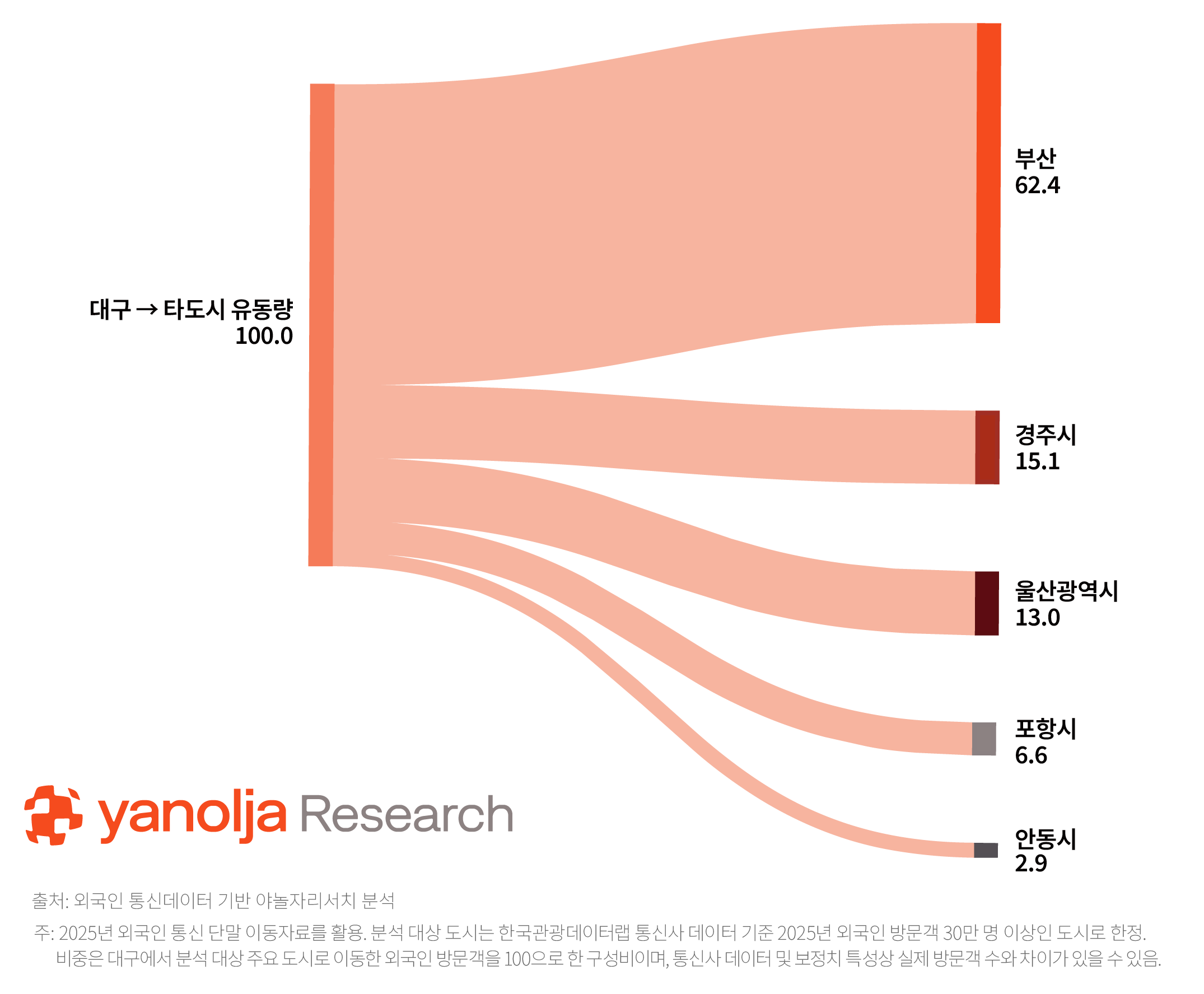
62.4% of International Visitors Leaving Daegu Travel to Busan—Stronger Link Than to Gyeongju or Ulsan
An analysis of foreign visitor mobile network data for 2025 found that among international visitors traveling from Daegu to major cities outside the city, Busan accounted for the largest share at 62.4%. It was followed by Gyeongju at 15.1%, Ulsan at 13.0%, Pohang at 6.6%, and Andong at 2.9%.
Busan alone accounted for a larger share than the other four cities combined. This indicates that the actual travel area of international visitors centered on Daegu extends well beyond the administrative boundaries of Daegu and North Gyeongsang Province, encompassing the broader Gyeongsang region, including Busan.
[Figure 1] Major Onward Destinations of International Visitors to Daegu (Unit: %)
Source: Yanolja Research analysis based on foreign visitor mobile network data (2025)
Daegu Shows a “Corridor-Based” Travel Pattern Toward Busan, While Busan Functions as a “Distribution Hub”
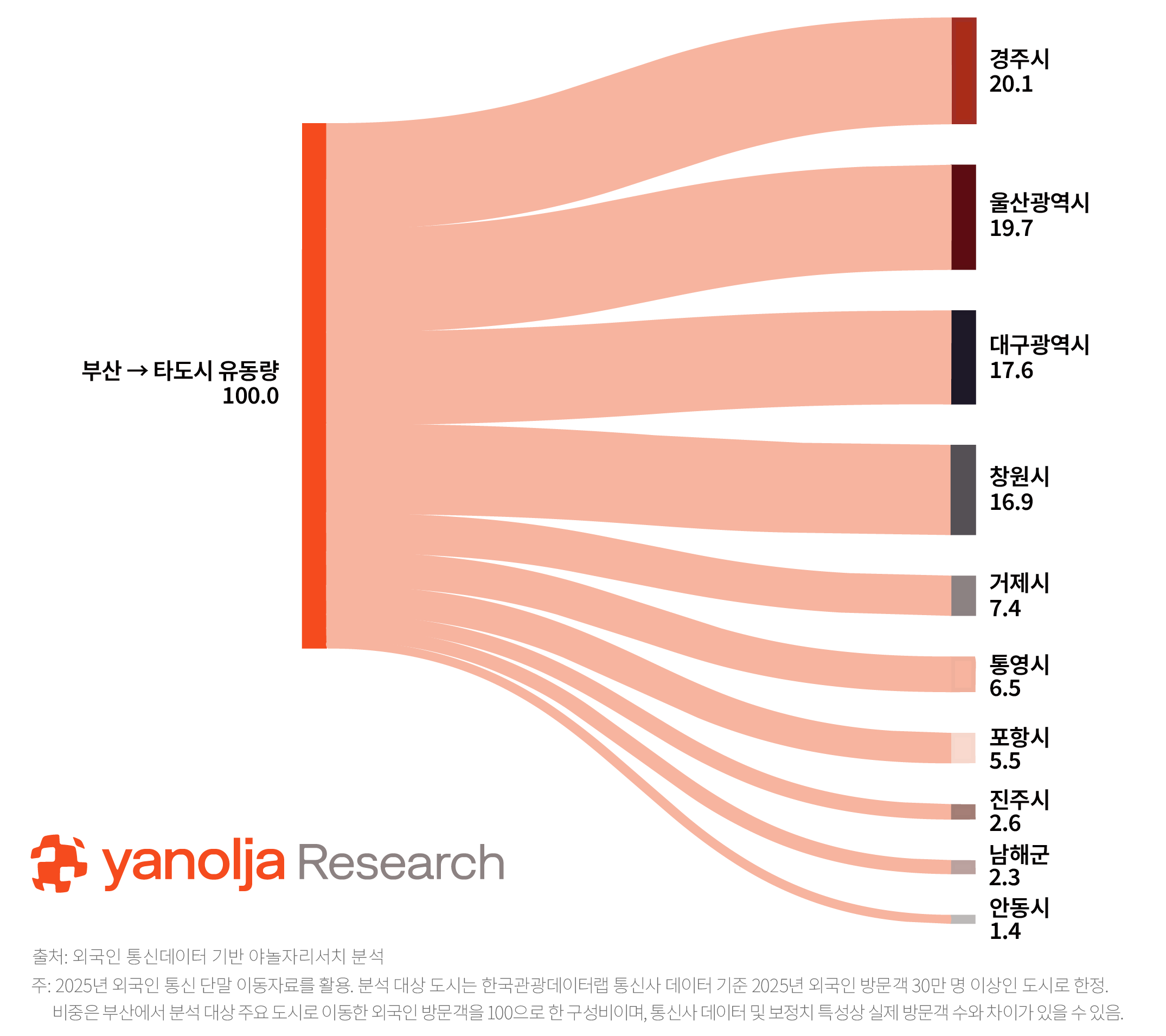
The same analysis using Busan as the point of origin reveals a distinctly different travel pattern. International visitors departing Busan were distributed relatively evenly across several destinations, including Gyeongju at 20.1%, Ulsan at 19.7%, Daegu at 17.6%, and Changwon at 16.9%.
While more than 60% of onward travel from Daegu is concentrated on a single destination—Busan—forming a corridor-based travel pattern, Busan functions as a distribution hub, dispersing tourists across multiple cities in the Gyeongsang region. The findings suggest that Daegu and Busan play different yet complementary roles within a single, interconnected regional tourism network.
[Figure 2] Major Onward Destinations of International Visitors to Busan (Unit: %)
Source: Yanolja Research analysis based on foreign visitor mobile network data (2025)
With Gimhae Airport at Capacity and Gadeokdo Delayed, Daegu Airport Should Serve as a Key Gateway for the Gyeongsang Region
These travel patterns are closely linked to aviation capacity across the Gyeongsang region. In 2025, Gimhae International Airport handled approximately 10.44 million international passengers, becoming the first regional airport in Korea to surpass 10 million international passengers in a single year. However, constraints involving slots, facilities, and staffing leave limited room for further expansion of international services.
Meanwhile, the opening of Gadeokdo New Airport, which is expected to take over and expand the region’s international aviation functions, has been postponed to 2035, creating a considerable gap before international air capacity in the Busan area can be expanded substantially.
Given that Dongdaegu and Busan are connected by KTX in roughly one hour, the report’s central recommendation is to utilize Daegu Airport not simply as an airport serving Daegu and North Gyeongsang Province, but as a complementary international gateway connecting travelers to the entire Gyeongsang region.
Under this model, Gimhae Airport would serve primarily as a gateway to coastal and maritime tourism, while Daegu Airport would function as a gateway to inland tourism, with visitors arriving through either airport dispersed throughout the broader Gyeongsang region. Rather than artificially creating a new tourism region, this approach seeks to strengthen the existing Daegu–Busan visitor corridor through coordinated aviation, transportation, and tourism-product policies.
Lessons from Japan’s Kansai: Daegu and Gimhae Should Be Viewed Not as Competitors, but as a “Dual Gateway” for the Gyeongsang Region
The report identifies Japan’s Kansai region, anchored by Osaka and Kyoto, as a leading example of a regional tourism destination from which the Gyeongsang region can draw lessons.
In Yanolja Research’s 2026 Global Tourism Attractiveness Index, Osaka ranked third and Kyoto fourth, following New York in first place and Paris in second, and ahead of Seoul in fifth. Supported by multiple international airports and an extensive regional transportation network, Kansai distributes international visitors across several cities and has developed into one of the world’s leading tourism regions.
The report also points to structural similarities between the Gyeongsang and Kansai regions in terms of population scale and the characteristics of their major cities, drawing parallels such as Busan–Osaka, Gyeongju–Kyoto, and Daegu–Kobe.
According to the report, if the Dual-Gateway strategy is successfully established, the Gyeongsang region could develop into a world-class tourism destination comparable to Kansai and become a major regional tourism hub supporting Korea as it moves toward an era of 30 million international visitors.
To achieve this, the report recommends redefining airport catchment areas according to tourists’ actual travel patterns rather than administrative boundaries. It also calls for Daegu Airport, Gimhae Airport, and the future Gadeokdo New Airport to be considered collectively under a single “Gyeongsang International Aviation Capacity Roadmap,” rather than planned and operated solely as individual airports.
The report further emphasizes the need for cross-regional tourism products and transportation systems that connect airports with major cities, including multi-city itineraries such as “Daegu IN–Busan OUT” and integrated passes linking air travel with KTX services.
SooCheong Jang, President of Yanolja Research, said, “The role of Daegu Airport should not be confined to short-term demand from Daegu and North Gyeongsang Province. In the longer term, it should be positioned as one of the key gateways supporting international tourism demand across the entire Gyeongsang region, alongside Gimhae Airport and the future Gadeokdo New Airport.”
“If Daegu serves as an inland gateway while the Busan area serves as a coastal gateway under a complementary ‘Dual-Gateway’ system, the Gyeongsang region can establish a new model of regional tourism growth that helps disperse inbound visitors currently concentrated in the Seoul metropolitan area,” Jang added.
Kyuwan Choi, Professor at the College of Hotel and Tourism Management at Kyung Hee University, said, “With its diverse tourism assets, the Gyeongsang region has the potential to emerge as a world-class tourism destination comparable to Japan’s Kansai region, home to Osaka and Kyoto.”
“By using two international airports as gateways and seamlessly connecting major cities such as Daegu, Gyeongju, Ulsan, Busan, and Changwon, the Gyeongsang region has strong potential to develop into another globally competitive inbound tourism hub alongside Seoul and the surrounding metropolitan area,” Choi added.
 Prev
Prev  Back
Back 