
[PR] Aviation Market Maintains Growth Despite Concerns Over the Middle East
- Reg Date
- 2026.08.14
International Aviation Market Maintains Growth Despite Concerns Over Declines Following the Middle East War
Clear Divergence Across Foreign Carriers and Routes, While Transfer Passengers at Incheon Airport Surge
Despite persistent concerns that the outbreak of the Middle East war would lead to a decline in international flights, actual statistics indicate that such concerns have not materialized. However, the pace of growth in both flights and passenger traffic has gradually slowed since April. While Korean carriers have largely maintained their previous growth trajectory, foreign carriers have seen slower growth in both capacity and passenger volumes. Performance has also diverged across routes, with Southeast Asia and Oceania remaining weak, while Northeast Asia, the Americas, and Europe have shown relatively resilient trends.
Yanolja Research, a research institute specializing in the travel and tourism industry led by President SooCheong Jang, presented these findings in its report, Analysis of Changes in South Korea’s International Aviation Market Following the Middle East War. The report examines changes in international flights, seat capacity, passenger traffic, and route structure in South Korea during the approximately four months of continued armed conflict in the Middle East.
Following the outbreak of armed conflict between the United States and Iran, jet fuel prices surged by approximately 83% in a short period, rising from USD 2.43 per gallon on February 27 to USD 4.45 on March 20. Although prices have since declined somewhat, they remain above pre-conflict levels. Given that international aviation is a critical infrastructure connecting inbound and outbound tourism, the study examined how this cost shock has translated into actual changes in international air capacity and traveler movements.
Market Continues to Expand, but Growth Slows… Passenger Growth Falls to 4.0% in June
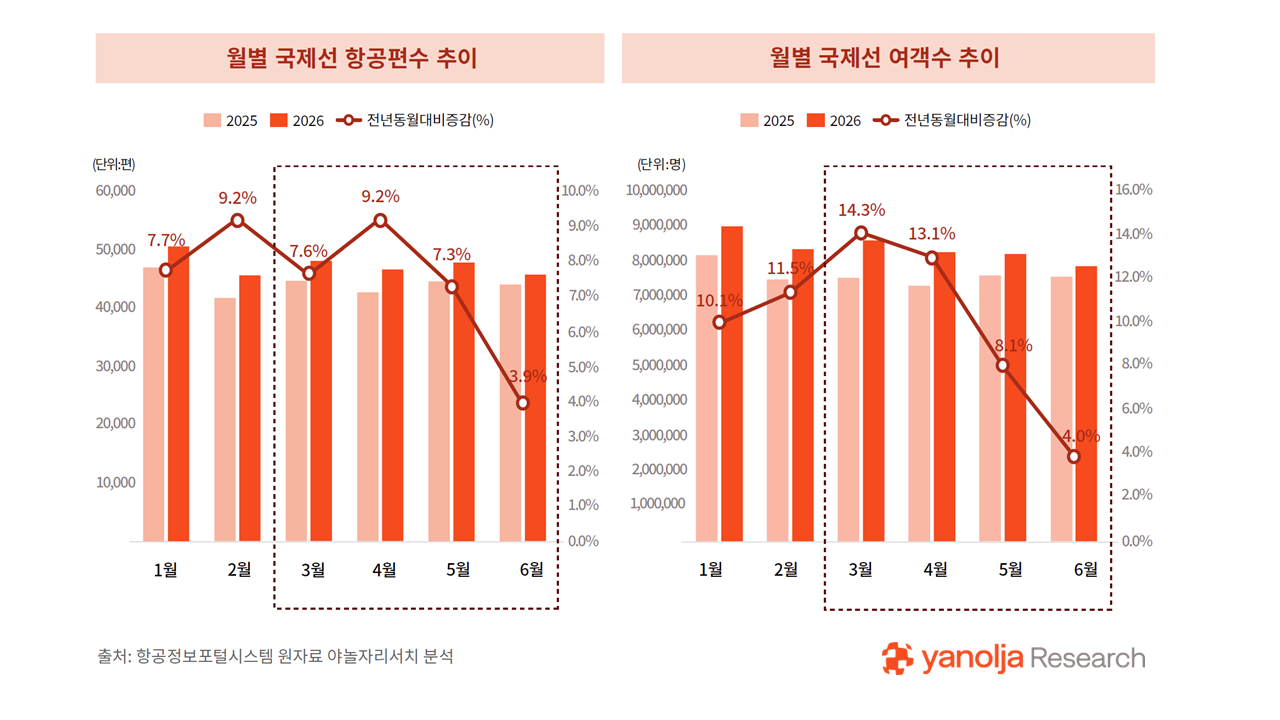
According to the report, South Korea’s international aviation market did not contract following the outbreak of the Middle East war. Both international flights and passenger volumes remained above their respective year-earlier levels throughout March to June. However, the pace of growth began to slow sharply around April.
The year-on-year growth rate in international flights declined from 9.2% in April to 7.3% in May and 3.9% in June. Passenger growth likewise slowed from 14.3% in March and 13.1% in April to 8.1% in May and 4.0% in June. In other words, rather than an immediate contraction of South Korea’s international aviation market, the more notable development following the Middle East war has been a simultaneous deceleration in the growth of both supply and demand.
The report cautions, however, against attributing this slowdown solely to the Middle East war or higher fuel costs. Other factors may also have contributed, including base effects associated with the normalization of the international aviation market, exchange-rate movements, economic conditions, and country-specific travel demand.
Monthly Changes in International Flight and Passenger Volumes (YoY)
Slowdown More Pronounced Among Foreign Carriers, While Korean Carriers Maintain Growth
Despite the overall slowdown in market growth, trends differed markedly between Korean and foreign carriers.
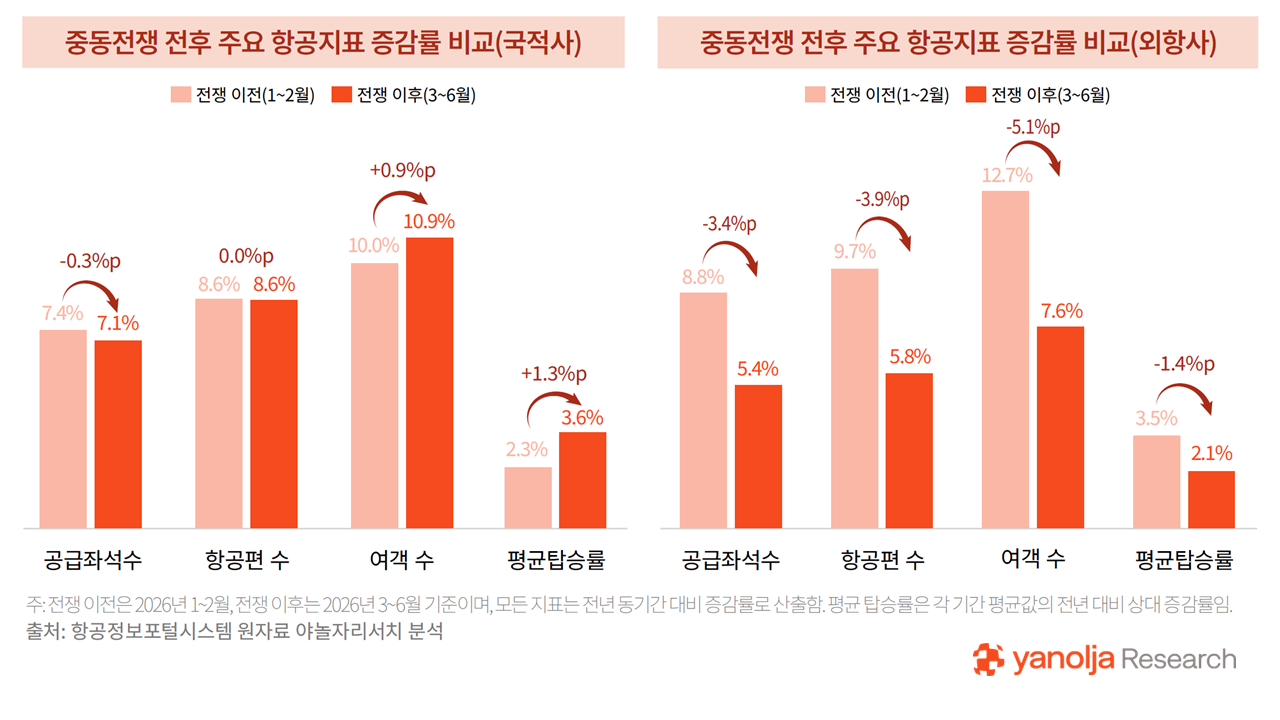
For Korean carriers, when comparing the pre-war period of January–February with the post-war period of March–June on a year-on-year basis, seat capacity growth remained broadly stable at 7.4% and 7.1%, respectively. Growth in the number of flights was unchanged at 8.6% in both periods. Passenger growth actually edged up from 10.0% to 10.9%.
Foreign carriers, by contrast, experienced a more pronounced slowdown. Growth in seat capacity fell from 8.8% to 5.4%, while growth in flights declined from 9.7% to 5.8%. Passenger growth also slowed by 5.1 percentage points, from 12.7% to 7.6%. In other words, while South Korea’s overall international aviation market continues to expand, the pace of additional capacity growth is slowing primarily among foreign carriers.
This trend also warrants attention from a tourism-industry perspective. If foreign-carrier capacity growth continues to weaken, it could constrain further improvements in access to South Korea from certain overseas markets where foreign airlines serve as a major channel for inbound travel.
Changes in Key Aviation Indicators Before and After the Middle East War, by Korean and Foreign Carriers (YoY)
Mixed Performance Across Routes: Middle East, Southeast Asia, and Oceania Weaken, While Northeast Asia, the Americas, and Europe Remain Resilient
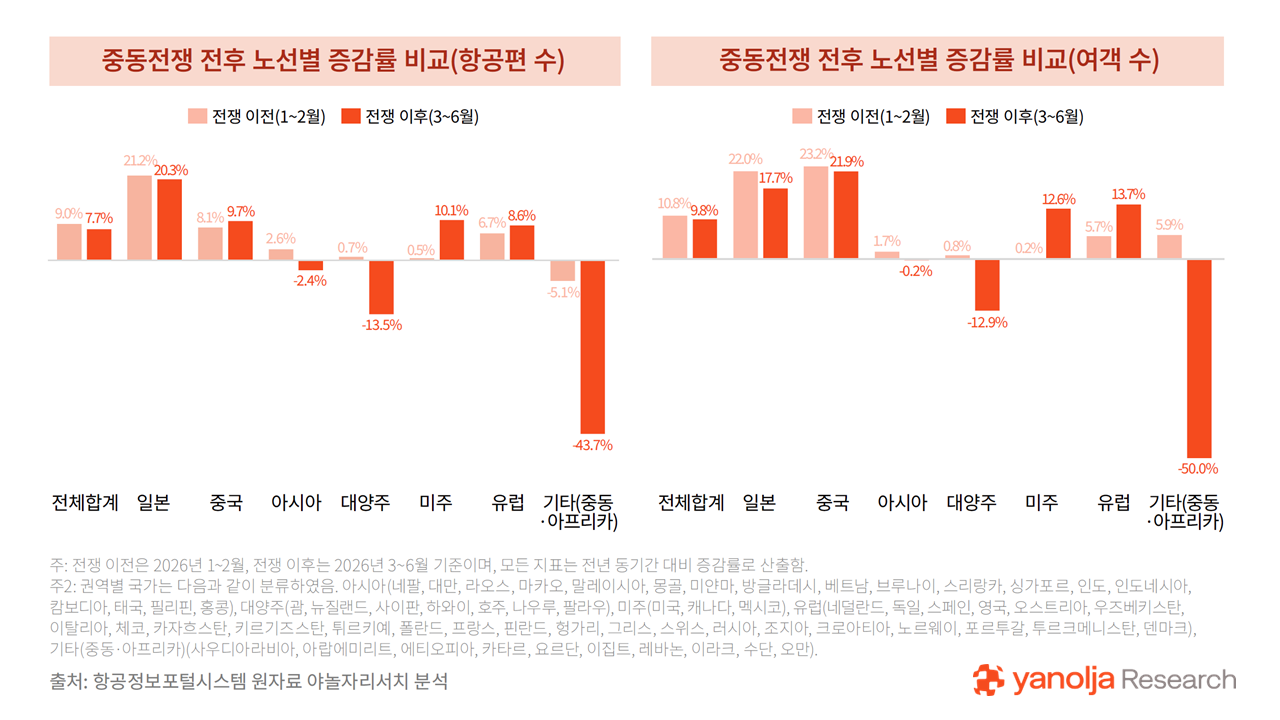
Route-level trends were similarly uneven. Passenger traffic on routes to Japan and China continued to post double-digit growth after the outbreak of the war, increasing 17.7% and 21.9% year on year, respectively. Northeast Asian routes to destinations such as Taiwan, Hong Kong, Macao, and Mongolia also maintained relatively stable growth throughout the first half of the year.
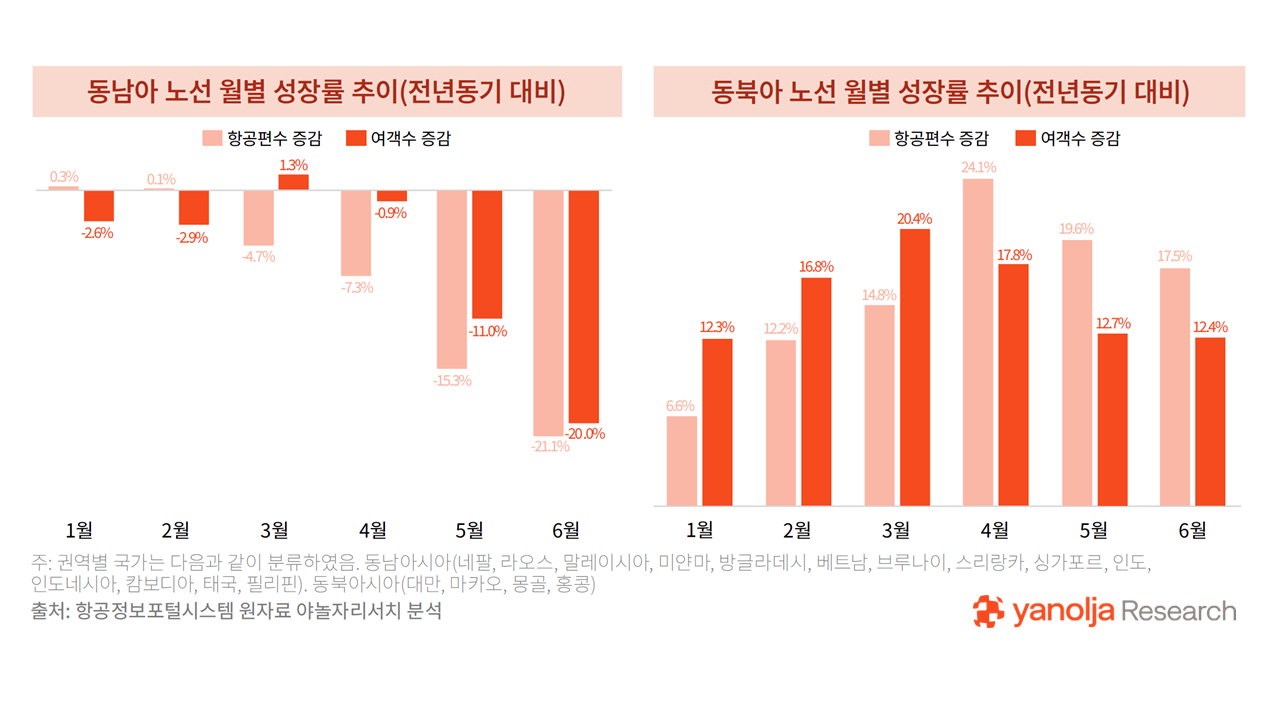
By contrast, Southeast Asian routes—including the Philippines, Thailand, Malaysia, and Vietnam—briefly rebounded in March before returning to decline from April. The downturn became particularly pronounced in May and June, when the number of flights fell 15.3% and 21.1% year on year, respectively. Oceania routes also weakened after the outbreak of the war, with flights declining 13.5% and passenger traffic falling 12.9% year on year.
The Americas and Europe, meanwhile, recorded stronger growth. Following the outbreak of the war, flights and passenger traffic on routes to the Americas increased 10.1% and 12.6%, respectively. In Europe, passenger growth accelerated from 5.7% before the war to 13.7% afterward. These patterns suggest that, rather than moving uniformly in one direction, the international aviation market has been restructuring along differentiated growth paths depending on underlying demand and route-specific conditions.
Comparison of Growth Rates in Flights and Passenger Traffic by Region (YoY)
Monthly Passenger Trends on Southeast Asian and Northeast Asian Routes (Excluding Japan and China)
Transfer Passengers Rise as Middle East Routes Contract… An Opportunity to Strengthen Incheon Airport’s Hub Competitiveness?
Another notable development identified in the analysis is the transfer market. In March, when the effects of the war became more pronounced, passenger traffic on Middle East routes plunged 75.6% year on year, while passenger traffic on European routes increased 22.3%. Across the first half of the year, transfer passengers on Middle East routes declined 41.9%, whereas transfer passengers on European routes surged 63.2%. Total transfer passenger volumes at Incheon International Airport also recorded strong year-on-year growth of around 30% from March onward.
Transfer Passenger Trends
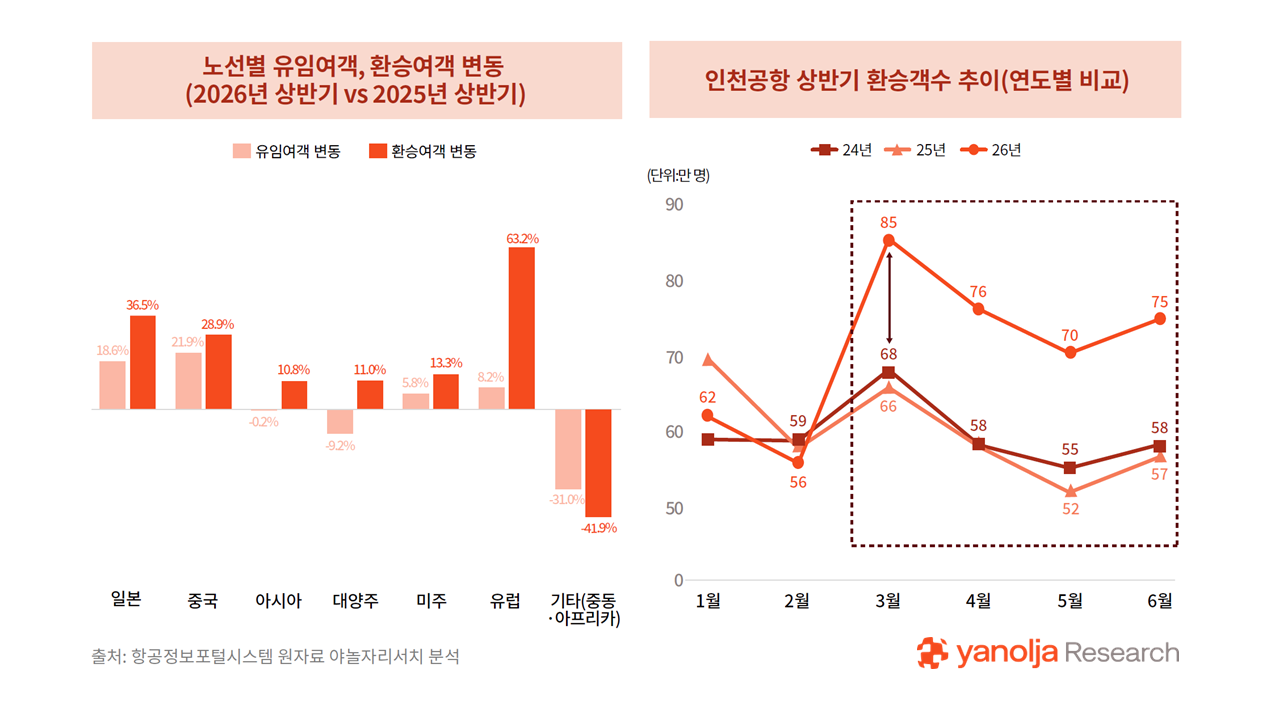
The report highlights the possibility that some transfer demand generated by weakening connectivity through Middle Eastern hubs may have shifted toward Northeast Asian hubs, including Incheon International Airport. However, the currently available data are insufficient to conclude that Incheon directly absorbed transfer passengers displaced from Middle Eastern hubs. Further verification using itinerary-level data, including passenger origins and final destinations, will be necessary.
Even so, the recent increase in transfer passengers could provide an opportunity to strengthen Incheon Airport’s competitiveness as a hub. Improvements in minimum connection times and transfer flows, combined with stopover accommodation and transportation services, K-culture experiences, and local culinary products for long-transfer passengers, could help convert rising transfer demand into stays and tourism spending within South Korea.
Deachul Seo, Senior Researcher at Yanolja Research who participated in the study, said, “The changes observed since the outbreak of the Middle East war suggest that South Korea’s international aviation market has not undergone a broad contraction. Rather, overall growth has slowed while differentiated adjustments have emerged across airlines and routes.” He added, “In particular, it will be important to continue monitoring how foreign-carrier capacity and trends in Southeast Asian and Oceania routes affect inbound tourism accessibility going forward.”
SooCheong Jang, President of Yanolja Research and professor at Purdue University, added, “The fact that transfer passenger volumes at Incheon Airport are increasing at the same time that Middle East routes are contracting is noteworthy from the perspective of hub competitiveness.” He continued, “If this additional transfer demand can be secured on a sustained basis and ultimately connected to tourism spending within South Korea, the ongoing restructuring of the international aviation network could create new opportunities for both Incheon Airport and Korea’s tourism industry.”
 Prev
Prev  Back
Back 