
Seminar on the 2026 Yanolja Attractiveness Index
- Date
- 2026-07-16 13:30 ~ 2026-07-16 17:30
- Location
- Seoul Global Center International Conference Hall
Seminar on the 2026 Yanolja Attractiveness Index
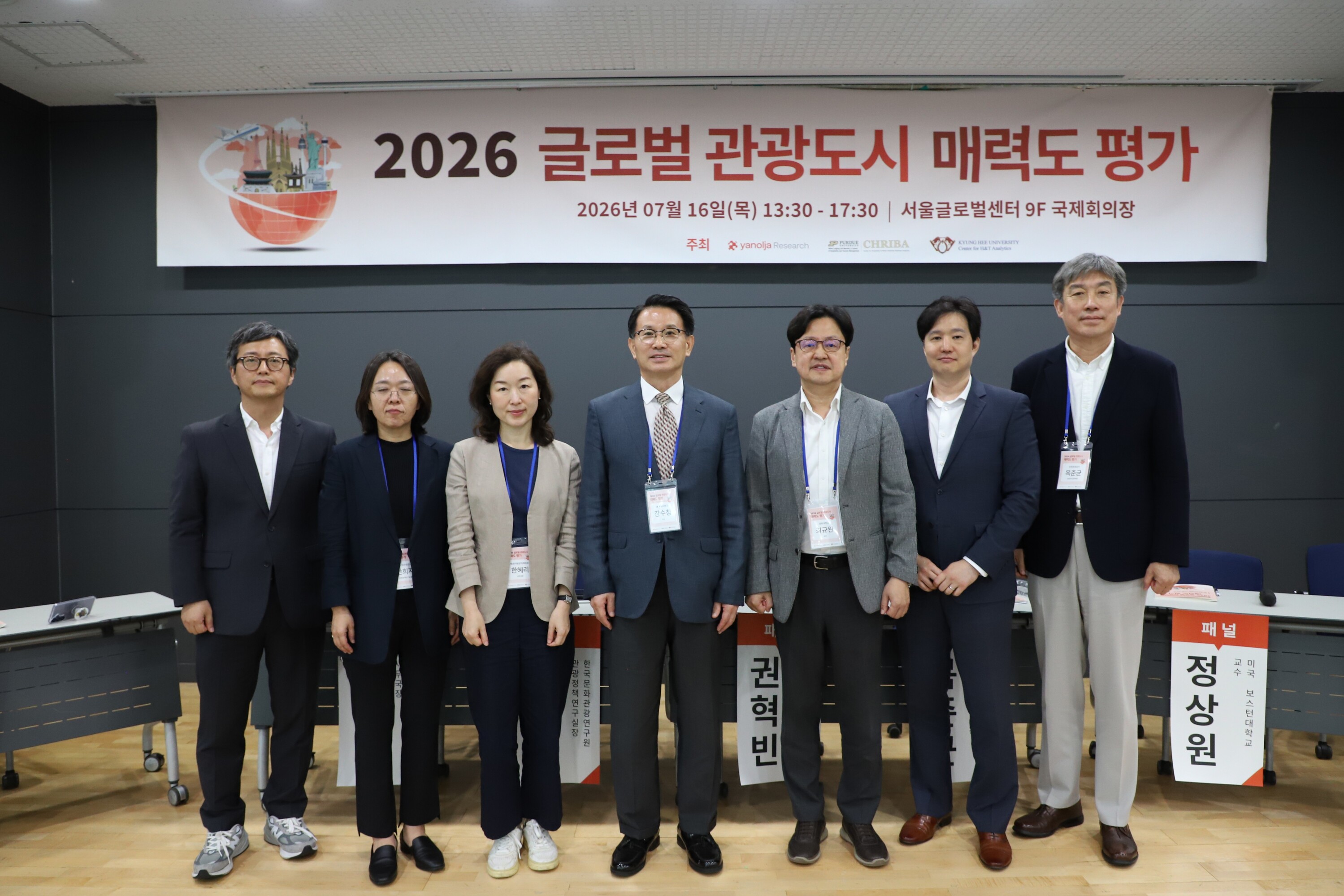
On June 16, 2026, Yanolja Research hosted the Seminar on the 2026 Yanolja Attractiveness Index. During the seminar, Yanolja Research announced the 2026 results of the Yanolja Attractiveness Index, which evaluates the attractiveness of major tourism cities worldwide from the perspective of tourists.
Presentation 1 | Development of the Global Tourism City Attractiveness Index
SooCheong Jang, Director of Yanolja Research / Professor at Purdue University
SooCheong Jang, Director of Yanolja Research and Professor at Purdue University, delivered the first presentation, providing a detailed explanation of the theoretical background, data, and analytical methodology used to develop the Yanolja Attractiveness Index.
Now in its second year, the evaluation was jointly conducted with Purdue University’s CHRIBA Institute and Kyung Hee University’s H&T Analytics Center. The number of cities assessed was significantly expanded from 191 in the previous year to 261, with the top 200 cities included in the published rankings.
First introduced in July 2025, the Yanolja Attractiveness Index was developed to measure a city’s attractiveness from the perspective of actual tourists, differentiating it from conventional tourism competitiveness assessments that primarily focus on supply-side factors such as tourism infrastructure and public policy.
The index consists of two core pillars: Awareness and Attractiveness. Awareness measures how widely known and visible a city is based on the volume of social media mentions, or buzz. Attractiveness measures how positively tourists perceive a city based on positive sentiment identified through sentiment analysis. By combining these two pillars, the index assesses the qualitative tourism competitiveness of cities, which cannot be fully captured through visitor volume or infrastructure levels alone.
Based on these two pillars, Yanolja Research conducted a comprehensive evaluation across four key dimensions of city attractiveness:
- Urban Beauty and Natural Scenery
- Culture and History
- Experiential Content
- Hospitality
The 2026 evaluation used global social media data in 14 languages provided by the UK-based consumer intelligence company Brandwatch. The analysis covered the period from June 2025 to May 2026.
Presentation 2 | Results of the 2026 Global Tourism City Attractiveness Evaluation
Kyu-Wan Choi, Professor, College of Hotel and Tourism Management, Kyung Hee University / Director, Kyung Hee University H&T Analytics Center
Kyu-Wan Choi, Professor at Kyung Hee University’s College of Hotel and Tourism Management, delivered the second presentation and announced the evaluation results based on the Global Tourism City Attractiveness Index.
In the 2026 evaluation, New York ranked first overall. Seoul retained fifth place overall for the second consecutive year and ranked fourth globally in the newly announced Attractiveness ranking, demonstrating that international visitors’ emotional satisfaction with the city is among the highest in the world.
The 1st Tier, comprising the top 50 cities, included 22 cities in Asia, 18 in the Americas, nine in Europe, and one in Oceania. By country, the United States, whose number of assessed cities increased substantially this year, had the largest representation with 16 cities.
Japan followed with eight cities—Osaka, Kyoto, Okinawa, Tokyo, Nagoya, Fukuoka, Yokohama, and Sapporo—while South Korea, Italy, and China each had three cities represented. South Korea’s cities were Seoul, Busan, and Jeju; Italy’s were Rome, Milan, and Venice; and China’s were Hong Kong, Beijing, and Shanghai.
Seoul ranked fifth overall, remaining among the world’s top five cities for the second consecutive year. It placed fourth globally in the Attractiveness ranking, following Osaka, Kyoto, and New York, demonstrating the exceptionally high level of emotional satisfaction among tourists who had experienced the city.
By dimension, Seoul ranked third in Urban Beauty and Natural Scenery, Experiential Content, and Hospitality, and seventh in Culture and History. Its placement within the top 10 across all four dimensions demonstrated its well-balanced competitiveness as a global tourism city.
Busan, ranked 42nd overall, and Jeju, ranked 44th, both entered the 1st Tier, or global top 50. Incheon, which was included in the evaluation for the first time this year, ranked 51st, placing it at the top of the 2nd Tier, while Daegu ranked 88th. As a result, all five South Korean cities included in the evaluation ranked within the global top 100.
Panel Discussion
During the panel discussion that followed, SooCheong Jang, Director of Yanolja Research, served as moderator and led an exchange of industry perspectives on the methodology and findings of the Yanolja Attractiveness Index.
The panelists included:
- Hyeri Han, Secretary-General, Visit Korea Committee
- An Hee-ja Son, Director of the Tourism Policy Research Division, Korea Culture and Tourism Institute
- Hyukbin Kwon, Head of the Tourism Industry Division, Seoul Tourism Organization
- Jun-kyun Mok, Executive Director and Division Head, Incheon Tourism Organization
- Sangwon Jung, Professor, School of Hospitality Administration, Boston University
The discussion examined the academic and policy significance of a demand-side attractiveness index and assessed its methodology and findings. Panelists also discussed Seoul’s future strategy following its achievement of a global top-five ranking, as well as strategies for strengthening Incheon’s attractiveness through a hub-and-spoke approach.
Further in-depth discussion addressed the importance of experiential tourism content and urban hospitality, along with strategies for promoting cities internationally based on these strengths.
Yanolja Research plans to publish the Yanolja Attractiveness Index annually to continuously track changes in global tourism trends and urban tourism competitiveness. Detailed results and analytical materials from the Global Tourism City Attractiveness Index are available on the official Yanolja Research website at https://www.yanolja-research.com.
 Prev
Prev  Back
Back 